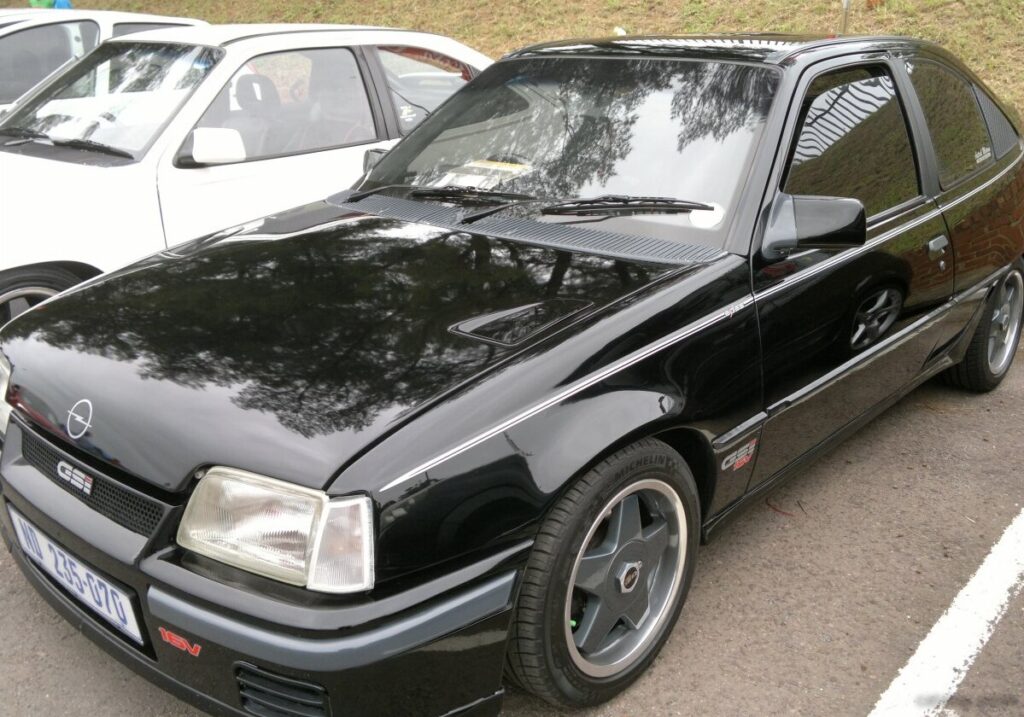
The Opel Kadett E CC 1.6 S, produced between 1984 and 1986, represented a significant step forward for Opel’s compact offering. Positioned as a sporty variant within the Kadett E range (CC denoting ‘Coupé Classic’ – essentially the 3-door hatchback), the 1.6 S with 90 horsepower aimed to appeal to drivers seeking a blend of practicality and performance. It was a key model in Opel’s lineup during a period of increasing competition in the European small family car segment, and served as a bridge between the more basic Kadett models and the later, more powerful GSi versions. The Kadett E, built on the GM T-platform (internally known as 1HX0/A3), was a thoroughly modern design for its time, offering improved aerodynamics, interior space, and driving dynamics compared to its predecessor.
Technical Specifications
| Brand | Opel |
| Model | Kadett |
| Generation | Kadett E CC |
| Type (Engine) | 1.6 S (90 Hp) |
| Start of production | 1984 |
| End of production | 1986 |
| Powertrain Architecture | Internal Combustion engine |
| Body type | Hatchback |
| Seats | 5 |
| Doors | 3-5 |
| Fuel Type | Petrol (Gasoline) |
| Acceleration 0 – 100 km/h | 11 sec |
| Acceleration 0 – 62 mph | 11 sec |
| Acceleration 0 – 60 mph | 10.5 sec |
| Maximum speed | 183 km/h (113.71 mph) |
| Weight-to-power ratio | 10.6 kg/Hp, 94.7 Hp/tonne |
| Weight-to-torque ratio | 7.5 kg/Nm, 132.6 Nm/tonne |
| Power | 90 Hp @ 5800 rpm |
| Power per litre | 56.3 Hp/l |
| Torque | 126 Nm @ 3800-4200 rpm (92.93 lb.-ft. @ 3800-4200 rpm) |
| Engine layout | Front, Transverse |
| Engine Model/Code | 16SH |
| Engine displacement | 1598 cm3 (97.52 cu. in.) |
| Number of cylinders | 4 |
| Engine configuration | Inline |
| Cylinder Bore | 80 mm (3.15 in.) |
| Piston Stroke | 79.5 mm (3.13 in.) |
| Compression ratio | 9.2:1 |
| Number of valves per cylinder | 2 |
| Fuel injection system | Carburettor |
| Engine aspiration | Naturally aspirated engine |
| Valvetrain | SOHC |
| Engine oil capacity | 3.25 l (3.43 US qt | 2.86 UK qt) |
| Coolant | 7.7 l (8.14 US qt | 6.78 UK qt) |
| Kerb Weight | 950 kg (2094.39 lbs.) |
| Max. weight | 1425 kg (3141.59 lbs.) |
| Max load | 475 kg (1047.2 lbs.) |
| Trunk (boot) space – minimum | 485 l (17.13 cu. ft.) |
| Trunk (boot) space – maximum | 1385 l (48.91 cu. ft.) |
| Fuel tank capacity | 52 l (13.74 US gal | 11.44 UK gal) |
| Length | 3998 mm (157.4 in.) |
| Width | 1663 mm (65.47 in.) |
| Height | 1400 mm (55.12 in.) |
| Wheelbase | 2520 mm (99.21 in.) |
| Front track | 1406 mm (55.35 in.) |
| Rear (Back) track | 1406 mm (55.35 in.) |
| Minimum turning circle | 10.5 m (34.45 ft.) |
Powertrain & Engine Architecture
The heart of the Kadett E 1.6 S was the 16SH engine, a 1.6-liter inline-four cylinder unit. This engine utilized a single overhead camshaft (SOHC) valvetrain and was equipped with a carburetor – a relatively common setup for European cars of this era, though fuel injection was becoming increasingly prevalent. The carburetor provided adequate fuel delivery for the engine’s output, but lacked the precision and efficiency of more modern fuel injection systems. The 16SH produced 90 horsepower at 5800 rpm and 126 Nm (93 lb-ft) of torque between 3800 and 4200 rpm. The engine’s relatively simple design contributed to its robustness and ease of maintenance. The Kadett E 1.6 S was typically paired with a four or five-speed manual transmission, but a three-speed automatic transmission was also available, though less common. The automatic gearbox, while offering convenience, did noticeably impact acceleration and fuel economy.
Driving Characteristics
The 1.6 S, particularly when equipped with the manual transmission, offered a reasonably engaging driving experience for its class. Acceleration from 0 to 60 mph took around 10.5 seconds, which was competitive for the time, but noticeably slower than the more powerful Kadett GSi models. The automatic transmission version added a couple of seconds to this time. The engine felt lively enough for everyday driving, with adequate torque for overtaking maneuvers, but it lacked the outright punch of larger-displacement engines. The Kadett E’s suspension provided a good balance between comfort and handling, making it a pleasant car to drive on both city streets and winding country roads. The steering was light and precise, contributing to a feeling of confidence behind the wheel.
Equipment & Trim Levels
The Kadett E 1.6 S occupied a mid-range position in the Kadett E lineup. Standard equipment typically included cloth upholstery, a basic stereo system, and manual windows and door locks. The interior was functional and well-built, though not particularly luxurious. Optional extras included a sunroof, upgraded stereo systems, and central locking. The ‘S’ designation indicated a slightly more sporty trim level, often featuring a sport steering wheel and revised interior trim compared to the base models. The 3-door hatchback configuration was more common for the ‘S’ trim, emphasizing its sporty appeal.
Chassis & Braking
The Kadett E featured a MacPherson strut front suspension and a twist-beam rear suspension. This setup provided a good compromise between ride comfort and handling. The 1.6 S typically came equipped with disc brakes on the front wheels and drum brakes on the rear. While adequate for most driving conditions, the rear drum brakes were a cost-saving measure and didn’t offer the same stopping power as disc brakes. Stabilizer bars were fitted to both the front and rear axles, helping to reduce body roll during cornering.
Market Reception & Comparison
The Kadett E 1.6 S was generally well-received by automotive critics. It was praised for its practicality, fuel efficiency, and relatively affordable price. However, some critics noted that the engine lacked refinement and that the automatic transmission version felt sluggish. Compared to other Kadett E variants, the 1.6 S offered a good balance between performance and economy. The more powerful GSi models provided significantly more performance, but at a higher price point. The diesel-powered Kadett models offered superior fuel economy, but lacked the 1.6 S’s sporty character. The 1.6 S competed with other popular European hatchbacks such as the Volkswagen Golf, Ford Escort, and Peugeot 205.
Legacy
The Opel Kadett E 1.6 S, while not a particularly rare or collectible car today, remains a popular choice among classic car enthusiasts. The 16SH engine is known for its reliability and relatively simple maintenance requirements. Parts availability is generally good, making it a relatively easy car to keep on the road. The Kadett E’s robust construction and straightforward design have contributed to its longevity. In the used car market, well-maintained examples of the 1.6 S can still command reasonable prices, particularly those with low mileage and a complete service history. It represents a solid and dependable example of 1980s European automotive engineering.