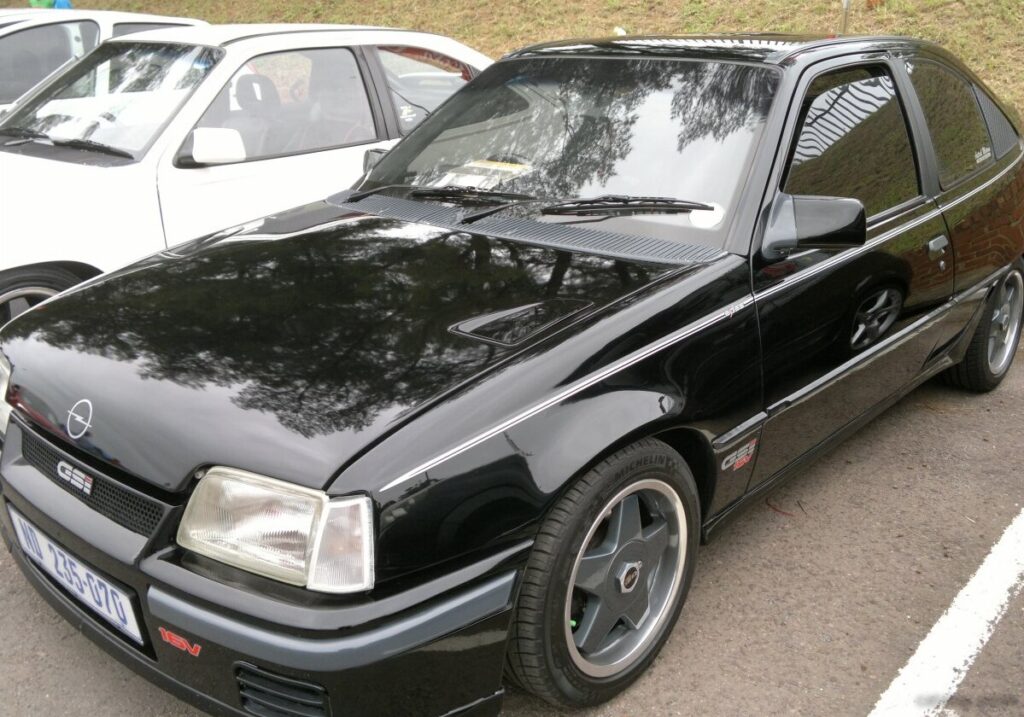
The Opel Kadett E CC 1.8 GSI was a performance-oriented variant of the Kadett E, produced between 1984 and 1986. Positioned as the top-of-the-line model within the Kadett E range, the GSI (Gran Sport Injection) offered a significant power upgrade over the standard Kadett models. It played a key role in Opel’s strategy to offer a sporty, affordable compact car, primarily targeted at the European market. The Kadett E itself was a significant model for Opel, representing a substantial leap forward in design, technology, and build quality compared to its predecessor, the Kadett D. It was built on the GM T-platform, shared with other European and global offerings like the Vauxhall Astra, Isuzu Gemini, and Holden Nova.
Technical Specifications
| Brand | Opel |
| Model | Kadett |
| Generation | Kadett E CC |
| Type (Engine) | 1.8 GSI (115 Hp) |
| Start of production | 1984 |
| End of production | 1986 |
| Powertrain Architecture | Internal Combustion engine |
| Body type | Hatchback |
| Seats | 5 |
| Doors | 3-5 |
| Fuel Type | Petrol (Gasoline) |
| Acceleration 0 – 100 km/h | 9 sec |
| Acceleration 0 – 62 mph | 9 sec |
| Acceleration 0 – 60 mph | 8.6 sec |
| Maximum speed | 203 km/h (126.14 mph) |
| Weight-to-power ratio | 8.3 kg/Hp, 121.1 Hp/tonne |
| Weight-to-torque ratio | 6.3 kg/Nm, 158.9 Nm/tonne |
| Power | 115 Hp @ 5800 rpm |
| Power per litre | 64 Hp/l |
| Torque | 151 Nm @ 4800 rpm (111.37 lb.-ft. @ 4800 rpm) |
| Engine layout | Front, Transverse |
| Engine Model/Code | 18E |
| Engine displacement | 1796 cm3 (109.6 cu. in.) |
| Number of cylinders | 4 |
| Engine configuration | Inline |
| Cylinder Bore | 84.8 mm (3.34 in.) |
| Piston Stroke | 79.5 mm (3.13 in.) |
| Compression ratio | 9.5:1 |
| Number of valves per cylinder | 2 |
| Fuel injection system | Multi-port manifold injection |
| Engine aspiration | Naturally aspirated engine |
| Valvetrain | SOHC |
| Engine oil capacity | 3.25 l (3.43 US qt | 2.86 UK qt) |
| Coolant | 7.5 l (7.93 US qt | 6.6 UK qt) |
| Kerb Weight | 950 kg (2094.39 lbs) |
| Max. weight | 1435 kg (3163.63 lbs) |
| Max load | 485 kg (1069.24 lbs) |
| Trunk (boot) space – minimum | 485 l (17.13 cu. ft.) |
| Trunk (boot) space – maximum | 1385 l (48.91 cu. ft.) |
| Fuel tank capacity | 42 l (11.1 US gal | 9.24 UK gal) |
| Length | 3998 mm (157.4 in.) |
| Width | 1666 mm (65.59 in.) |
| Height | 1395 mm (54.92 in.) |
| Wheelbase | 2520 mm (99.21 in.) |
| Front track | 1406 mm (55.35 in.) |
| Rear (Back) track | 1406 mm (55.35 in.) |
| Minimum turning circle | 10.5 m (34.45 ft.) |
| Drivetrain Architecture | Front wheel drive |
| Number of gears and type of gearbox | 5 gears, manual transmission |
| Front brakes | Ventilated discs |
| Rear brakes | Drum |
Powertrain & Engine Architecture
The heart of the Kadett E 1.8 GSI was the 18E engine, an inline four-cylinder unit displacing 1796cc. This engine featured a single overhead camshaft (SOHC) valvetrain operating two valves per cylinder. Crucially, the 18E in the GSI was equipped with Bosch Motronic fuel injection, a multi-port system that significantly improved throttle response and fuel efficiency compared to earlier carbureted Opel engines. The 18E engine was known for its relative simplicity and durability. The engine’s 9.5:1 compression ratio contributed to its respectable power output. The five-speed manual transmission was the only gearbox option available with the 1.8 GSI, designed to handle the increased torque and allow for spirited driving. The transmission featured a relatively short throw, enhancing the driving experience.
Driving Characteristics
The 1.8 GSI offered a noticeable performance improvement over the base Kadett models. Acceleration to 60 mph was achieved in around 8.6 seconds, and it could reach a top speed of 126 mph. While not a sports car by modern standards, the GSI provided a lively and engaging driving experience for its time. The five-speed gearbox allowed drivers to keep the engine in its optimal power band. The GSI’s suspension was tuned for a balance between comfort and handling, offering a more controlled ride than the standard Kadett. However, it wasn’t as firm or track-focused as some of its more dedicated rivals. The front-wheel-drive layout, while common for the class, could exhibit some torque steer under hard acceleration.
Equipment & Trim Levels
The Kadett E 1.8 GSI came with a more comprehensive equipment list than the lower-spec models. Standard features typically included a sports steering wheel, upgraded interior trim, a rev counter, and tinted glass. Exterior features included a distinctive front spoiler, rear spoiler, and side skirts, giving the GSI a more aggressive appearance. Optional extras included a sunroof, central locking, and upgraded audio systems. Interior upholstery was typically cloth, with a sporty pattern. The dashboard layout was functional and driver-focused, with clear instrumentation.
Chassis & Braking
The Kadett E utilized a MacPherson strut front suspension and a torsion beam rear suspension. The GSI variant often featured a thicker front stabilizer bar compared to the base models, reducing body roll during cornering. Braking was handled by ventilated disc brakes at the front and drum brakes at the rear. While adequate for everyday driving, the rear drum brakes were a point of criticism, as they didn’t offer the same stopping power as disc brakes. The steering was a rack-and-pinion system, providing precise and responsive control.
Market Reception & Comparison
The Kadett E 1.8 GSI was generally well-received by automotive critics. It was praised for its performance, handling, and value for money. Compared to other hot hatches of the era, such as the Volkswagen Golf GTI, the Kadett GSI offered a similar level of performance at a slightly lower price point. However, the Golf GTI was often considered to have a more refined interior and a more prestigious brand image. The Kadett GSI’s fuel economy was respectable for a performance car of the 1980s, averaging around 30-35 mpg. Reliability was generally good, although the 18E engine could be prone to oil leaks as it aged.
Legacy
The Opel Kadett E 1.8 GSI has become a popular classic car among enthusiasts. The 18E engine is known for its durability and relative ease of maintenance. Parts availability is generally good, although some specific trim pieces can be difficult to find. Today, well-maintained examples of the Kadett E 1.8 GSI are sought after by collectors and those looking for a nostalgic driving experience. The Kadett E, and particularly the GSI variant, represents a significant chapter in Opel’s history, showcasing the brand’s ability to produce affordable and enjoyable compact cars. The 18E engine, while not a technological marvel, proved to be a robust and reliable powerplant, contributing to the Kadett E’s enduring appeal.