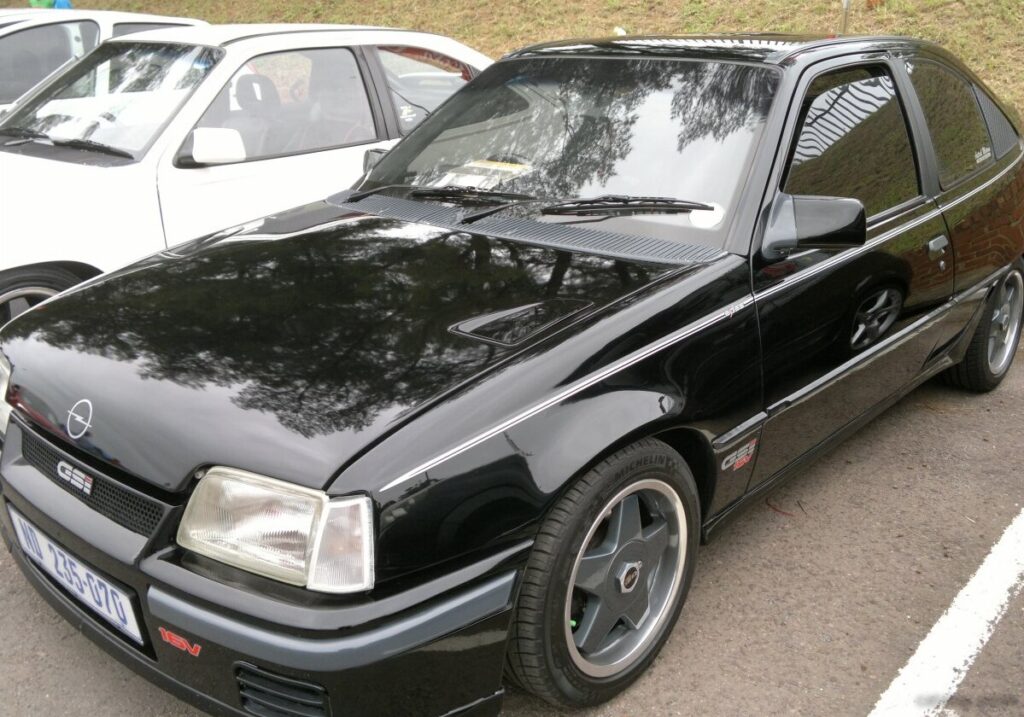
The Opel Kadett E CC 2.0 GSI, produced between 1986 and 1991, represented the performance pinnacle of the Kadett E range. Positioned as the sporty variant, the GSI (Gran Sport Injection) offered a significant upgrade over the base models, appealing to drivers seeking a more engaging driving experience. It was a key model in Opel’s lineup during a period of increasing competition in the European compact car segment, and served as a predecessor to the Astra, which would replace the Kadett in 1991. The Kadett E was built on the GM T platform, shared with other models like the Vauxhall/Chevrolet Nova and Isuzu Gemini.
Technical Specifications
| Brand | Opel |
| Model | Kadett |
| Generation | Kadett E CC |
| Type (Engine) | 2.0 GSI (115 Hp) |
| Start of production | 1986 |
| End of production | 1991 |
| Powertrain Architecture | Internal Combustion engine |
| Body type | Hatchback |
| Seats | 5 |
| Doors | 3-5 |
| Fuel consumption (urban) | 10.1 l/100 km (23.3 US mpg, 28 UK mpg, 9.9 km/l) |
| Fuel consumption (extra urban) | 5.7 l/100 km (41.3 US mpg, 49.6 UK mpg, 17.5 km/l) |
| Fuel consumption (combined) | 7.2 l/100 km (32.7 US mpg, 39.2 UK mpg, 13.9 km/l) |
| Fuel Type | Petrol (Gasoline) |
| Acceleration 0 – 100 km/h | 9 sec |
| Acceleration 0 – 62 mph | 9 sec |
| Acceleration 0 – 60 mph | 8.6 sec |
| Maximum speed | 194 km/h (120.55 mph) |
| Weight-to-power ratio | 8.6 kg/Hp, 116.2 Hp/tonne |
| Weight-to-torque ratio | 5.8 kg/Nm, 171.7 Nm/tonne |
| Power | 115 Hp @ 5200 rpm |
| Power per litre | 57.6 Hp/l |
| Torque | 170 Nm @ 2600 rpm (125.39 lb.-ft. @ 2600 rpm) |
| Engine layout | Front, Transverse |
| Engine Model/Code | 20NE |
| Engine displacement | 1998 cm3 (121.93 cu. in.) |
| Number of cylinders | 4 |
| Engine configuration | Inline |
| Cylinder Bore | 86 mm (3.39 in.) |
| Piston Stroke | 86 mm (3.39 in.) |
| Compression ratio | 9.2:1 |
| Number of valves per cylinder | 2 |
| Engine aspiration | Naturally aspirated |
| Valvetrain | OHC |
| Engine oil capacity | 4 l (4.23 US qt | 3.52 UK qt) |
| Coolant capacity | 6.9 l (7.29 US qt | 6.07 UK qt) |
| Kerb Weight | 990 kg (2182.58 lbs.) |
| Max. weight | 1480 kg (3262.84 lbs.) |
| Max load | 490 kg (1080.27 lbs.) |
| Fuel tank capacity | 52 l (13.74 US gal | 11.44 UK gal) |
| Length | 3998 mm (157.4 in.) |
| Width | 1663 mm (65.47 in.) |
| Height | 1400 mm (55.12 in.) |
| Wheelbase | 2520 mm (99.21 in.) |
| Front track | 1406 mm (55.35 in.) |
| Rear track | 1426 mm (56.14 in.) |
| Drivetrain Architecture | Front wheel drive |
| Drive wheel | Front wheel drive |
| Number of gears | 5 gears, manual transmission |
| Front suspension | Independent type McPherson |
| Front brakes | Ventilated discs |
| Rear brakes | Drum |
| Assisting systems | ABS (Anti-lock braking system) |
| Steering type | Steering rack and pinion |
| Tires size | 185/60 R14 |
| Wheel rims size | 14 |
Powertrain & Engine Architecture
The heart of the Kadett E 2.0 GSI was the 20NE engine, a 1998cc inline-four cylinder unit. This engine featured a single overhead camshaft (OHC) design and Bosch Motronic fuel injection, a significant advancement over the carbureted engines found in earlier Kadett models. The 20NE produced 115 horsepower at 5200 rpm and 170 Nm (125 lb-ft) of torque at 2600 rpm. The engine’s relatively high compression ratio of 9.2:1 contributed to its spirited performance. The engine was transversely mounted, driving the front wheels through a robust five-speed manual transmission. This transmission was known for its precise shift action and durability. The 20NE was a relatively simple and reliable engine, benefiting from Opel’s experience in four-cylinder engine design.
Driving Characteristics
The 2.0 GSI offered a noticeable step up in performance compared to the lower-spec Kadett E models. Acceleration from 0 to 60 mph took approximately 8.6 seconds, and it could reach a top speed of around 120 mph. While not a sports car by modern standards, the GSI provided a lively and engaging driving experience for its time. The five-speed manual transmission allowed drivers to keep the engine in its optimal power band, and the front disc brakes provided adequate stopping power. The McPherson strut front suspension and torsion beam rear suspension offered a good balance between ride comfort and handling. Compared to the 1.6-liter Kadett, the 2.0 GSI felt significantly more powerful, especially during overtaking maneuvers. It also offered a more refined driving experience, with less engine noise and vibration.
Equipment & Trim Levels
The Kadett E 2.0 GSI came reasonably well-equipped for its era. Standard features typically included power steering, central locking, electric windows, and a basic stereo system. The interior featured sport seats with patterned upholstery, and a leather-wrapped steering wheel. Optional extras included a sunroof, alloy wheels, and upgraded audio systems. The GSI also featured a distinctive body kit, including a front spoiler, side skirts, and a rear spoiler, which helped to differentiate it from the more pedestrian Kadett models. The dashboard layout was functional and straightforward, with clear instrumentation.
Chassis & Braking
The Kadett E GSI utilized a MacPherson strut suspension setup at the front, providing good handling characteristics. The rear suspension employed a torsion beam, a cost-effective solution that offered a reasonable compromise between comfort and stability. The braking system consisted of ventilated disc brakes at the front and drum brakes at the rear. Anti-lock braking system (ABS) was available as an option, enhancing safety by preventing wheel lockup during hard braking. The chassis was relatively lightweight, contributing to the car’s nimble handling. Stabilizer bars were fitted to both the front and rear axles to reduce body roll during cornering.
Market Reception & Comparison
The Kadett E 2.0 GSI was generally well-received by automotive critics. It was praised for its performance, handling, and value for money. Compared to rivals like the Volkswagen Golf GTI and Ford Escort XR3i, the Kadett GSI offered a similar level of performance at a slightly lower price point. However, some critics noted that the interior quality was not quite as refined as that of its competitors. Fuel economy was respectable for a performance car of the era, averaging around 33 mpg on the combined cycle. Reliability was generally good, although some owners reported issues with the fuel injection system and electrical components.
Legacy
The Opel Kadett E 2.0 GSI remains a popular choice among classic car enthusiasts. Its combination of performance, affordability, and relative simplicity makes it an attractive option for those seeking a classic hatchback. The 20NE engine is known for its durability, and parts availability is generally good. However, like any older car, the Kadett GSI requires regular maintenance to keep it in good condition. Today, well-maintained examples command a growing following in the classic car market, appreciated for their nostalgic appeal and engaging driving experience. The Kadett E, and particularly the GSI variant, represents a significant chapter in Opel’s history, bridging the gap between the more utilitarian Kadett D and the more modern Astra.