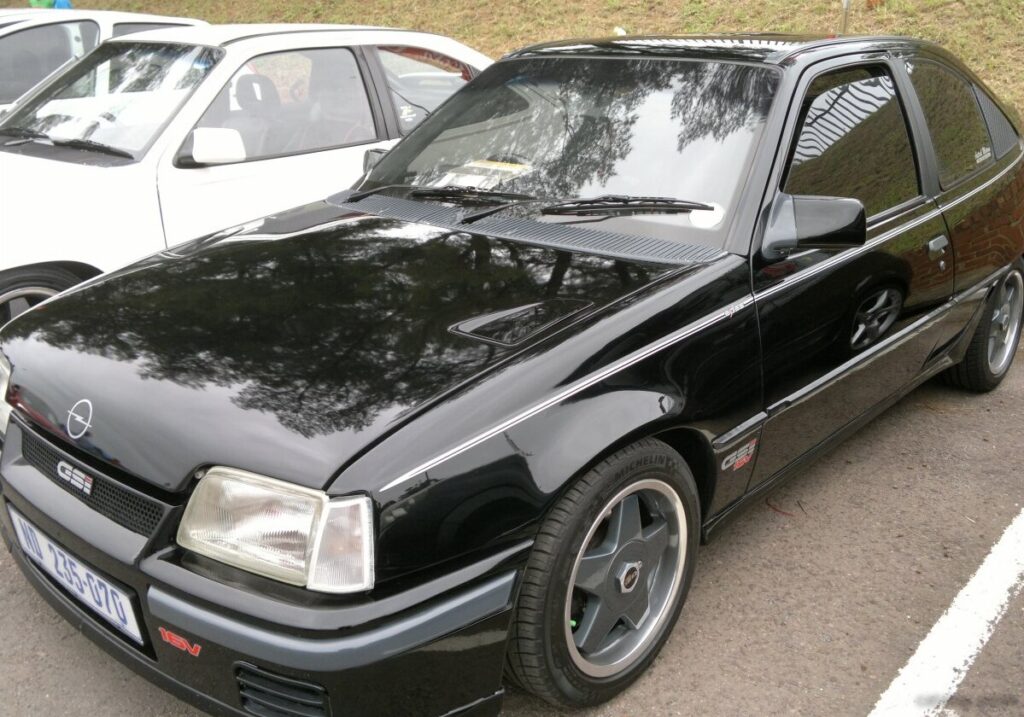
The Opel Kadett E CC 2.0 GSI CAT, produced between 1986 and 1991, represented the performance-oriented pinnacle of the Kadett E range. Positioned as the sporting variant, the GSI (Grossraum Sport Injection) offered a significant step up in power and handling compared to the more economical Kadett models. It was a key player in the European C-segment hatchback market, competing with vehicles like the Volkswagen Golf GTI and Ford Escort XR3. The “CC” designation denotes the ‘Coupe’ body style, referring to the three-door hatchback configuration. This model was never officially sold in the United States, but it remains a popular classic car among enthusiasts.
Technical Specifications
| Brand | Opel |
| Model | Kadett |
| Generation | Kadett E CC |
| Type (Engine) | 2.0 GSI CAT (115 Hp) |
| Start of production | 1986 |
| End of production | 1991 |
| Powertrain Architecture | Internal Combustion engine |
| Body type | Hatchback |
| Seats | 5 |
| Doors | 3-5 |
| Fuel Type | Petrol (Gasoline) |
| Acceleration 0 – 100 km/h | 9 sec |
| Acceleration 0 – 62 mph | 9 sec |
| Acceleration 0 – 60 mph | 8.6 sec |
| Maximum speed | 200 km/h (124.27 mph) |
| Weight-to-power ratio | 8.3 kg/Hp, 119.8 Hp/tonne |
| Weight-to-torque ratio | 5.6 kg/Nm, 177.1 Nm/tonne |
| Power | 115 Hp @ 5400 rpm |
| Power per litre | 57.6 Hp/l |
| Torque | 170 Nm @ 3000 rpm (125.39 lb.-ft. @ 3000 rpm) |
| Engine layout | Front, Transverse |
| Engine Model/Code | C20NE |
| Engine displacement | 1998 cm3 (121.93 cu. in.) |
| Number of cylinders | 4 |
| Engine configuration | Inline |
| Cylinder Bore | 86 mm (3.39 in.) |
| Piston Stroke | 86 mm (3.39 in.) |
| Compression ratio | 9.2:1 |
| Number of valves per cylinder | 2 |
| Fuel injection system | Multi-port manifold injection |
| Engine aspiration | Naturally aspirated engine |
| Valvetrain | SOHC |
| Engine oil capacity | 4 l (4.23 US qt | 3.52 UK qt) |
| Coolant | 6.9 l (7.29 US qt | 6.07 UK qt) |
| Kerb Weight | 960 kg (2116.44 lbs.) |
| Max. weight | 1445 kg (3185.68 lbs.) |
| Max load | 485 kg (1069.24 lbs.) |
| Trunk (boot) space – minimum | 485 l (17.13 cu. ft.) |
| Trunk (boot) space – maximum | 1385 l (48.91 cu. ft.) |
| Fuel tank capacity | 52 l (13.74 US gal | 11.44 UK gal) |
| Length | 3998 mm (157.4 in.) |
| Width | 1666 mm (65.59 in.) |
| Height | 1395 mm (54.92 in.) |
| Wheelbase | 2520 mm (99.21 in.) |
| Front track | 1406 mm (55.35 in.) |
| Rear (Back) track | 1406 mm (55.35 in.) |
| Minimum turning circle | 10.5 m (34.45 ft.) |
| Drivetrain Architecture | The Internal combustion engine (ICE) drives the front wheels of the vehicle. |
| Drive wheel | Front wheel drive |
| Number of gears and type of gearbox | 5 gears, manual transmission |
| Front brakes | Ventilated discs |
| Rear brakes | Drum |
Powertrain & Engine Architecture
The heart of the Kadett E 2.0 GSI CAT was the C20NE engine, a 1998cc inline-four cylinder unit. This engine featured a single overhead camshaft (SOHC) valvetrain operating two valves per cylinder. The ‘NE’ designation indicated a catalytic converter was fitted, complying with increasingly stringent emissions regulations in Europe. Bosch Motronic fuel injection managed the fuel delivery, providing precise control for improved efficiency and performance. The engine’s 9.2:1 compression ratio was a compromise between performance and the fuel quality available at the time. The five-speed manual transmission was the standard offering, providing a direct connection between the engine and the front wheels. The gearbox ratios were tuned for a balance of acceleration and highway cruising, though some reviewers noted a slightly long first gear.
Driving Characteristics
The 2.0 GSI CAT offered a noticeable performance improvement over the lower-spec Kadett E models. The 115 horsepower output, while not overwhelming by modern standards, provided brisk acceleration, achieving 0-60 mph in around 8.6 seconds. The engine delivered a relatively flat torque curve, making it responsive in everyday driving situations. The manual transmission allowed for precise control, and the GSI’s suspension upgrades – including stiffer springs and dampers – resulted in improved handling and reduced body roll. Compared to the 1.6-liter Kadett, the 2.0 GSI felt significantly more powerful and capable. While not as refined as some of its rivals, the GSI offered a satisfyingly sporty driving experience.
Equipment & Trim Levels
The GSI trim level was well-equipped for its time. Standard features included a sports steering wheel, upgraded instrumentation, and a more supportive seating configuration. Interior trim typically featured a combination of cloth and vinyl upholstery. Optional extras included power windows, central locking, and a sunroof. The exterior was distinguished by a rear spoiler, body-colored bumpers, and unique alloy wheel designs. The GSI was positioned as a premium offering within the Kadett E range, appealing to drivers who prioritized performance and style.
Chassis & Braking
The Kadett E GSI utilized a MacPherson strut front suspension and a torsion beam rear suspension. The GSI variant benefited from stiffer springs and dampers compared to standard Kadett models, improving handling and stability. Braking was handled by ventilated disc brakes at the front and drum brakes at the rear. While adequate for most driving conditions, the rear drum brakes were a point of criticism, as they lacked the stopping power of disc brakes. The steering was a rack-and-pinion system, providing precise and responsive control.
Market Reception & Comparison
The Kadett E 2.0 GSI CAT was generally well-received by automotive journalists. It was praised for its performance, handling, and value for money. However, some critics noted the interior quality was not as refined as some of its rivals, such as the Volkswagen Golf GTI. Compared to the Golf GTI, the Kadett GSI offered a similar level of performance at a lower price point, making it an attractive option for budget-conscious buyers. The 1.8-liter Kadett models, while more economical, lacked the outright performance of the 2.0 GSI. The diesel-powered Kadett variants offered superior fuel economy but were significantly slower.
Legacy
The Opel Kadett E 2.0 GSI CAT has become a sought-after classic car among enthusiasts. The C20NE engine is known for its durability and relative simplicity, making it a reliable powerplant. However, like any classic car, regular maintenance is essential to prevent issues. Rust can be a concern, particularly in areas exposed to harsh weather conditions. Today, well-maintained examples of the Kadett E GSI CAT command a premium in the used car market, representing a piece of 1980s European automotive history. Its blend of performance, affordability, and practicality has cemented its place as a popular choice for classic car collectors and enthusiasts alike.