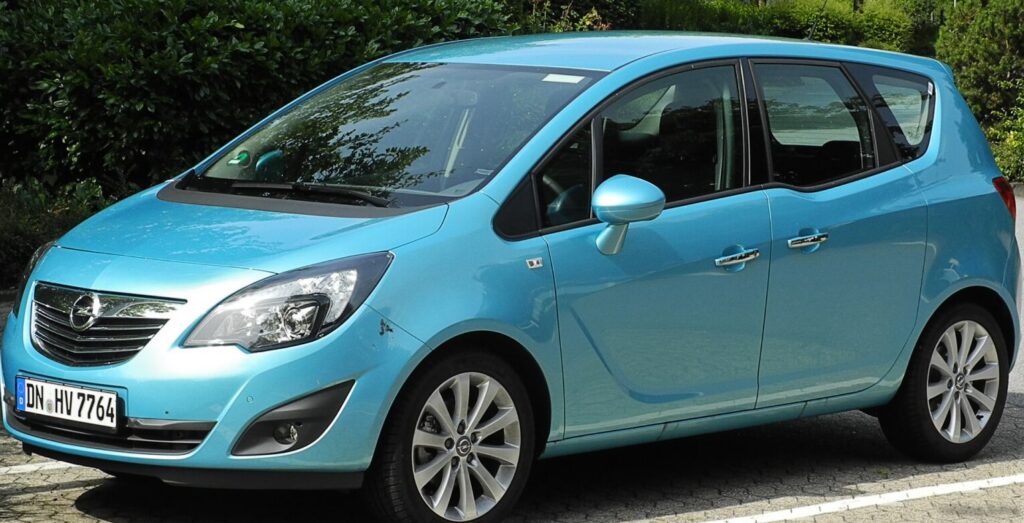
The Opel Meriva B 1.3 CDTI (95 hp) Start/Stop, produced from 2011 to 2014, represented an entry-level diesel option within the second generation of the Meriva minivan. Positioned as a fuel-efficient and practical choice for families, this variant utilized a small-displacement turbodiesel engine paired with a five-speed manual transmission. It was a key offering in European markets, where compact MPVs were highly popular, offering a balance between affordability, space, and running costs. The Meriva B, built on the GM Gamma platform, aimed to improve upon the original Meriva with enhanced interior flexibility and a more modern design.
Technical Specifications
| Brand | Opel |
| Model | Meriva |
| Generation | Meriva B |
| Type (Engine) | 1.3 CDTI (95 Hp) Start/Stop |
| Start of production | July, 2011 |
| End of production | 2014 |
| Powertrain Architecture | Internal Combustion engine |
| Body type | Minivan |
| Seats | 5 |
| Doors | 5 |
| Fuel consumption (urban) | 4.8 l/100 km (49 US mpg, 58.9 UK mpg, 20.8 km/l) |
| Fuel consumption (extra urban) | 3.7 l/100 km (63.6 US mpg, 76.3 UK mpg, 27 km/l) |
| Fuel consumption (combined) | 4.1 l/100 km (57.4 US mpg, 68.9 UK mpg, 24.4 km/l) |
| CO2 emissions | 109 g/km |
| Fuel Type | Diesel |
| Acceleration 0 – 100 km/h | 13.8 sec |
| Acceleration 0 – 62 mph | 13.8 sec |
| Acceleration 0 – 60 mph | 13.1 sec |
| Maximum speed | 168 km/h (104.39 mph) |
| Emission standard | Euro 5 |
| Weight-to-power ratio | 15 kg/Hp, 66.5 Hp/tonne |
| Weight-to-torque ratio | 7.9 kg/Nm, 126.1 Nm/tonne |
| Power | 95 Hp @ 4000 rpm |
| Power per litre | 76.1 Hp/l |
| Torque | 180 Nm @ 1750-3500 rpm (132.76 lb.-ft. @ 1750-3500 rpm) |
| Engine layout | Front, Transverse |
| Engine Model/Code | A13DTE |
| Engine displacement | 1248 cm3 (76.16 cu. in.) |
| Number of cylinders | 4 |
| Engine configuration | Inline |
| Compression ratio | 16.8:1 |
| Number of valves per cylinder | 4 |
| Fuel injection system | Diesel Commonrail |
| Engine aspiration | Turbocharger, Intercooler |
| Engine oil capacity | 3.5 l (3.7 US qt | 3.08 UK qt) |
| Coolant capacity | 6.2 l (6.55 US qt | 5.46 UK qt) |
| Kerb Weight | 1428 kg (3148.2 lbs.) |
| Max. weight | 2025 kg (4464.36 lbs.) |
| Max load | 597 kg (1316.16 lbs.) |
| Trunk (boot) space – minimum | 400 l (14.13 cu. ft.) |
| Trunk (boot) space – maximum | 1500 l (52.97 cu. ft.) |
| Fuel tank capacity | 54 l (14.27 US gal | 11.88 UK gal) |
| Length | 4288 mm (168.82 in.) |
| Width | 1994 mm (78.5 in.) |
| Height | 1615 mm (63.58 in.) |
| Wheelbase | 2644 mm (104.09 in.) |
| Front track | 1488 mm (58.58 in.) |
| Rear (Back) track | 1509 mm (59.41 in.) |
| Minimum turning circle | 11.06 m (36.29 ft.) |
| Drivetrain Architecture | Front wheel drive |
| Number of gears | 5 |
| Gearbox type | Manual transmission |
Powertrain & Engine Architecture
The heart of the Meriva B 1.3 CDTI was the A13DTE engine, a 1.3-liter inline-four cylinder diesel. This engine was part of Opel/Fiat’s family of small-displacement diesel engines, known for their fuel efficiency. It featured a common rail direct injection system, delivering fuel at extremely high pressure for optimized combustion. A turbocharger with an intercooler was employed to boost power output, mitigating the typical torque deficit of smaller engines. The engine utilized four valves per cylinder and a relatively high compression ratio of 16.8:1, contributing to its efficiency. The five-speed manual transmission was chosen to maximize fuel economy and provide adequate control for everyday driving. The Start/Stop system, a relatively new technology at the time, automatically shut off the engine when the vehicle came to a halt, further reducing fuel consumption and emissions.
Driving Characteristics
The 95 hp output and 180 Nm (132.76 lb-ft) of torque of the 1.3 CDTI engine resulted in a driving experience focused on economy rather than outright performance. Acceleration from 0-60 mph took around 13.1 seconds, and top speed was limited to 168 km/h (104.39 mph). The engine’s torque peak, available from 1750-3500 rpm, provided reasonable responsiveness for overtaking and merging onto highways, but required downshifting for quicker acceleration. Compared to the more powerful 1.7 CDTI or petrol variants, the 1.3 CDTI felt noticeably slower. The manual transmission, while contributing to fuel efficiency, demanded more driver involvement than an automatic. The gear ratios were tuned for economy, meaning the engine often needed to be revved to maintain speed on inclines. However, for urban commuting and relaxed highway cruising, the 1.3 CDTI offered a comfortable and economical driving experience.
Equipment & Trim Levels
The 1.3 CDTI Start/Stop typically came with a base level of equipment, focusing on practicality and value. Standard features generally included air conditioning, power steering, electric front windows, a basic audio system with USB connectivity, and ABS brakes. Safety features like driver and passenger airbags were also standard. Interior upholstery was typically cloth, and the dashboard featured a functional, if somewhat basic, design. Optional extras included alloy wheels, upgraded audio systems, parking sensors, and a panoramic sunroof. Higher trim levels, such as Enjoy or Cosmo, added more features like climate control, cruise control, and more premium interior materials.
Chassis & Braking
The Meriva B’s chassis was tuned for comfort and stability. The front suspension utilized MacPherson struts, while the rear employed a torsion beam setup. This configuration provided a good balance between ride quality and handling. The 1.3 CDTI variant, being one of the lighter engine options, generally benefited from a slightly more agile feel. Braking systems consisted of disc brakes on the front wheels and drum brakes on the rear. ABS (Anti-lock Braking System) was standard, enhancing braking performance and safety. Stabilizer bars were fitted to both the front and rear axles to reduce body roll during cornering.
Market Reception & Comparison
The Opel Meriva B 1.3 CDTI Start/Stop was generally well-received by critics as a practical and economical family vehicle. Its fuel efficiency was a major selling point, particularly in Europe where diesel fuel was often cheaper than petrol. However, some reviewers noted the engine’s lack of outright power and the need to frequently shift gears. Compared to the 1.7 CDTI, the 1.3 CDTI offered lower running costs but sacrificed performance. Against petrol-powered Merivas, the 1.3 CDTI provided superior fuel economy but a less refined driving experience. Its main competitors included the Renault Modus, Ford Fusion, and Citroën C3 Picasso.
Legacy
The A13DTE engine, while generally reliable, is known to require regular maintenance, particularly regarding the diesel particulate filter (DPF). Proper servicing and the use of high-quality diesel fuel are crucial to prevent DPF blockages. The Meriva B 1.3 CDTI Start/Stop remains a relatively affordable option on the used car market. Its fuel efficiency and practicality continue to appeal to budget-conscious buyers. However, potential buyers should be aware of the potential maintenance costs associated with the DPF and turbocharger. Overall, the 1.3 CDTI variant of the Meriva B represents a sensible and economical choice for those seeking a compact and versatile family vehicle.