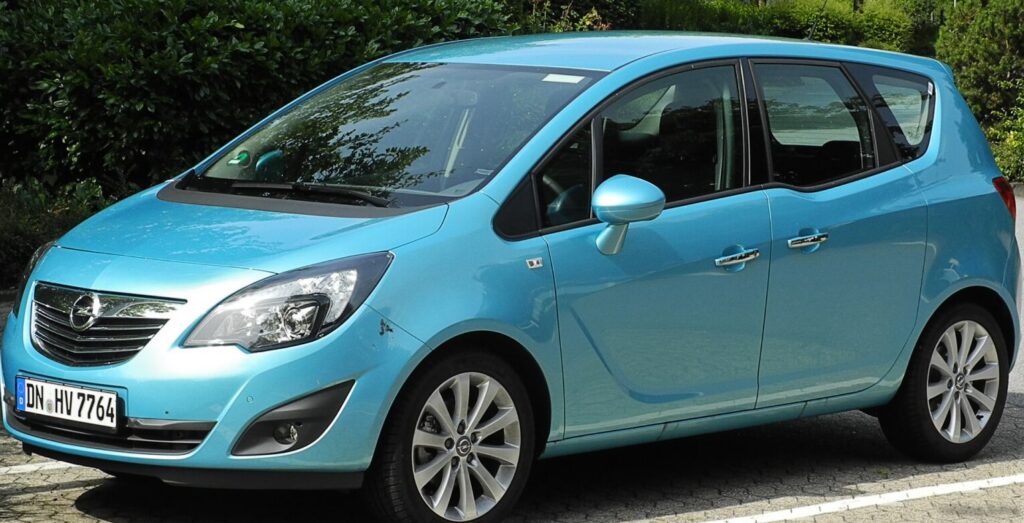
The Opel Meriva B 1.7 CDTI Automatic, produced between June 2010 and December 2011, represented an entry-level diesel option within the second generation Meriva (B) lineup. Positioned as a practical and fuel-efficient family vehicle, this variant combined a 1.7-liter common rail diesel engine with a six-speed automatic transmission. It was primarily marketed in Europe, offering a balance between affordability and convenience for buyers seeking a compact minivan. The Meriva B itself was built on the General Motors Gamma platform, shared with other models like the Opel/Vauxhall Corsa D and the Fiat Punto Evo, aiming for a more refined and versatile package than its predecessor.
Technical Specifications
| Brand | Opel |
| Model | Meriva |
| Generation | Meriva B |
| Type (Engine) | 1.7 CDTI (100 Hp) Automatic |
| Start of production | June, 2010 |
| End of production | December, 2011 |
| Powertrain Architecture | Internal Combustion engine |
| Body type | Minivan |
| Seats | 5 |
| Doors | 5 |
| Fuel consumption (urban) | 8.6 l/100 km (27.4 US mpg, 32.8 UK mpg, 11.6 km/l) |
| Fuel consumption (extra urban) | 5.1 l/100 km (46.1 US mpg, 55.4 UK mpg, 19.6 km/l) |
| Fuel consumption (combined) | 6.4 l/100 km (36.8 US mpg, 44.1 UK mpg, 15.6 km/l) |
| CO2 emissions | 168 g/km |
| Fuel Type | Diesel |
| Acceleration 0 – 100 km/h | 13.9 sec |
| Acceleration 0 – 62 mph | 13.9 sec |
| Acceleration 0 – 60 mph | 13.2 sec |
| Maximum speed | 172 km/h (106.88 mph) |
| Emission standard | Euro 5 |
| Weight-to-power ratio | 14.3 kg/Hp, 70 Hp/tonne |
| Weight-to-torque ratio | 5.5 kg/Nm, 182.1 Nm/tonne |
| Power | 100 Hp @ 4000 rpm |
| Power per litre | 59.3 Hp/l |
| Torque | 260 Nm @ 1700-2550 rpm (191.77 lb.-ft. @ 1700-2550 rpm) |
| Engine layout | Front, Transverse |
| Engine Model/Code | A17DT |
| Engine displacement | 1686 cm3 (102.89 cu. in.) |
| Number of cylinders | 4 |
| Engine configuration | Inline |
| Cylinder Bore | 79 mm (3.11 in.) |
| Piston Stroke | 86 mm (3.39 in.) |
| Compression ratio | 18:1 |
| Number of valves per cylinder | 4 |
| Fuel injection system | Diesel Commonrail |
| Engine aspiration | Turbocharger, Intercooler |
| Engine oil capacity | 5.4 l (5.71 US qt | 4.75 UK qt) |
| Coolant | 7.1 l (7.5 US qt | 6.25 UK qt) |
| Kerb Weight | 1428 kg (3148.2 lbs.) |
| Max. weight | 2025 kg (4464.36 lbs.) |
| Max load | 597 kg (1316.16 lbs.) |
| Trunk (boot) space – minimum | 400 l (14.13 cu. ft.) |
| Trunk (boot) space – maximum | 1500 l (52.97 cu. ft.) |
| Fuel tank capacity | 54 l (14.27 US gal | 11.88 UK gal) |
| Length | 4288 mm (168.82 in.) |
| Width | 1994 mm (78.5 in.) |
| Height | 1615 mm (63.58 in.) |
| Wheelbase | 2644 mm (104.09 in.) |
| Front track | 1488 mm (58.58 in.) |
| Rear (Back) track | 1509 mm (59.41 in.) |
| Minimum turning circle | 11.06 m (36.29 ft.) |
| Drivetrain Architecture | Front wheel drive |
| Number of gears | 6 |
| Gearbox type | Automatic transmission |
| Assisting systems | ABS (Anti-lock braking system) |
| Steering type | Steering rack and pinion |
| Tires size | 205/55 R16 |
| Wheel rims size | 16 |
Powertrain & Engine Architecture
The heart of the Meriva B 1.7 CDTI Automatic is the A17DT engine, a 1.7-liter inline-four cylinder diesel. This engine is part of Opel/Fiat’s family of small-displacement diesel engines, known for its relatively simple construction and focus on fuel efficiency. It utilizes a common rail direct injection system, delivering fuel at extremely high pressure for optimized combustion. A turbocharger with an intercooler is employed to boost power output and improve torque across a wider rev range. The engine produces 100 horsepower at 4000 rpm and a respectable 260 Nm (192 lb-ft) of torque between 1700 and 2550 rpm. The six-speed automatic transmission, while providing convenience, was not known for particularly rapid shifts, prioritizing smooth operation over outright performance. It was a conventional torque converter automatic, lacking the efficiency of more modern dual-clutch transmissions.
Driving Characteristics
The 1.7 CDTI Automatic Meriva B offered a comfortable, if not particularly exciting, driving experience. Acceleration from 0-60 mph took around 13.2 seconds, and top speed was limited to 106.88 mph. The automatic transmission, while smooth, did detract from the engine’s available torque, resulting in a slightly sluggish feel, especially during overtaking maneuvers. The gear ratios were tuned for fuel economy rather than performance. Compared to the more powerful 1.4 Turbo petrol variants or even the later 1.7 CDTI models with increased power output, this version felt noticeably slower. However, it excelled in urban driving and on long highway journeys, where its fuel efficiency and relaxed cruising ability were appreciated.
Equipment & Trim Levels
The 1.7 CDTI Automatic typically came equipped with a reasonable level of standard features. These included air conditioning, power windows, central locking, and an audio system with CD player. Safety features such as ABS, front and side airbags, and stability control were also standard. Higher trim levels, such as ‘Enjoy’ or ‘Cosmo’, added features like alloy wheels, upgraded upholstery, a multi-function steering wheel, and parking sensors. Optional extras included a panoramic sunroof, navigation system, and rear parking sensors. The interior was generally functional and well-built, with a focus on practicality and durability.
Chassis & Braking
The Meriva B featured a MacPherson strut front suspension and a semi-independent torsion beam rear suspension. This setup provided a comfortable ride, although it wasn’t particularly sporty. The front brakes were ventilated discs, while the rear brakes were typically drum brakes on this specific variant, contributing to cost savings. The steering was a rack and pinion system, offering reasonable precision. The relatively modest power output of the 1.7 CDTI engine meant that the braking system was generally adequate for everyday use.
Market Reception & Comparison
The Opel Meriva B 1.7 CDTI Automatic was generally well-received as a practical and economical family vehicle. Critics praised its spacious interior, versatile seating arrangements, and fuel efficiency. However, the automatic transmission was often criticized for its lack of responsiveness. Compared to the manual transmission version of the same engine, the automatic offered slightly worse fuel economy and slower acceleration. Against competitors like the Renault Scenic or Citroën C4 Picasso, the Meriva B offered a more affordable option, but lacked some of the more advanced features and refined driving experience of its rivals.
Legacy
The A17DT engine, while not without its quirks, proved to be a relatively reliable unit when properly maintained. Common issues included diesel particulate filter (DPF) clogging, particularly on vehicles used primarily for short journeys, and occasional problems with the turbocharger. The six-speed automatic transmission, while generally durable, could experience issues with solenoid failure or valve body wear over time. Today, the Meriva B 1.7 CDTI Automatic represents an affordable and practical used car option. Its fuel efficiency and spacious interior continue to appeal to budget-conscious buyers seeking a versatile family vehicle. However, potential buyers should be aware of the potential maintenance costs associated with the DPF and automatic transmission.