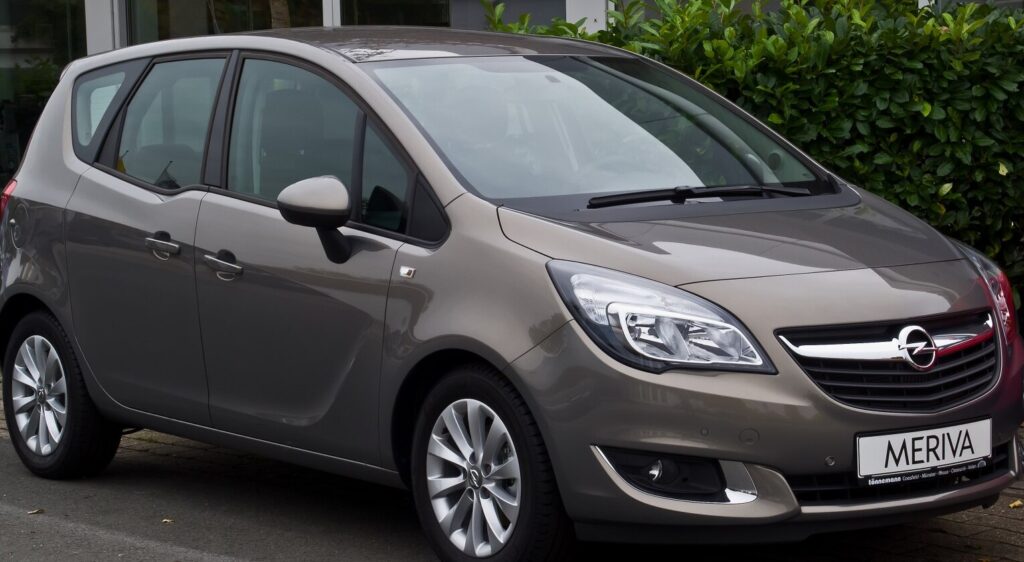
The Opel Meriva B, particularly the facelifted version introduced in 2014, represented a significant evolution of Opel’s compact MPV offering. The 1.3 CDTI (95 hp) ecoFLEX variant, produced from January to November 2014, occupied the entry-level position in the Meriva B lineup, focusing on fuel efficiency and affordability. This model was primarily aimed at European markets, where compact MPVs were highly popular due to their practicality and versatility. It sat within the broader Meriva B generation (2010-2019), which utilized the General Motors Gamma platform, also known as the 1HX0/A3 platform. The ecoFLEX designation signified Opel’s commitment to reducing emissions and improving fuel economy through various engineering optimizations.
Technical Specifications
| Brand | Opel |
| Model | Meriva |
| Generation | Meriva B (facelift 2014) |
| Type (Engine) | 1.3 CDTI (95 Hp) ecoFLEX |
| Start of production | January, 2014 |
| End of production | November, 2014 |
| Powertrain Architecture | Internal Combustion engine |
| Body type | MPV |
| Seats | 5 |
| Doors | 5 |
| Fuel consumption (urban) | 5.6 l/100 km (42 US mpg, 50.4 UK mpg, 17.9 km/l) |
| Fuel consumption (extra urban) | 3.9 l/100 km (60.3 US mpg, 72.4 UK mpg, 25.6 km/l) |
| Fuel consumption (combined) | 4.5 l/100 km (52.3 US mpg, 62.8 UK mpg, 22.2 km/l) |
| CO2 emissions | 119 g/km |
| Fuel Type | Diesel |
| Acceleration 0 – 100 km/h | 16.9 sec |
| Acceleration 0 – 62 mph | 16.9 sec |
| Acceleration 0 – 60 mph | 16.1 sec |
| Maximum speed | 160 km/h (99.42 mph) |
| Emission standard | Euro 5 |
| Weight-to-power ratio | 14.7 kg/Hp, 68.2 Hp/tonne |
| Weight-to-torque ratio | 7.7 kg/Nm, 129.2 Nm/tonne |
| Power | 95 Hp @ 4000 rpm |
| Power per litre | 76.1 Hp/l |
| Torque | 180 Nm @ 1750-2500 rpm (132.76 lb.-ft. @ 1750-2500 rpm) |
| Engine layout | Front, Transverse |
| Engine Model/Code | A13DTE |
| Engine displacement | 1248 cm3 (76.16 cu. in.) |
| Number of cylinders | 4 |
| Engine configuration | Inline |
| Cylinder Bore | 69.6 mm (2.74 in.) |
| Piston Stroke | 82 mm (3.23 in.) |
| Fuel injection system | Diesel Commonrail |
| Engine aspiration | Turbocharger, Intercooler |
| Valvetrain | DOHC |
| Engine oil capacity | 3.5 l (3.7 US qt | 3.08 UK qt) |
| Coolant | 6.2 l (6.55 US qt | 5.46 UK qt) |
| Kerb Weight | 1393 kg (3071.04 lbs.) |
| Trunk (boot) space – minimum | 400 l (14.13 cu. ft.) |
| Trunk (boot) space – maximum | 1500 l (52.97 cu. ft.) |
| Fuel tank capacity | 54 l (14.27 US gal | 11.88 UK gal) |
| Length | 4300 mm (169.29 in.) |
| Width | 1912 mm (75.28 in.) |
| Height | 1615 mm (63.58 in.) |
| Wheelbase | 2644 mm (104.09 in.) |
| Front track | 1488 mm (58.58 in.) |
| Rear (Back) track | 1509 mm (59.41 in.) |
| Minimum turning circle | 11.06 m (36.29 ft.) |
| Drivetrain Architecture | Front wheel drive |
| Number of gears | 5 gears, manual transmission |
| Front suspension | Independent type McPherson |
| Rear suspension | Elastic beam |
| Front brakes | Ventilated discs |
| Rear brakes | Disc |
| Assisting systems | ABS (Anti-lock braking system) |
| Steering type | Steering rack and pinion |
| Power steering | Electric Steering |
Powertrain & Engine Architecture
The heart of the Meriva B 1.3 CDTI ecoFLEX is the A13DTE engine, a 1.3-liter inline-four cylinder diesel. This engine is part of Opel/Fiat’s family of small-displacement diesel engines, known for their fuel efficiency. The engine utilizes a common rail direct injection system, delivering fuel directly into the combustion chamber at extremely high pressure for optimized combustion. A turbocharger with an intercooler is employed to boost power output and improve torque across a wider rev range. The engine features a double overhead camshaft (DOHC) valvetrain, contributing to efficient gas exchange. The 95 horsepower output is achieved at 4000 rpm, while peak torque of 180 Nm (132.76 lb-ft) is available between 1750 and 2500 rpm. This engine was paired with a five-speed manual transmission, chosen for its simplicity and contribution to fuel economy. The ecoFLEX variants also featured optimized aerodynamics and reduced rolling resistance tires to further enhance efficiency.
Driving Characteristics
The 1.3 CDTI 95 hp engine, coupled with the five-speed manual transmission, provided adequate, though not exhilarating, performance. Acceleration from 0 to 100 km/h (0-62 mph) took approximately 16.9 seconds, and top speed was limited to 160 km/h (99.42 mph). The engine’s torque delivery was relatively flat, making it suitable for everyday driving and providing sufficient power for overtaking maneuvers, albeit requiring downshifts. Compared to higher-output versions of the Meriva B, such as those equipped with the 1.7 CDTI engine, the 1.3 CDTI felt noticeably slower. However, the trade-off was significantly improved fuel economy. The gear ratios were tuned for efficiency, with a relatively long fifth gear designed to reduce engine speed at highway cruising speeds. The driving experience was generally comfortable, typical of a compact MPV, with a focus on practicality rather than sporty handling.
Equipment & Trim Levels
The 1.3 CDTI ecoFLEX trim typically came with a reasonable level of standard equipment, focusing on essential features. This included air conditioning, power windows, central locking, and an audio system with MP3 compatibility. Safety features such as ABS, electronic stability control (ESP), and multiple airbags were also standard. Interior upholstery was typically cloth, with a functional and durable design. Optional extras included alloy wheels, parking sensors, a navigation system, and upgraded audio systems. The Meriva B offered a flexible interior with sliding rear seats and a configurable boot space, enhancing its practicality. The dashboard layout was straightforward and user-friendly, prioritizing ease of use.
Chassis & Braking
The Meriva B 1.3 CDTI ecoFLEX utilized a McPherson strut independent suspension at the front and an elastic beam suspension at the rear. This setup provided a good balance between ride comfort and handling. The front brakes were ventilated discs, offering good stopping power, while the rear brakes were solid discs. The steering was rack and pinion with electric power assistance, providing light and precise steering feel. The suspension was tuned to prioritize comfort, absorbing bumps and irregularities in the road surface effectively. The relatively lightweight engine contributed to a balanced weight distribution, enhancing handling characteristics.
Market Reception & Comparison
The Opel Meriva B 1.3 CDTI ecoFLEX was generally well-received by critics for its fuel efficiency and practicality. It was praised for its spacious interior, flexible seating arrangements, and low running costs. However, some reviewers noted that the engine lacked outright power, particularly when fully loaded. Compared to other trims in the Meriva B lineup, the 1.3 CDTI offered the best fuel economy but the slowest performance. It competed with other compact MPVs such as the Renault Modus, Fiat Qubo, and Citroën Berlingo Multispace, offering a compelling combination of practicality and affordability.
Legacy
The 1.3 CDTI engine, while not known for being particularly robust, generally proved reliable with regular maintenance. Common issues included turbocharger wear and potential problems with the diesel particulate filter (DPF), particularly on vehicles primarily used for short journeys. In the used car market, the Meriva B 1.3 CDTI ecoFLEX remains a popular choice for budget-conscious buyers seeking a practical and fuel-efficient MPV. Its affordability and low running costs continue to make it an attractive option, despite its age and relatively modest performance. The ecoFLEX variants, in particular, are sought after for their enhanced fuel economy and reduced emissions.