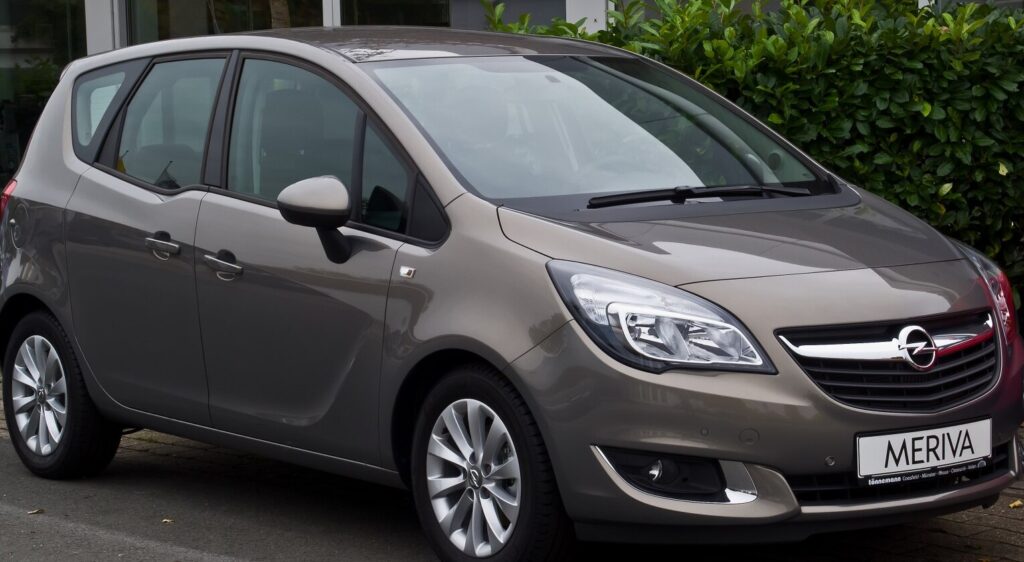
The Opel Meriva B, particularly the facelifted version introduced in January 2014, represented a significant evolution of Opel’s compact MPV offering. This iteration, produced through January 2017, aimed to blend practicality with a more refined driving experience. Among the engine options available, the 1.4-liter Turbo Ecotec producing 140 horsepower became a popular choice, offering a balance between performance and fuel efficiency within the Meriva B lineup. This variant occupied a mid-range position, appealing to families seeking a versatile vehicle without sacrificing a reasonable level of power. It was positioned above the base 1.2L engine and below the more expensive diesel options.
Technical Specifications
| Brand | Opel |
| Model | Meriva |
| Generation | Meriva B (facelift 2014) |
| Type (Engine) | 1.4 (140 Hp) Turbo Ecotec |
| Start of production | January, 2014 |
| End of production | January, 2017 |
| Powertrain Architecture | Internal Combustion engine |
| Body type | MPV |
| Seats | 5 |
| Doors | 5 |
| Fuel consumption (urban) | 8.4 l/100 km (28 US mpg, 33.6 UK mpg, 11.9 km/l) |
| Fuel consumption (extra urban) | 5.2 l/100 km (45.2 US mpg, 54.3 UK mpg, 19.2 km/l) |
| Fuel consumption (combined) | 6.3 l/100 km (37.3 US mpg, 44.8 UK mpg, 15.9 km/l) |
| CO2 emissions | 149 g/km |
| Fuel Type | Petrol (Gasoline) |
| Acceleration 0 – 100 km/h | 10.1 sec |
| Acceleration 0 – 62 mph | 10.1 sec |
| Acceleration 0 – 60 mph | 9.6 sec |
| Maximum speed | 196 km/h (121.79 mph) |
| Emission standard | Euro 6 |
| Power | 140 Hp @ 4900-6000 rpm |
| Power per litre | 102.6 Hp/l |
| Torque | 200 Nm @ 1850-4900 rpm (147.51 lb.-ft. @ 1850-4900 rpm) |
| Engine layout | Front, Transverse |
| Engine Model/Code | B14NET |
| Engine displacement | 1364 cm3 (83.24 cu. in.) |
| Number of cylinders | 4 |
| Engine configuration | Inline |
| Cylinder Bore | 72.5 mm (2.85 in.) |
| Piston Stroke | 82.6 mm (3.25 in.) |
| Fuel injection system | Multi-port manifold injection |
| Engine aspiration | Turbocharger, Intercooler |
| Valvetrain | DOHC |
| Engine oil capacity | 4 l (4.23 US qt | 3.52 UK qt) |
| Coolant | 6.2 l (6.55 US qt | 5.46 UK qt) |
| Trunk (boot) space – minimum | 400 l (14.13 cu. ft.) |
| Trunk (boot) space – maximum | 1500 l (52.97 cu. ft.) |
| Fuel tank capacity | 54 l (14.27 US gal | 11.88 UK gal) |
| Length | 4300 mm (169.29 in.) |
| Width | 1912 mm (75.28 in.) |
| Height | 1615 mm (63.58 in.) |
| Wheelbase | 2644 mm (104.09 in.) |
| Front track | 1488 mm (58.58 in.) |
| Rear (Back) track | 1509 mm (59.41 in.) |
| Minimum turning circle | 11.06 m (36.29 ft.) |
| Drivetrain Architecture | The Internal combustion engine (ICE) drives the front wheels of the vehicle. |
| Drive wheel | Front wheel drive |
| Number of gears and type of gearbox | 6 gears, manual transmission |
| Front suspension | Independent type McPherson |
| Rear suspension | Elastic beam |
| Front brakes | Ventilated discs |
| Rear brakes | Disc |
| Assisting systems | ABS (Anti-lock braking system) |
| Steering type | Steering rack and pinion |
| Power steering | Electric Steering |
Powertrain & Engine Architecture
The heart of this Meriva variant is the B14NET engine, a 1.4-liter inline-four cylinder gasoline engine. This engine utilizes a turbocharger with an intercooler to boost power output, allowing it to produce 140 horsepower and 200 Nm (147.51 lb-ft) of torque. The engine employs multi-port fuel injection, a relatively conventional system for its time, delivering fuel directly into the intake ports. The double overhead camshaft (DOHC) valvetrain contributes to efficient cylinder filling and exhaust scavenging. The 6-speed manual transmission was standard, providing drivers with good control over the engine’s powerband. The engine’s design prioritized a broad torque curve, making it responsive in everyday driving situations.
Driving Characteristics
The 1.4-liter Turbo Ecotec equipped Meriva B offered a noticeable step up in performance compared to the base 1.2-liter engine. While not a sports car, the 140 hp engine provided adequate power for highway merging and overtaking maneuvers. The six-speed manual transmission allowed drivers to keep the engine in its optimal power range. Acceleration from 0-60 mph was achieved in approximately 9.6 seconds, and top speed was rated at 121.79 mph. Compared to the diesel variants, the 1.4T offered a more eager throttle response, but lacked the low-end torque of the diesel engines. The gear ratios were tuned for a balance between fuel economy and drivability, with a relatively long sixth gear for relaxed cruising.
Equipment & Trim Levels
The 1.4 Turbo Ecotec Meriva B typically came with a reasonable level of standard equipment. This included air conditioning, power windows, central locking, and a basic audio system. Higher trim levels, such as the Cosmo, added features like alloy wheels, upgraded upholstery, a touchscreen infotainment system, and parking sensors. Optional extras included a panoramic sunroof, navigation system, and heated seats. Interior upholstery was typically cloth, with leather options available on higher trims. The dashboard layout was functional and user-friendly, with a focus on practicality.
Chassis & Braking
The Meriva B utilized a McPherson strut front suspension and an elastic beam rear suspension. This setup provided a comfortable ride quality, well-suited for family transportation. The front brakes were ventilated discs, offering good stopping power, while the rear brakes were solid discs. Anti-lock Braking System (ABS) was standard. The steering was electrically assisted, providing light and precise control. Stabilizer bars were fitted to both the front and rear axles to reduce body roll during cornering. The suspension tuning was geared towards comfort rather than sporty handling.
Market Reception & Comparison
The 1.4 Turbo Ecotec Meriva B received generally positive reviews. Critics praised its blend of practicality, fuel efficiency, and reasonable performance. Compared to the 1.2-liter engine, the 1.4T offered a significant improvement in power and drivability. However, the diesel variants were often favored by those prioritizing fuel economy and low-speed torque. The 1.4T offered a good compromise for drivers who wanted a more engaging driving experience without sacrificing fuel efficiency. Fuel economy figures of around 37.3 US mpg combined were considered respectable for its class.
Legacy
The Opel Meriva B 1.4 Turbo Ecotec has proven to be a relatively reliable powertrain. The B14NET engine, while not without its potential issues (such as occasional turbocharger problems), is generally considered durable with proper maintenance. In the used car market, these Merivas represent a good value proposition for families seeking a practical and affordable MPV. Parts availability is generally good, and maintenance costs are reasonable. The Meriva B, in this configuration, remains a popular choice for those seeking a versatile and dependable vehicle.