
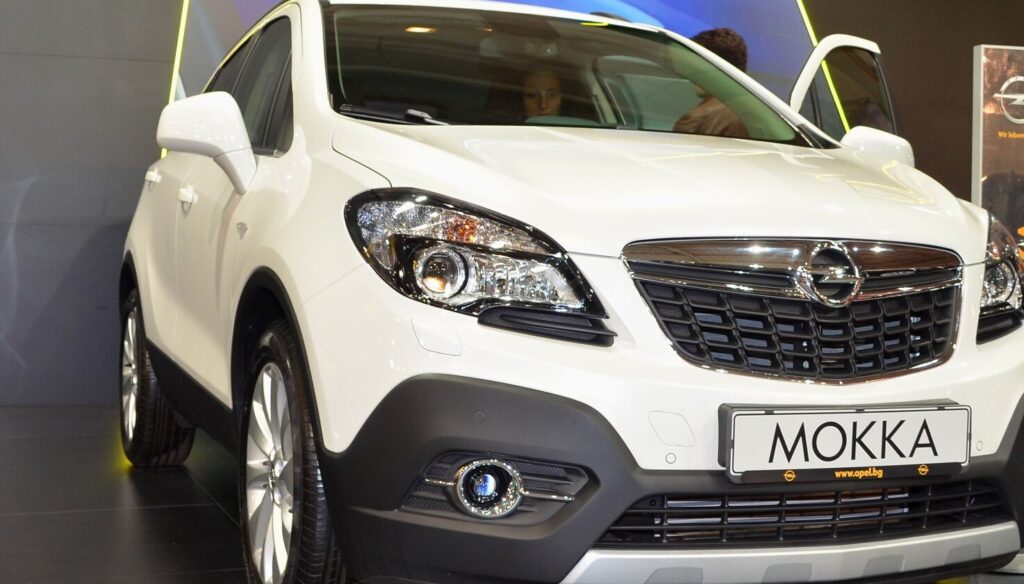
The Opel Mokka 1.4 Turbo Ecotec start/stop, marketed from October 2012 to May 2016, represents a key variant within the first generation of the Mokka (later rebranded as the Vauxhall Mokka in the UK). Positioned as a mid-range offering, this version aimed to balance fuel efficiency with a respectable level of performance in the burgeoning subcompact SUV segment. The Mokka, built on the GM Gamma platform (also underpinning vehicles like the Chevrolet Trax), was Opel’s first foray into the small SUV market, designed to appeal to buyers seeking a more versatile and stylish alternative to traditional hatchbacks. This 1.4 Turbo model was a significant part of the initial Mokka lineup, offering a step up in power and refinement compared to the base engine options.
Technical Specifications
| Brand | Opel |
| Model | Mokka |
| Generation | Mokka |
| Type (Engine) | 1.4 Turbo (140 Hp) Ecotec start/stop |
| Start of production | October, 2012 |
| End of production | May, 2016 |
| Powertrain Architecture | Internal Combustion engine |
| Body type | SUV |
| Seats | 5 |
| Doors | 5 |
| Fuel consumption (urban) | 7.6 l/100 km (30.9 US mpg) |
| Fuel consumption (extra urban) | 5.1 l/100 km (46.1 US mpg) |
| Fuel consumption (combined) | 6 l/100 km (39.2 US mpg) |
| CO2 emissions | 139 g/km |
| Fuel Type | Petrol (Gasoline) |
| Acceleration 0 – 100 km/h | 9.9 sec |
| Acceleration 0 – 62 mph | 9.9 sec |
| Acceleration 0 – 60 mph | 9.4 sec |
| Maximum speed | 196 km/h (121.79 mph) |
| Emission standard | Euro 5 |
| Power | 140 Hp @ 4900-6000 rpm |
| Torque | 200 Nm @ 1850-4900 rpm (147.51 lb.-ft.) |
| Engine layout | Front, Transverse |
| Engine Model/Code | A14NET, B14NET |
| Engine displacement | 1364 cm3 (83.24 cu. in.) |
| Number of cylinders | 4 |
| Engine configuration | Inline |
| Cylinder Bore | 72.5 mm (2.85 in.) |
| Piston Stroke | 82.6 mm (3.25 in.) |
| Fuel injection system | Multi-port manifold injection |
| Engine aspiration | Turbocharger, Intercooler |
| Engine oil capacity | 4 l (4.23 US qt | 3.52 UK qt) |
| Coolant | 6 l (6.34 US qt | 5.28 UK qt) |
| Trunk (boot) space – minimum | 356 l (12.57 cu. ft.) |
| Trunk (boot) space – maximum | 1372 l (48.45 cu. ft.) |
| Fuel tank capacity | 54 l (14.27 US gal | 11.88 UK gal) |
| Length | 4278 mm (168.43 in.) |
| Width | 1658 mm (65.28 in.) |
| Height | 1777 mm (69.96 in.) |
| Wheelbase | 2555 mm (100.59 in.) |
| Front track | 1540 mm (60.63 in.) |
| Rear track | 1540 mm (60.63 in.) |
| Minimum turning circle | 10.8 m (35.43 ft.) |
| Drivetrain Architecture | Front wheel drive |
| Number of gears | 6 gears, manual transmission |
| Front suspension | Independent type McPherson |
| Rear suspension | Semi-independent, coil spring |
| Front brakes | Ventilated discs |
| Rear brakes | Disc |
| Tires size | 215/55 R18 |
| Wheel rims size | 18 |
Powertrain & Engine Architecture
The heart of the Mokka 1.4 Turbo is the A14NET or B14NET engine, a 1.4-liter inline-four cylinder gasoline engine. This engine is part of Opel/Vauxhall’s Ecotec family, known for its focus on efficiency and refinement. The engine utilizes a single-scroll turbocharger with an intercooler to boost power output. Fuel delivery is managed by a multi-port fuel injection system, providing precise fuel metering for optimal combustion. The engine features double overhead camshafts (DOHC) and four valves per cylinder, contributing to its relatively high specific output. The ‘Start/Stop’ system, standard on this variant, automatically shuts off the engine when the vehicle is stationary (at traffic lights, for example) to reduce fuel consumption and emissions. The engine is transversely mounted, driving the front wheels through a six-speed manual transmission. While an automatic transmission was offered on other Mokka trims, the 140 hp engine was primarily paired with the manual gearbox in many European markets.
Driving Characteristics
The 1.4 Turbo engine delivers a noticeable improvement in performance compared to the lower-powered 1.6-liter naturally aspirated engine available in some Mokka trims. With 140 horsepower and 200 Nm (147.51 lb-ft) of torque, the Mokka 1.4 Turbo offers adequate acceleration for everyday driving, achieving 0-60 mph in around 9.4 seconds. The turbocharger provides a boost in power at lower engine speeds, making it feel responsive in urban environments. However, the power delivery isn’t particularly aggressive, and the engine needs to be revved to access its full potential. The six-speed manual transmission is well-matched to the engine, offering smooth gear changes and allowing drivers to maintain optimal engine speed. Compared to the higher-output 1.8-liter engine (available in some markets), the 1.4 Turbo feels less powerful, particularly during overtaking maneuvers. However, it offers a better balance between performance and fuel economy.
Equipment & Trim Levels
The Mokka 1.4 Turbo typically came equipped with a reasonable level of standard features. These generally included air conditioning, a CD/MP3 stereo system with USB connectivity, electric front windows, and remote central locking. Safety features such as ABS, ESP (Electronic Stability Program), and multiple airbags were also standard. Higher trim levels, such as ‘Sport’ or ‘Cosmo’, added features like alloy wheels, a touchscreen infotainment system, rear parking sensors, cruise control, and automatic climate control. Interior upholstery was typically cloth, with options for leather upgrades on higher trims. The dashboard design was relatively simple and functional, with a focus on ease of use.
Chassis & Braking
The Mokka’s chassis features an independent McPherson strut suspension at the front and a semi-independent torsion beam suspension at the rear. This setup provides a comfortable ride quality, absorbing bumps and imperfections in the road surface effectively. The steering is electrically assisted, offering light and precise control. Braking duties are handled by ventilated discs at the front and solid discs at the rear. ABS (Anti-lock Braking System) is standard, providing enhanced braking performance in emergency situations. The Mokka’s suspension and braking systems were tuned to provide a safe and predictable driving experience, prioritizing comfort over outright sportiness.
Market Reception & Comparison
The Opel Mokka 1.4 Turbo was generally well-received by automotive critics. It was praised for its stylish design, comfortable ride, and relatively fuel-efficient engine. However, some critics noted that the interior materials felt somewhat low-rent and that the engine could be a bit noisy at higher speeds. Compared to rivals like the Nissan Juke and Renault Captur, the Mokka offered a more conventional and understated design. In terms of fuel economy, the 1.4 Turbo performed competitively, achieving around 39.2 US mpg on the combined cycle. Reliability reports suggest that the 1.4 Turbo engine is generally reliable, although some owners have reported issues with the turbocharger and fuel injectors.
Legacy
The Opel Mokka 1.4 Turbo Ecotec start/stop played a significant role in establishing the Mokka as a popular choice in the subcompact SUV segment. The 1.4 Turbo engine proved to be a capable and efficient powerplant, offering a good balance between performance and fuel economy. In the used car market, these models represent a good value proposition, offering a practical and stylish SUV at an affordable price. While the engine is generally reliable, potential buyers should be aware of the potential for turbocharger and fuel injector issues and ensure that the vehicle has been properly maintained. The Mokka’s success paved the way for the second-generation Mokka, which continues to be a strong contender in the competitive SUV market.
