
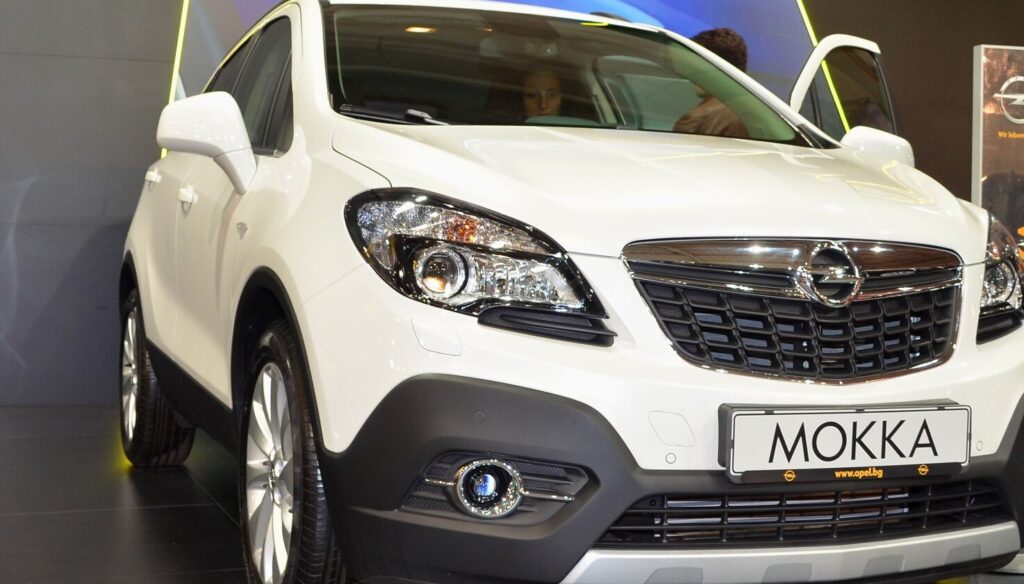
The Opel Mokka 1.6 (115 hp) Ecotec start/stop, marketed in the United Kingdom and some other regions as the Vauxhall Mokka, was a front-wheel-drive subcompact SUV produced between October 2012 and November 2014. It represented Opel’s entry into the rapidly growing crossover segment, aiming to attract buyers seeking a stylish, practical, and relatively affordable vehicle. This particular variant, powered by the 1.6-liter Ecotec engine paired with a five-speed manual transmission, served as a core model within the Mokka lineup, positioned as the entry-level offering for buyers prioritizing fuel efficiency and value. It was built on the GM Gamma platform, shared with other small Opel/Vauxhall vehicles.
Technical Specifications
| Brand | Opel |
| Model | Mokka |
| Generation | Mokka |
| Type (Engine) | 1.6 (115 Hp) Ecotec start/stop |
| Start of production | October, 2012 |
| End of production | November, 2014 |
| Powertrain Architecture | Internal Combustion engine |
| Body type | SUV |
| Seats | 5 |
| Doors | 5 |
| Fuel consumption (urban) | 8.4 l/100 km (28 US mpg, 33.6 UK mpg, 11.9 km/l) |
| Fuel consumption (extra urban) | 5.4 l/100 km (43.6 US mpg, 52.3 UK mpg, 18.5 km/l) |
| Fuel consumption (combined) | 6.5 l/100 km (36.2 US mpg, 43.5 UK mpg, 15.4 km/l) |
| CO2 emissions | 153 g/km |
| Fuel Type | Petrol (Gasoline) |
| Acceleration 0 – 100 km/h | 12.3 sec |
| Acceleration 0 – 62 mph | 12.3 sec |
| Acceleration 0 – 60 mph | 11.7 sec |
| Maximum speed | 170 km/h (105.63 mph) |
| Emission standard | Euro 5 |
| Weight-to-power ratio | 13 kg/Hp, 77.2 Hp/tonne |
| Weight-to-torque ratio | 9.6 kg/Nm, 104 Nm/tonne |
| Power | 115 Hp @ 6000 rpm |
| Power per litre | 72 Hp/l |
| Torque | 155 Nm @ 4000 rpm (114.32 lb.-ft. @ 4000 rpm) |
| Engine layout | Front, Transverse |
| Engine Model/Code | A16XER |
| Engine displacement | 1598 cm3 (97.52 cu. in.) |
| Number of cylinders | 4 |
| Engine configuration | Inline |
| Cylinder Bore | 79 mm (3.11 in.) |
| Piston Stroke | 81.5 mm (3.21 in.) |
| Fuel injection system | Multi-port manifold injection |
| Engine aspiration | Naturally aspirated engine |
| Engine oil capacity | 4.5 l (4.76 US qt | 3.96 UK qt) |
| Coolant | 5.6 l (5.92 US qt | 4.93 UK qt) |
| Kerb Weight | 1490 kg (3284.89 lbs.) |
| Max. weight | 1959 kg (4318.86 lbs.) |
| Max load | 469 kg (1033.97 lbs.) |
| Trunk (boot) space – minimum | 356 l (12.57 cu. ft.) |
| Trunk (boot) space – maximum | 1372 l (48.45 cu. ft.) |
| Fuel tank capacity | 54 l (14.27 US gal | 11.88 UK gal) |
| Length | 4278 mm (168.43 in.) |
| Width | 1658 mm (65.28 in.) |
| Height | 1777 mm (69.96 in.) |
| Wheelbase | 2555 mm (100.59 in.) |
| Front track | 1540 mm (60.63 in.) |
| Rear (Back) track | 1540 mm (60.63 in.) |
| Minimum turning circle | 10.9 m (35.76 ft.) |
| Drivetrain Architecture | Front wheel drive |
| Number of gears and type of gearbox | 5 gears, manual transmission |
| Front suspension | Independent type McPherson |
| Rear suspension | Semi-independent, coil spring |
| Front brakes | Ventilated discs |
| Rear brakes | Disc |
| Assisting systems | ABS (Anti-lock braking system) |
| Steering type | Steering rack and pinion |
| Tires size | 215/55 R18 |
| Wheel rims size | 18 |
Powertrain & Engine Architecture
The heart of the Mokka 1.6 was the A16XER engine, a 1.6-liter inline-four cylinder gasoline engine. This engine was a member of Opel’s Ecotec family, known for its focus on efficiency and refinement. It featured multi-point fuel injection and a dual overhead camshaft (DOHC) valvetrain with four valves per cylinder. The A16XER produced 115 horsepower at 6000 rpm and 155 Nm (114 lb-ft) of torque at 4000 rpm. The engine’s Start/Stop system, a standard feature, automatically shut off the engine when the vehicle came to a halt, improving fuel economy in urban driving conditions. The five-speed manual transmission was chosen for its simplicity and cost-effectiveness, offering a relatively direct driving experience. Gear ratios were tuned for fuel efficiency rather than outright performance.
Driving Characteristics
The Mokka 1.6 Automatic offered a comfortable, if not particularly sporty, driving experience. Acceleration from 0-60 mph took around 11.7 seconds, and top speed was limited to 105.63 mph. The 115 hp engine, while adequate for everyday driving, felt strained when fully loaded or tackling steep inclines. The five-speed manual transmission provided reasonable control, but the relatively long gearing emphasized fuel economy over responsiveness. Compared to the more powerful 1.4 Turbo models, the 1.6 felt noticeably slower. However, it offered a smoother and more predictable power delivery, making it a good choice for drivers prioritizing ease of use over performance. The suspension was tuned for comfort, absorbing bumps and imperfections in the road well, but this came at the expense of sharp handling.
Equipment & Trim Levels
The Mokka 1.6 typically came with a decent level of standard equipment. This included air conditioning, electric front windows, a CD/MP3 stereo system, and ABS brakes. Higher trim levels, such as the Cosmo, added features like alloy wheels, cruise control, parking sensors, and a touchscreen infotainment system. Interior upholstery was typically cloth, with a functional and durable design. Optional extras included a panoramic sunroof, leather seats, and a navigation system. The dashboard layout was straightforward and user-friendly, with clearly labeled controls.
Chassis & Braking
The Mokka’s chassis featured an independent McPherson strut suspension at the front and a semi-independent torsion beam suspension at the rear. This setup provided a good balance between comfort and handling. The front brakes were ventilated discs, while the rear brakes were solid discs. ABS (Anti-lock Braking System) was standard, providing enhanced stopping power and stability in emergency braking situations. The steering was a rack-and-pinion system, offering light and precise control.
Market Reception & Comparison
The Opel Mokka 1.6 received mixed reviews from automotive critics. While praised for its stylish design, spacious interior, and comfortable ride, it was often criticized for its underpowered engine and somewhat bland driving dynamics. Compared to other subcompact SUVs, such as the Nissan Juke or the Renault Captur, the Mokka 1.6 offered a more conventional and refined driving experience, but lacked the same level of excitement. Fuel economy was competitive, averaging around 36.2 US mpg in combined driving. Reliability was generally good, although some owners reported minor issues with the Start/Stop system.
Legacy
The Opel Mokka 1.6 (115 hp) Ecotec start/stop, while not the most exciting version of the Mokka, proved to be a popular choice for buyers seeking an affordable and practical subcompact SUV. The A16XER engine, while not known for its performance, was generally reliable and relatively inexpensive to maintain. On the used car market, these models represent a good value proposition, offering a comfortable and well-equipped vehicle at a reasonable price. However, potential buyers should be aware of the potential for issues with the Start/Stop system and ensure that the vehicle has been properly maintained.
