
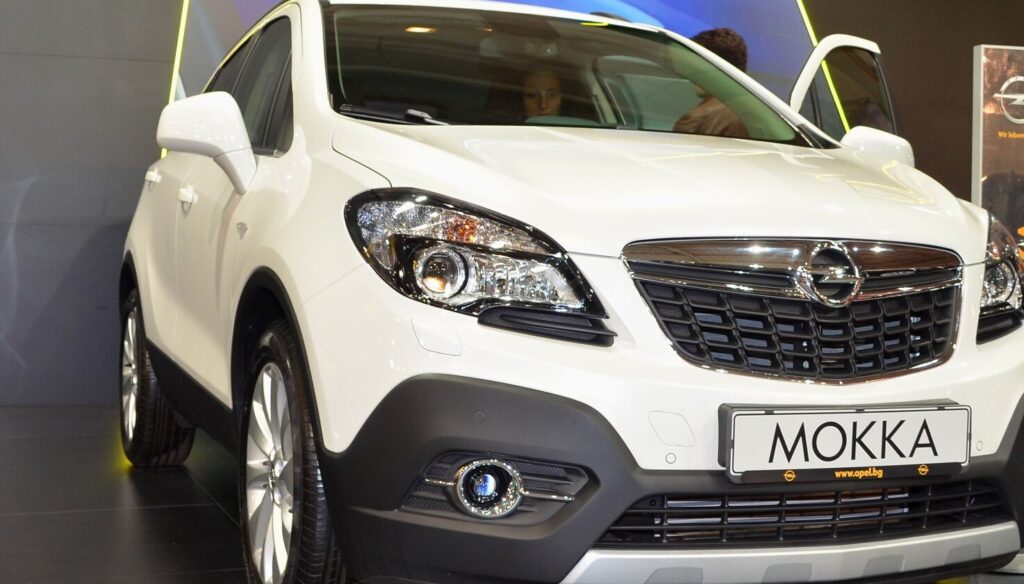
The Opel Mokka 1.6 CDTI ecoFLEX Automatic, produced between December 2014 and May 2016, represents a significant offering within the first generation of the Mokka subcompact SUV (J13). Positioned as a fuel-efficient diesel option, this variant aimed to balance practicality, economy, and a more relaxed driving experience with its automatic transmission. It was a key model in Opel’s attempt to gain market share in the rapidly growing European B-SUV segment, competing with vehicles like the Nissan Juke, Peugeot 2008, and Renault Captur. The Mokka, and subsequently this 1.6 CDTI Automatic trim, was also sold under the Vauxhall brand in the United Kingdom.
Technical Specifications
| Brand | Opel |
| Model | Mokka |
| Generation | Mokka (J13) |
| Type (Engine) | 1.6 CDTI ecoFLEX (136 Hp) Automatic |
| Start of production | December, 2014 |
| End of production | May, 2016 |
| Powertrain Architecture | Internal Combustion engine |
| Body type | SUV |
| Seats | 5 |
| Doors | 5 |
| Fuel consumption (urban) | 6.1-5.9 l/100 km (38.6 – 39.9 US mpg) |
| Fuel consumption (extra urban) | 4.5-4.3 l/100 km (52.3 – 54.7 US mpg) |
| Fuel consumption (combined) | 5.1-4.9 l/100 km (46.1 – 48 US mpg) |
| CO2 emissions | 134-129 g/km |
| Fuel Type | Diesel |
| Acceleration 0 – 100 km/h | 10.9 sec |
| Acceleration 0 – 62 mph | 10.9 sec |
| Acceleration 0 – 60 mph | 10.4 sec |
| Maximum speed | 188 km/h (116.82 mph) |
| Emission standard | Euro 6 |
| Power | 136 Hp @ 3500-4000 rpm |
| Torque | 320 Nm @ 2000-2250 rpm (236.02 lb.-ft.) |
| Engine layout | Front, Transverse |
| Engine Model/Code | B16DTH |
| Engine displacement | 1598 cm3 (97.52 cu. in.) |
| Number of cylinders | 4 |
| Engine configuration | Inline |
| Compression ratio | 16:1 |
| Number of valves per cylinder | 4 |
| Fuel injection system | Diesel Commonrail |
| Engine oil capacity | 5 l (5.28 US qt | 4.4 UK qt) |
| Coolant capacity | 6.2 l (6.55 US qt | 5.46 UK qt) |
| Trunk (boot) space – minimum | 356 l (12.57 cu. ft.) |
| Trunk (boot) space – maximum | 1372 l (48.45 cu. ft.) |
| Fuel tank capacity | 52 l (13.74 US gal | 11.44 UK gal) |
| Permitted trailer load with brakes (12%) | 1500 kg (3306.93 lbs.) |
| Permitted trailer load without brakes | 500 kg (1102.31 lbs.) |
| Length | 4278 mm (168.43 in.) |
| Width | 1777 mm (69.96 in.) |
| Width including mirrors | 2038 mm (80.24 in.) |
| Height | 1658 mm (65.28 in.) |
| Wheelbase | 2555 mm (100.59 in.) |
| Front track | 1540 mm (60.63 in.) |
| Rear track | 1540 mm (60.63 in.) |
| Minimum turning circle | 10.9 m (35.76 ft.) |
| Drivetrain Architecture | Front wheel drive |
| Number of gears | 6 |
| Gearbox type | Automatic transmission |
| Front suspension | Independent type McPherson |
| Rear suspension | Semi-independent, coil spring |
| Front brakes | Ventilated discs |
| Rear brakes | Disc |
| Assisting systems | ABS (Anti-lock braking system) |
| Steering type | Steering rack and pinion |
INTRODUCTION
The Opel Mokka 1.6 CDTI ecoFLEX Automatic, launched in late 2014, was a crucial addition to the Mokka lineup. The first-generation Mokka (internally designated J13) aimed to bring Opel into the burgeoning subcompact SUV market. This particular variant, combining a 1.6-liter diesel engine with an automatic transmission, was designed to appeal to buyers prioritizing fuel efficiency and ease of driving. The “ecoFLEX” designation indicated Opel’s efforts to optimize fuel economy through aerodynamic improvements and engine calibration. It sat in the mid-range of the Mokka offerings, positioned above the base petrol models but below the more powerful and often better-equipped trims.
Powertrain & Engine Architecture
At the heart of the Mokka 1.6 CDTI ecoFLEX Automatic lies the B16DTH engine, a 1.6-liter inline-four cylinder diesel. This engine is part of Opel/Vauxhall’s ‘A’ family of diesel engines, known for its relatively compact size and efficiency. The B16DTH utilizes a common rail direct injection system, delivering fuel at extremely high pressure for optimized combustion. A turbocharger with an intercooler further enhances performance by forcing more air into the cylinders. The engine produces 136 horsepower at 3500-4000 rpm and a respectable 320 Nm (236 lb-ft) of torque between 2000-2250 rpm. This torque output is a key characteristic of diesel engines, providing strong low-end pulling power. The engine also features a diesel particulate filter (DPF) to reduce harmful emissions, meeting Euro 6 standards. Paired with the engine is a six-speed automatic transmission, providing smooth gear changes and contributing to the vehicle’s ease of use. This transmission isn’t known for being particularly sporty, prioritizing comfort and fuel efficiency over rapid shifts.
Driving Characteristics
The Mokka 1.6 CDTI Automatic offers a comfortable and relaxed driving experience. While not particularly quick – 0-60 mph takes around 10.4 seconds – the engine’s torque provides adequate acceleration for everyday driving situations. The automatic transmission, while smooth, can feel somewhat hesitant at times, particularly during overtaking maneuvers. Compared to the manual transmission versions of the 1.6 CDTI, the automatic sacrifices some responsiveness. The gear ratios are tuned for fuel economy, meaning the engine often operates at lower revolutions per minute (RPM) during cruising. This contributes to the good fuel economy figures (around 46-48 mpg combined) but can also result in a slightly less engaging driving experience. Compared to the more powerful 1.4 Turbo petrol variants, the 1.6 CDTI Automatic feels noticeably slower, but offers significantly better fuel efficiency.
Equipment & Trim Levels
The Mokka 1.6 CDTI ecoFLEX Automatic typically came equipped with a reasonable level of standard features. These included air conditioning, electric front windows, a CD/MP3 stereo system, and alloy wheels. Safety features such as ABS, electronic stability control, and multiple airbags were also standard. Higher trim levels, such as Tech Line or Sport Line, added features like a touchscreen infotainment system with navigation, rear parking sensors, cruise control, and automatic climate control. Interior upholstery was typically cloth, with options for leather upgrades on higher trims. The dashboard layout was functional and straightforward, with a focus on usability rather than luxury.
Chassis & Braking
The Mokka’s chassis utilizes a McPherson strut suspension setup at the front and a semi-independent coil spring suspension at the rear. This configuration provides a comfortable ride quality, absorbing bumps and imperfections in the road reasonably well. The front brakes are ventilated discs, providing good stopping power, while the rear brakes are solid discs. The steering is a rack and pinion system, offering reasonable precision and feedback. Stabilizer bars are fitted to both the front and rear axles to reduce body roll during cornering. The suspension setup is tuned for comfort rather than sporty handling, prioritizing a smooth and predictable ride.
Market Reception & Comparison
The Opel Mokka 1.6 CDTI Automatic was generally well-received by critics as a practical and fuel-efficient option in the subcompact SUV segment. Reviewers praised its comfortable ride, spacious interior, and good fuel economy. However, some criticized the automatic transmission for its lack of responsiveness and the engine for being somewhat noisy. Compared to the petrol-powered Mokkas, the 1.6 CDTI Automatic offered significantly better fuel economy, making it a popular choice for drivers covering long distances. Against competitors like the Nissan Juke and Peugeot 2008, the Mokka offered a more conventional and arguably more refined driving experience, although it lacked the Juke’s distinctive styling or the 2008’s more modern interior.
Legacy
The Opel Mokka 1.6 CDTI Automatic has proven to be a relatively reliable powertrain in the used car market. The B16DTH engine, while requiring regular maintenance (including DPF regeneration), is generally robust. The automatic transmission, while not the most sophisticated, has also proven to be durable. Common issues reported by owners include DPF blockages (particularly on vehicles used primarily for short journeys) and occasional problems with the electronic parking brake. Today, these Mokkas represent an affordable and practical option for buyers seeking a fuel-efficient and comfortable subcompact SUV. Their relatively low running costs and readily available parts make them a sensible choice for those looking for a dependable used car.
