
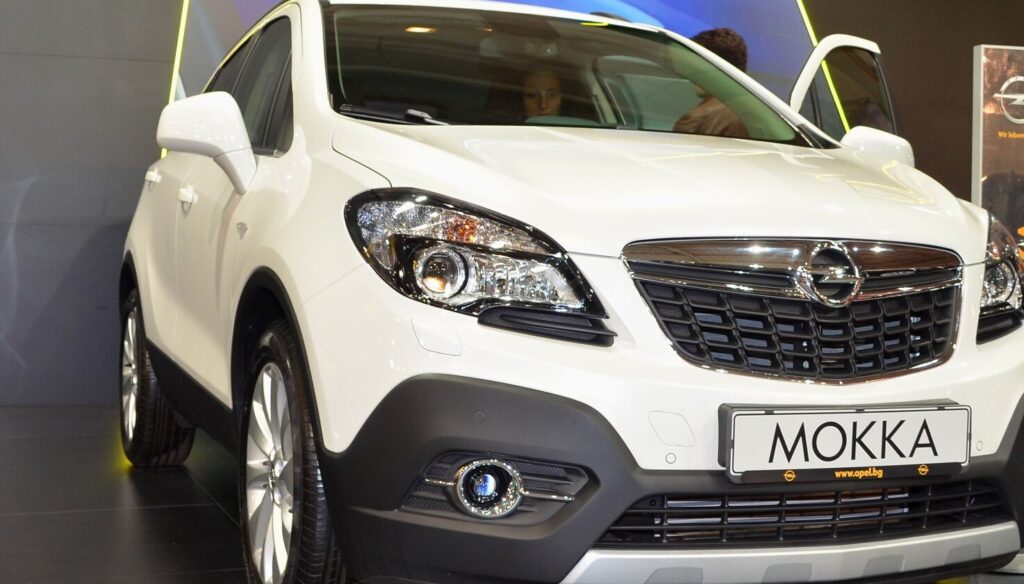
The Opel Mokka 1.6 CDTI ecoFLEX, produced from December 2014 to May 2016, represented a key offering in Opel’s burgeoning SUV lineup. Positioned as a fuel-efficient diesel option within the first-generation Mokka (J13) series, it aimed to attract buyers seeking practicality and economy in a compact package. This variant, equipped with the 1.6-liter CDTI engine and a six-speed manual transmission, was a significant player in the European market, where diesel engines held a substantial share. The Mokka itself was Opel’s first foray into the subcompact SUV segment, designed to compete with vehicles like the Nissan Juke and Peugeot 2008.
Technical Specifications
| Brand | Opel |
| Model | Mokka |
| Generation | Mokka |
| Type (Engine) | 1.6 CDTI ecoFLEX (136 Hp) start/stop |
| Start of production | December, 2014 |
| End of production | May, 2016 |
| Powertrain Architecture | Internal Combustion engine |
| Body type | SUV |
| Seats | 5 |
| Doors | 5 |
| Fuel consumption (urban) | 4.8-4.7 l/100 km (49 – 50 US mpg, 58.9 – 60.1 UK mpg, 20.8 – 21.3 km/l) |
| Fuel consumption (extra urban) | 4.0-3.8 l/100 km (58.8 – 61.9 US mpg, 70.6 – 74.3 UK mpg, 25 – 26.3 km/l) |
| Fuel consumption (combined) | 4.3-4.1 l/100 km (54.7 – 57.4 US mpg, 65.7 – 68.9 UK mpg, 23.3 – 24.4 km/l) |
| CO2 emissions | 114-109 g/km |
| Fuel Type | Diesel |
| Acceleration 0 – 100 km/h | 9.9 sec |
| Acceleration 0 – 62 mph | 9.9 sec |
| Acceleration 0 – 60 mph | 9.4 sec |
| Maximum speed | 191 km/h (118.68 mph) |
| Emission standard | Euro 6 |
| Power | 136 Hp @ 3500-4000 rpm |
| Torque | 320 Nm @ 2000-2250 rpm (236.02 lb.-ft. @ 2000-2250 rpm) |
| Engine layout | Front, Transverse |
| Engine Model/Code | B16DTH |
| Engine displacement | 1598 cm3 (97.52 cu. in.) |
| Number of cylinders | 4 |
| Engine configuration | Inline |
| Compression ratio | 16:1 |
| Number of valves per cylinder | 4 |
| Fuel injection system | Diesel Commonrail |
| Engine aspiration | Turbocharger, Intercooler |
| Engine oil capacity | 5 l (5.28 US qt | 4.4 UK qt) |
| Coolant capacity | 6.2 l (6.55 US qt | 5.46 UK qt) |
| Trunk (boot) space – minimum | 356 l (12.57 cu. ft.) |
| Trunk (boot) space – maximum | 1372 l (48.45 cu. ft.) |
| Fuel tank capacity | 52 l (13.74 US gal | 11.44 UK gal) |
| Permitted trailer load with brakes (12%) | 1500 kg (3306.93 lbs.) |
| Permitted trailer load without brakes | 500 kg (1102.31 lbs.) |
| Length | 4278 mm (168.43 in.) |
| Width | 1777 mm (69.96 in.) |
| Width including mirrors | 2038 mm (80.24 in.) |
| Height | 1658 mm (65.28 in.) |
| Wheelbase | 2555 mm (100.59 in.) |
| Front track | 1540 mm (60.63 in.) |
| Rear track | 1540 mm (60.63 in.) |
| Minimum turning circle | 10.9 m (35.76 ft.) |
| Drivetrain Architecture | Front wheel drive |
| Number of gears | 6 gears, manual transmission |
| Front suspension | Independent type McPherson |
| Rear suspension | Semi-independent, coil spring |
| Front brakes | Ventilated discs |
| Rear brakes | Disc |
Powertrain & Engine Architecture
The heart of the Mokka 1.6 CDTI ecoFLEX is the B16DTH engine, a 1.6-liter inline-four cylinder diesel. This engine is part of Opel’s ‘Whisper Diesel’ family, known for its relatively quiet operation and fuel efficiency. It utilizes a common rail direct injection system, delivering fuel at extremely high pressure for optimized combustion. The engine also features a turbocharger with an intercooler, boosting power output and improving torque delivery. The B16DTH produces 136 horsepower at 3500-4000 rpm and a substantial 320 Nm (236 lb-ft) of torque between 2000 and 2250 rpm. This torque band provides good low-end responsiveness, making it suitable for everyday driving. The engine also incorporates a Start/Stop system to further enhance fuel economy in urban environments. Paired with the engine is a six-speed manual transmission, chosen for its efficiency and driver engagement.
Driving Characteristics
The 1.6 CDTI ecoFLEX Mokka offers a balanced driving experience. While not a performance-oriented vehicle, the 136 hp engine and 320 Nm of torque provide adequate power for most driving situations. Acceleration from 0-60 mph takes around 9.4 seconds, and the top speed is 118.68 mph. The manual transmission allows for precise gear selection, and the engine’s torque curve means that drivers don’t need to constantly shift gears to maintain momentum. Compared to the lower-powered 1.4-liter petrol versions, the 1.6 CDTI offers significantly more pulling power, making it better suited for carrying passengers or cargo. However, it doesn’t provide the same level of refinement or outright performance as the more expensive and less common 1.4 Turbo variants. The suspension setup prioritizes comfort over sporty handling, providing a reasonably smooth ride on most road surfaces.
Equipment & Trim Levels
The Mokka 1.6 CDTI ecoFLEX typically came equipped with a reasonable level of standard features. These included air conditioning, electric front windows, a CD/MP3 stereo system, and ABS brakes. Higher trim levels, such as ‘Sport’ or ‘Cosmo’, added features like alloy wheels, cruise control, parking sensors, and a touchscreen infotainment system with Bluetooth connectivity. Interior upholstery was typically cloth, with options for leather upgrades on higher trims. The dashboard layout was functional and straightforward, with a focus on ease of use. Optional extras included a panoramic sunroof, heated seats, and a rear-view camera.
Chassis & Braking
The Mokka utilizes a front-wheel-drive layout with an independent McPherson strut suspension at the front and a semi-independent coil spring suspension at the rear. This setup provides a good balance between ride comfort and handling. The front brakes are ventilated discs, while the rear brakes are solid discs. ABS (Anti-lock Braking System) is standard, providing enhanced braking performance and stability. The steering is a rack and pinion system, offering precise and responsive control. Stabilizer bars are fitted to both the front and rear axles to reduce body roll during cornering.
Market Reception & Comparison
The Opel Mokka 1.6 CDTI ecoFLEX was generally well-received by critics for its fuel efficiency and practicality. It offered a compelling alternative to petrol-powered rivals, particularly for drivers who covered long distances. Fuel economy figures of around 54.7-57.4 US mpg combined were highly competitive. However, some reviewers noted that the engine could be slightly noisy under hard acceleration. Compared to the 1.4-liter petrol versions, the 1.6 CDTI offered superior torque and fuel economy, but at a slightly higher price point. The 1.4 Turbo offered more power but was less fuel-efficient. Reliability reports suggest that the B16DTH engine is generally robust, although regular servicing is essential to maintain optimal performance.
Legacy
The Opel Mokka 1.6 CDTI ecoFLEX remains a relatively common sight on European roads today. The B16DTH engine has proven to be a durable and reliable unit when properly maintained. In the used car market, these Mokkas offer good value for money, providing a practical and economical mode of transport. While newer SUVs have surpassed the Mokka in terms of technology and refinement, the 1.6 CDTI ecoFLEX continues to appeal to buyers seeking a dependable and fuel-efficient compact SUV.
