
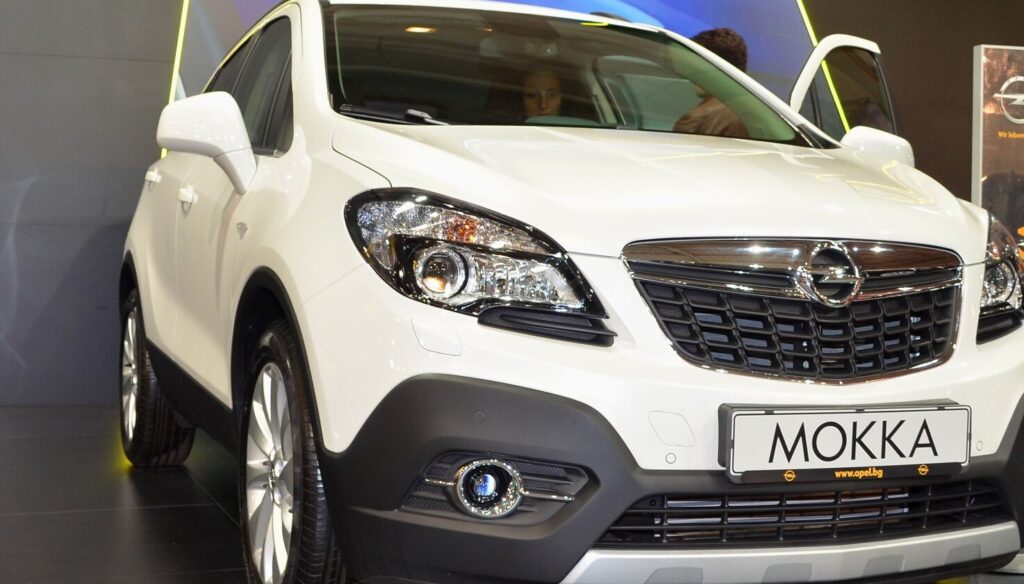
The Opel Mokka 1.7 CDTI AWD Ecotec start/stop, produced from October 2012 to 2015, represented a key variant within the first generation of Opel’s popular subcompact SUV. Positioned as a mid-range offering, it combined a diesel engine with all-wheel drive and fuel-saving start/stop technology, appealing to buyers seeking practicality, efficiency, and all-weather capability. This model played a significant role in establishing the Mokka as a strong competitor in the burgeoning European B-segment SUV market, offering a more rugged alternative to traditional hatchbacks.
Technical Specifications
| Brand | Opel |
| Model | Mokka |
| Generation | Mokka |
| Type (Engine) | 1.7 CDTI (130 Hp) AWD Ecotec start/stop |
| Start of production | October, 2012 |
| End of production | 2015 |
| Powertrain Architecture | Internal Combustion engine |
| Body type | SUV |
| Seats | 5 |
| Doors | 5 |
| Fuel consumption (urban) | 5.6 l/100 km (42 US mpg, 50.4 UK mpg, 17.9 km/l) |
| Fuel consumption (extra urban) | 4.5 l/100 km (52.3 US mpg, 62.8 UK mpg, 22.2 km/l) |
| Fuel consumption (combined) | 4.9 l/100 km (48 US mpg, 57.6 UK mpg, 20.4 km/l) |
| CO2 emissions | 129 g/km |
| Fuel Type | Diesel |
| Acceleration 0 – 100 km/h | 9.4 sec |
| Acceleration 0 – 62 mph | 9.4 sec |
| Acceleration 0 – 60 mph | 8.9 sec |
| Maximum speed | 185 km/h (114.95 mph) |
| Emission standard | Euro 5 |
| Weight-to-power ratio | 11.5 kg/Hp, 87.2 Hp/tonne |
| Weight-to-torque ratio | 5 kg/Nm, 201.3 Nm/tonne |
| Power | 130 Hp @ 4000 rpm |
| Power per litre | 77.1 Hp/l |
| Torque | 300 Nm @ 2000-2500 rpm (221.27 lb.-ft. @ 2000-2500 rpm) |
| Engine layout | Front, Transverse |
| Engine Model/Code | A17DTS |
| Engine displacement | 1686 cm3 (102.89 cu. in.) |
| Number of cylinders | 4 |
| Engine configuration | Inline |
| Cylinder Bore | 79 mm (3.11 in.) |
| Piston Stroke | 86 mm (3.39 in.) |
| Fuel injection system | Diesel Commonrail |
| Engine aspiration | Turbocharger, Intercooler |
| Engine oil capacity | 4.5 l (4.76 US qt | 3.96 UK qt) |
| Kerb Weight | 1490 kg (3284.89 lbs.) |
| Max. weight | 1959 kg (4318.86 lbs.) |
| Max load | 469 kg (1033.97 lbs.) |
| Trunk (boot) space – minimum | 356 l (12.57 cu. ft.) |
| Trunk (boot) space – maximum | 1372 l (48.45 cu. ft.) |
| Fuel tank capacity | 54 l (14.27 US gal | 11.88 UK gal) |
| Length | 4278 mm (168.43 in.) |
| Width | 1658 mm (65.28 in.) |
| Height | 1777 mm (69.96 in.) |
| Wheelbase | 2555 mm (100.59 in.) |
| Front track | 1540 mm (60.63 in.) |
| Rear (Back) track | 1540 mm (60.63 in.) |
| Minimum turning circle | 10.9 m (35.76 ft.) |
| Drive wheel | All wheel drive (4×4) |
| Number of gears and type of gearbox | 6 gears, manual transmission |
| Front suspension | Independent type McPherson |
| Rear suspension | Semi-independent, coil spring |
| Front brakes | Ventilated discs |
| Rear brakes | Disc |
| Assisting systems | ABS (Anti-lock braking system) |
| Steering type | Steering rack and pinion |
| Tires size | 215/55 R18 |
| Wheel rims size | 18 |
Powertrain & Engine Architecture
The heart of the Mokka 1.7 CDTI AWD was the A17DTS engine, a 1.7-liter inline-four cylinder diesel. This engine was part of Opel/Vauxhall’s ‘Ecotec’ family, emphasizing efficiency and reduced emissions. It utilized a common rail direct injection system, delivering fuel at extremely high pressure for optimized combustion. A turbocharger with an intercooler boosted power output to 130 horsepower at 4000 rpm and 300 Nm (221 lb-ft) of torque between 2000 and 2500 rpm. The engine featured a single overhead camshaft (SOHC) valvetrain with two valves per cylinder. The six-speed manual transmission was the only gearbox option available with this engine and drivetrain combination. The all-wheel-drive system was a torque-on-demand setup, primarily driving the front wheels but engaging the rear axle when traction was lost.
Driving Characteristics
The 1.7 CDTI AWD Mokka offered a balanced driving experience. While not particularly quick – achieving 0-60 mph in around 8.9 seconds – the engine provided ample torque for everyday driving and overtaking maneuvers. The six-speed manual transmission allowed drivers to keep the engine in its optimal power band. The all-wheel-drive system enhanced stability and grip, particularly on slippery surfaces, making it a confident choice for drivers in regions with inclement weather. Compared to the base 1.6-liter petrol engine, the 1.7 CDTI offered significantly more torque and better fuel economy. However, it lacked the outright performance of higher-spec Mokka models equipped with the 1.4-liter turbocharged petrol engine.
Equipment & Trim Levels
The 1.7 CDTI AWD typically came with a reasonable level of standard equipment. This included air conditioning, electric front windows, a CD/MP3 stereo system, and ABS brakes. Higher trim levels, such as ‘Sport’ or ‘Cosmo’, added features like alloy wheels, cruise control, parking sensors, and a more sophisticated infotainment system. Interior upholstery was typically cloth, with options for leather upgrades. The dashboard layout was functional and straightforward, prioritizing usability over outright luxury.
Chassis & Braking
The Mokka’s chassis featured independent McPherson strut suspension at the front and a semi-independent torsion beam setup at the rear. This configuration provided a comfortable ride quality, although it wasn’t particularly sporty. The front brakes were ventilated discs, while the rear brakes were solid discs. The steering was a rack-and-pinion system, offering reasonable precision. The all-wheel-drive system added weight, which slightly impacted handling agility compared to front-wheel-drive versions.
Market Reception & Comparison
The Opel Mokka 1.7 CDTI AWD was generally well-received by automotive critics. It was praised for its fuel efficiency, practicality, and all-weather capability. However, some reviewers noted that the engine could be somewhat noisy and that the interior materials weren’t the most premium. Compared to rivals like the Nissan Juke and Renault Captur, the Mokka offered a more conventional SUV styling and a more robust all-wheel-drive system. Fuel economy was competitive, averaging around 48 US mpg on the combined cycle. Reliability was generally good, although some owners reported minor issues with the diesel particulate filter (DPF).
Legacy
The Opel Mokka 1.7 CDTI AWD remains a relatively common sight on European roads today. The A17DTS engine is known for its durability, provided it has been properly maintained. Regular servicing, including DPF regeneration, is crucial to prevent issues. In the used car market, these Mokkas represent a good value proposition for buyers seeking a practical, fuel-efficient, and capable small SUV. While newer generations of the Mokka have been introduced, the first-generation model, particularly the 1.7 CDTI AWD variant, holds a place as a significant milestone in Opel’s SUV history.
