
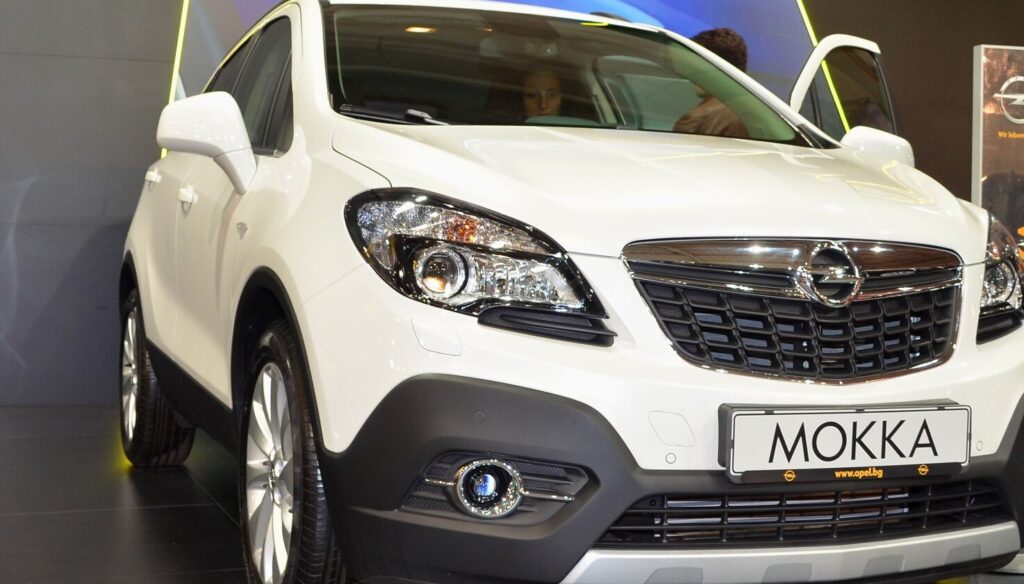
The Opel Mokka 1.7 CDTI (130 hp) Ecotec start/stop was a popular subcompact SUV produced between 2012 and 2015. Positioned as a mid-range offering within the first generation Mokka lineup (J13), it aimed to balance fuel efficiency with reasonable performance for European drivers. The Mokka, Opel’s entry into the rapidly growing crossover segment, was also sold under the Vauxhall brand in the United Kingdom. This particular variant, with its diesel engine and manual transmission, represented a significant portion of Mokka sales, appealing to buyers seeking lower running costs and practicality.
Technical Specifications
| Brand | Opel |
| Model | Mokka |
| Generation | Mokka |
| Type (Engine) | 1.7 CDTI (130 Hp) Ecotec start/stop |
| Start of production | 2012 |
| End of production | 2015 |
| Powertrain Architecture | Internal Combustion engine |
| Body type | SUV |
| Seats | 5 |
| Doors | 5 |
| Fuel consumption (urban) | 5.4 l/100 km (43.6 US mpg) |
| Fuel consumption (extra urban) | 4 l/100 km (58.8 US mpg) |
| Fuel consumption (combined) | 4.5 l/100 km (52.3 US mpg) |
| CO2 emissions | 120 g/km |
| Fuel Type | Diesel |
| Acceleration 0 – 100 km/h | 9.6 sec |
| Acceleration 0 – 62 mph | 9.6 sec |
| Acceleration 0 – 60 mph | 9.1 sec |
| Maximum speed | 193 km/h (119.92 mph) |
| Emission standard | Euro 5 |
| Weight-to-power ratio | 11.5 kg/Hp |
| Weight-to-torque ratio | 5 kg/Nm |
| Power | 130 Hp @ 4000 rpm |
| Torque | 300 Nm @ 2000-2500 rpm (221.27 lb.-ft.) |
| Engine layout | Front, Transverse |
| Engine Model/Code | A17DTS |
| Engine displacement | 1686 cm3 (102.89 cu. in.) |
| Number of cylinders | 4 |
| Engine configuration | Inline |
| Cylinder Bore | 79 mm (3.11 in.) |
| Piston Stroke | 86 mm (3.39 in.) |
| Fuel injection system | Diesel Commonrail |
| Engine aspiration | Turbocharger, Intercooler |
| Engine oil capacity | 4.5 l (4.76 US qt | 3.96 UK qt) |
| Kerb Weight | 1490 kg (3284.89 lbs.) |
| Max. weight | 1959 kg (4318.86 lbs.) |
| Max load | 469 kg (1033.97 lbs.) |
| Trunk (boot) space – minimum | 356 l (12.57 cu. ft.) |
| Trunk (boot) space – maximum | 1372 l (48.45 cu. ft.) |
| Fuel tank capacity | 54 l (14.27 US gal | 11.88 UK gal) |
| Length | 4278 mm (168.43 in.) |
| Width | 1658 mm (65.28 in.) |
| Height | 1777 mm (69.96 in.) |
| Wheelbase | 2555 mm (100.59 in.) |
| Front track | 1540 mm (60.63 in.) |
| Rear (Back) track | 1540 mm (60.63 in.) |
| Minimum turning circle | 10.8 m (35.43 ft.) |
| Drivetrain Architecture | Front wheel drive |
| Number of gears and type of gearbox | 6 gears, manual transmission |
| Front suspension | Independent type McPherson |
| Rear suspension | Semi-independent, coil spring |
| Front brakes | Ventilated discs |
| Rear brakes | Disc |
| Assisting systems | ABS (Anti-lock braking system) |
| Steering type | Steering rack and pinion |
| Tires size | 215/55 R18 |
| Wheel rims size | 18 |
Powertrain & Engine Architecture
The heart of the Mokka 1.7 CDTI was the A17DTS engine, a 1.7-liter inline-four cylinder diesel. This engine was part of Opel/Vauxhall’s ‘Ecotec’ family, emphasizing efficiency and reduced emissions. It utilized a common rail direct injection system, delivering fuel at extremely high pressure for optimized combustion. A turbocharger with an intercooler was employed to boost power output and improve torque across a wider rev range. The engine produced 130 horsepower at 4000 rpm and a respectable 300 Nm (221 lb-ft) of torque between 2000 and 2500 rpm. The six-speed manual transmission was the standard offering for this variant, providing a good balance between fuel economy and driver control. The Start/Stop system, a key feature of the ‘Ecotec’ range, automatically shut off the engine when the vehicle came to a standstill, further enhancing fuel efficiency in urban driving conditions.
Driving Characteristics
The 1.7 CDTI Mokka, with its 130 hp and manual gearbox, offered a practical and economical driving experience. Acceleration from 0-60 mph took around 9.1 seconds, which was adequate for everyday driving but didn’t provide particularly sporty performance. The engine’s torque characteristics meant that it felt reasonably responsive in the mid-range, making overtaking at highway speeds manageable. The six-speed gearbox was well-matched to the engine, allowing drivers to keep the engine in its optimal power band. Compared to the more powerful 1.4 Turbo petrol variants, the 1.7 CDTI prioritized fuel economy over outright performance. The manual transmission also provided a more engaging driving experience than the optional automatic gearbox available on other Mokka trims.
Equipment & Trim Levels
The 1.7 CDTI typically came equipped with a reasonable level of standard features. These included air conditioning, electric front windows, a CD/MP3 stereo system, and ABS brakes. Higher trim levels, such as ‘Sport’ or ‘Cosmo’, added features like alloy wheels, cruise control, parking sensors, and a more sophisticated infotainment system. Interior upholstery was typically cloth, with options for upgraded materials on higher trims. The dashboard layout was functional and straightforward, prioritizing ease of use. Optional extras included a panoramic sunroof, leather seats, and a navigation system.
Chassis & Braking
The Mokka’s chassis featured independent McPherson strut suspension at the front and a semi-independent coil spring setup at the rear. This configuration provided a comfortable ride quality, absorbing bumps and imperfections in the road surface effectively. The front brakes were ventilated discs, offering good stopping power, while the rear brakes were solid discs. ABS (Anti-lock Braking System) was standard, enhancing safety and stability during emergency braking. The steering was a rack and pinion system, providing precise and responsive handling. Stabilizer bars were fitted to both the front and rear axles to reduce body roll during cornering.
Market Reception & Comparison
The Opel Mokka 1.7 CDTI was generally well-received by automotive critics. It was praised for its fuel efficiency, comfortable ride, and practical interior space. However, some reviewers noted that the engine could feel a little underpowered, particularly when fully loaded. Compared to the 1.4 Turbo petrol variants, the 1.7 CDTI offered significantly better fuel economy, making it a popular choice for drivers who covered long distances. The manual transmission was also favored by many drivers over the optional automatic, offering a more engaging driving experience. Reliability reports were generally positive, with the A17DTS engine proving to be a durable and dependable unit.
Legacy
The Opel Mokka 1.7 CDTI remains a relatively common sight on European roads today. The A17DTS engine has proven to be a robust and reliable powertrain, with many examples exceeding high mileage without major issues. In the used car market, this variant offers a good balance of affordability, fuel efficiency, and practicality. While not the most exciting vehicle to drive, the Mokka 1.7 CDTI represents a sensible and economical choice for buyers seeking a compact SUV. Its success helped establish the Mokka as a key model in Opel’s lineup and paved the way for the second-generation Mokka, which continues to build on the original’s strengths.
