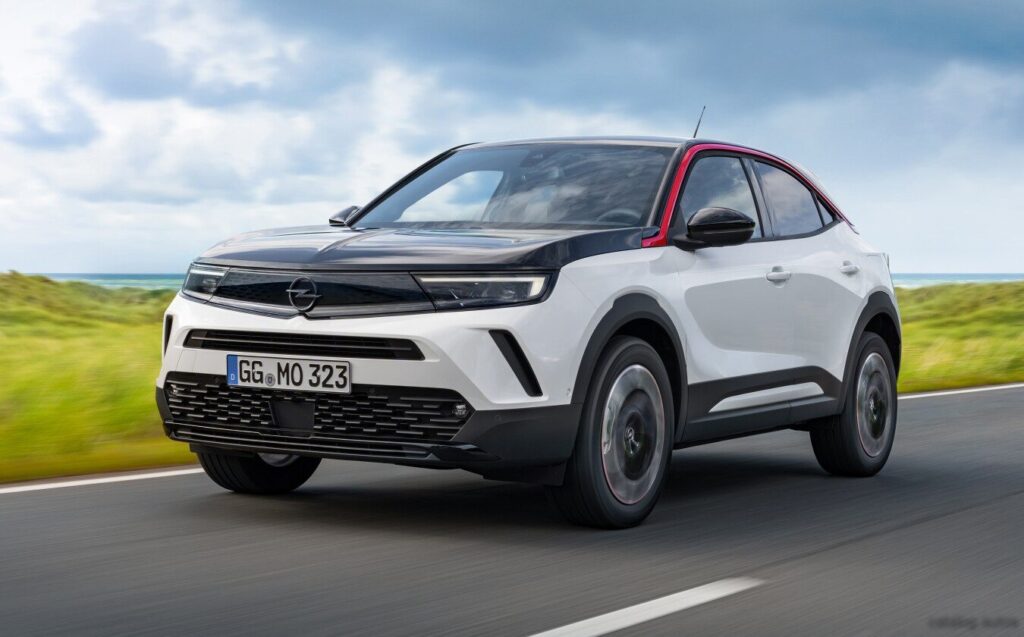
The Opel Mokka B 1.2 Turbo (130 hp) Automatic, produced from 2020 through October 2024, represents a key variant within the second generation of Opel’s popular subcompact SUV. Positioned as a mid-range offering, this model aimed to balance fuel efficiency with adequate performance for everyday driving. It’s built on the Common Modular Platform (CMP) shared with other Stellantis brands, and was a significant step forward in design and technology for the Mokka line, moving away from the more conservative styling of its predecessor. The Mokka B was primarily marketed in Europe, offering a competitive option in the rapidly growing B-SUV segment.
Technical Specifications
| Brand | Opel |
| Model | Mokka |
| Generation | Mokka B |
| Type (Engine) | 1.2 Turbo (130 Hp) Automatic |
| Start of production | 2020 |
| End of production | October, 2024 |
| Powertrain Architecture | Internal Combustion engine |
| Body type | SUV |
| Seats | 5 |
| Doors | 5 |
| Combined fuel consumption (WLTP) | 5.9-6 l/100 km (39.9 – 39.2 US mpg, 47.9 – 47.1 UK mpg, 16.9 – 16.7 km/l) |
| CO2 emissions (WLTP) | 133-135 g/km |
| Fuel consumption (economy) – urban (NEDC) | 5.9 l/100 km (39.9 US mpg, 47.9 UK mpg, 16.9 km/l) |
| Fuel consumption (economy) – extra urban (NEDC) | 4.2 l/100 km (56 US mpg, 67.3 UK mpg, 23.8 km/l) |
| Fuel consumption (economy) – combined (NEDC) | 4.8 l/100 km (49 US mpg, 58.9 UK mpg, 20.8 km/l) |
| CO2 emissions (NEDC) | 111 g/km |
| Fuel Type | Petrol (Gasoline) |
| Acceleration 0 – 100 km/h | 9.2 sec |
| Acceleration 0 – 62 mph | 9.2 sec |
| Acceleration 0 – 60 mph | 8.7 sec |
| Maximum speed | 200 km/h (124.27 mph) |
| Emission standard | Euro 6d |
| Weight-to-power ratio | 9.4 kg/Hp, 106.6 Hp/tonne |
| Weight-to-torque ratio | 5.3 kg/Nm, 188.5 Nm/tonne |
| Power | 130 Hp @ 5500 rpm |
| Power per litre | 108.4 Hp/l |
| Torque | 230 Nm @ 1750 rpm (169.64 lb.-ft. @ 1750 rpm) |
| Engine layout | Front, Transverse |
| Engine Model/Code | F12XHT |
| Engine displacement | 1199 cm3 (73.17 cu. in.) |
| Number of cylinders | 3 |
| Engine configuration | Inline |
| Number of valves per cylinder | 4 |
| Fuel injection system | Direct injection |
| Engine aspiration | Turbocharger, Intercooler |
| Valvetrain | DOHC |
| Engine oil capacity | 3.5 l (3.7 US qt | 3.08 UK qt) |
| Kerb Weight | 1220 kg (2689.64 lbs.) |
| Max. weight | 1740 kg (3836.04 lbs.) |
| Max load | 520 kg (1146.4 lbs.) |
| Trunk (boot) space – minimum | 350 l (12.36 cu. ft.) |
| Trunk (boot) space – maximum | 1105 l (39.02 cu. ft.) |
| Fuel tank capacity | 44 l (11.62 US gal | 9.68 UK gal) |
| Max. roof load | 70 kg (154.32 lbs.) |
| Permitted trailer load with brakes (12%) | 1200 kg (2645.55 lbs.) |
| Permitted trailer load without brakes | 640 kg (1410.96 lbs.) |
| Permitted towbar download | 55 kg (121.25 lbs.) |
| Length | 4151 mm (163.43 in.) |
| Width | 1791 mm (70.51 in.) |
| Width including mirrors | 1987 mm (78.23 in.) |
| Height | 1531 mm (60.28 in.) |
| Wheelbase | 2557 mm (100.67 in.) |
| Front track | 1548 mm (60.94 in.) |
| Rear (Back) track | 1548 mm (60.94 in.) |
| Drag coefficient (Cd) | 0.32 |
| Minimum turning circle (turning diameter) | 11.08 m (36.35 ft.) |
| Drivetrain Architecture | The Internal combustion engine (ICE) drives the front wheels of the vehicle. |
| Drive wheel | Front wheel drive |
| Number of gears and type of gearbox | 8 gears, automatic transmission |
Powertrain & Engine Architecture
The heart of the Mokka B 1.2 Turbo Automatic is the F12XHT engine, a 1.2-liter, three-cylinder turbocharged gasoline engine. This engine is part of Stellantis’s “PureTech” family, known for its compact size and efficiency. It utilizes direct fuel injection, delivering fuel directly into the combustion chamber for improved combustion and reduced emissions. The engine also features a single-scroll turbocharger with an intercooler, enhancing power output. The valvetrain employs a Dual Overhead Camshaft (DOHC) configuration with four valves per cylinder, optimizing airflow for increased performance. Paired with this engine is an eight-speed automatic transmission (typically an Aisin-sourced unit), chosen for its smooth shifting and contribution to fuel economy. This transmission offers a wide range of gear ratios, allowing the engine to operate efficiently across various driving conditions.
Driving Characteristics
The 130 hp output and 230 Nm (169.64 lb-ft) of torque provide adequate, though not exhilarating, performance. Acceleration from 0-100 km/h (0-62 mph) takes around 9.2 seconds. The automatic transmission is tuned for comfort and efficiency, prioritizing smooth gear changes over aggressive downshifts. Compared to the manual transmission version, the automatic offers convenience, particularly in urban environments, but sacrifices some responsiveness. Higher-output versions of the Mokka B, such as those with more powerful gasoline engines or the all-electric variant, offer significantly quicker acceleration. The 1.2 Turbo Automatic is best suited for drivers prioritizing fuel economy and ease of use over sporty driving dynamics. The gear ratios are optimized for mid-range torque, making it feel reasonably capable during overtaking maneuvers on the highway.
Equipment & Trim Levels
The 1.2 Turbo Automatic trim typically included standard features such as air conditioning, a touchscreen infotainment system with Apple CarPlay and Android Auto compatibility, lane departure warning, automatic emergency braking, and cruise control. Interior upholstery was generally cloth, with options for upgraded materials like leatherette available. Higher trim levels added features like a larger touchscreen, heated seats, a panoramic sunroof, and advanced driver-assistance systems (ADAS) such as adaptive cruise control and blind-spot monitoring. Exterior options included various wheel designs, paint colors, and styling packages.
Chassis & Braking
The Mokka B utilizes a front-wheel-drive platform with a MacPherson strut suspension in the front and a torsion beam suspension in the rear. This setup provides a comfortable ride quality, suitable for everyday driving. Braking systems typically consisted of disc brakes on the front wheels and drum brakes on the rear wheels, although some higher trim levels featured disc brakes all around. Anti-lock Braking System (ABS) and Electronic Stability Control (ESC) were standard safety features. Stabilizer bars were included to reduce body roll during cornering.
Market Reception & Comparison
The Opel Mokka B 1.2 Turbo Automatic received generally positive reviews, with critics praising its stylish design, comfortable interior, and fuel efficiency. However, some reviewers noted that the engine could feel strained when fully loaded or driving uphill. Compared to other B-SUVs like the Renault Captur or Peugeot 2008, the Mokka B offered a competitive package in terms of price, features, and fuel economy. The 1.8L diesel variants offered better fuel economy, but at the cost of increased complexity and potential maintenance issues. The petrol automatic was often seen as a good all-rounder for drivers who didn’t prioritize outright performance.
Legacy
The F12XHT engine has proven to be relatively reliable, although some owners have reported issues with the turbocharger and fuel injectors. The eight-speed automatic transmission has also generally been dependable. On the used car market, the Mokka B 1.2 Turbo Automatic holds its value reasonably well, thanks to its popularity and fuel efficiency. It remains a viable option for buyers seeking a stylish and practical subcompact SUV, offering a good balance of features and affordability.