
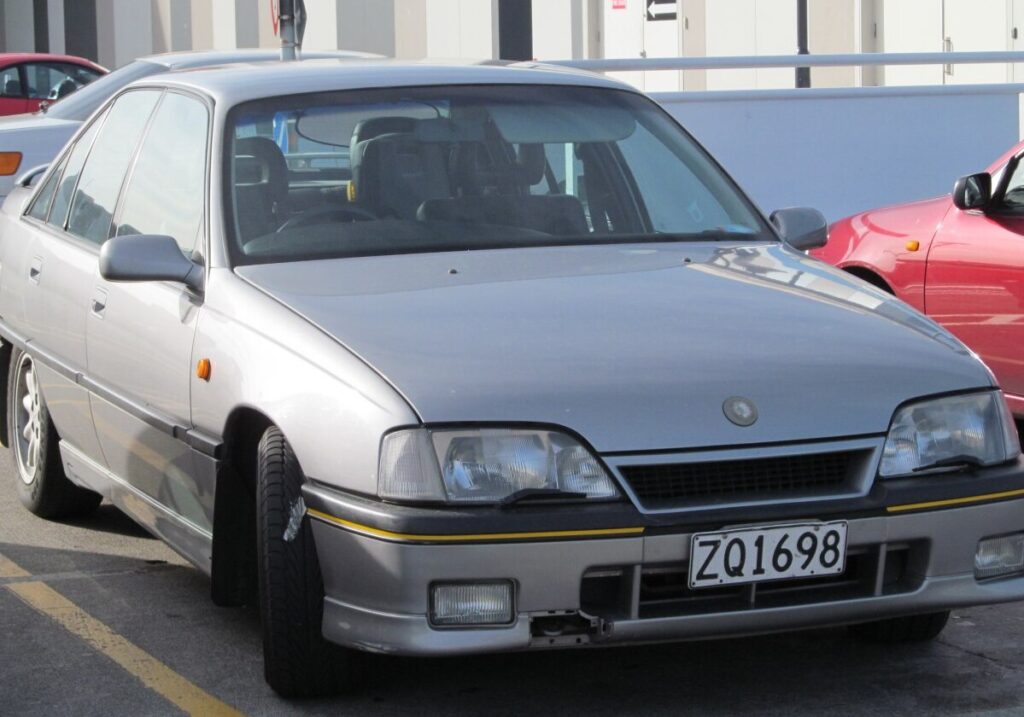
The Opel Omega A 1.8 S Automatic, produced between 1987 and 1989, represented the entry-level powertrain option for Opel’s flagship sedan. Positioned within the first generation (Omega A) of the Omega line, this variant aimed to provide comfortable, reliable transportation for families and business users. It served as a more affordable alternative to the higher-performance and more luxurious Omega models equipped with larger engines and manual transmissions. The Omega A, built on the GM V platform (also known as the 1HX0/A3 platform), was Opel’s replacement for the Rekord series, signifying a move upmarket in terms of size and sophistication.
Technical Specifications
| Brand | Opel |
| Model | Omega |
| Generation | Omega A |
| Type (Engine) | 1.8 S (88 Hp) Automatic |
| Start of production | 1987 |
| End of production | 1989 |
| Powertrain Architecture | Internal Combustion engine |
| Body type | Sedan |
| Seats | 5 |
| Doors | 4 |
| Fuel consumption (urban) | 10.1 l/100 km (23.3 US mpg / 28 UK mpg / 9.9 km/l) |
| Fuel consumption (extra urban) | 5.7 l/100 km (41.3 US mpg / 49.6 UK mpg / 17.5 km/l) |
| Fuel consumption (combined) | 7.3 l/100 km (32.2 US mpg / 38.7 UK mpg / 13.7 km/l) |
| Fuel Type | Petrol (Gasoline) |
| Acceleration 0 – 100 km/h | 15.5 sec |
| Acceleration 0 – 62 mph | 15.5 sec |
| Acceleration 0 – 60 mph | 14.7 sec |
| Maximum speed | 183 km/h (113.71 mph) |
| Weight-to-power ratio | 13.8 kg/Hp, 72.4 Hp/tonne |
| Weight-to-torque ratio | 8.5 kg/Nm, 117.7 Nm/tonne |
| Power | 88 Hp @ 5200 rpm |
| Power per litre | 49 Hp/l |
| Torque | 143 Nm @ 3200 rpm (105.47 lb.-ft. @ 3200 rpm) |
| Engine layout | Front, Longitudinal |
| Engine Model/Code | E18NVR |
| Engine displacement | 1796 cm3 (109.6 cu. in.) |
| Number of cylinders | 4 |
| Engine configuration | Inline |
| Cylinder Bore | 84.8 mm (3.34 in.) |
| Piston Stroke | 79.5 mm (3.13 in.) |
| Compression ratio | 9.2:1 |
| Number of valves per cylinder | 2 |
| Fuel injection system | Carburettor |
| Engine aspiration | Naturally aspirated |
| Engine oil capacity | 4.5 l (4.76 US qt | 3.96 UK qt) |
| Coolant capacity | 6.4 l (6.76 US qt | 5.63 UK qt) |
| Kerb Weight | 1215 kg (2678.62 lbs.) |
| Max. weight | 1770 kg (3902.18 lbs.) |
| Max load | 555 kg (1223.57 lbs.) |
| Trunk (boot) space – minimum | 520 l (18.36 cu. ft.) |
| Trunk (boot) space – maximum | 870 l (30.72 cu. ft.) |
| Fuel tank capacity | 75 l (19.81 US gal | 16.5 UK gal) |
| Length | 4740 mm (186.61 in.) |
| Width | 1760 mm (69.29 in.) |
| Height | 1445 mm (56.89 in.) |
| Wheelbase | 2730 mm (107.48 in.) |
| Front track | 1445 mm (56.89 in.) |
| Rear track | 1460 mm (57.48 in.) |
| Drivetrain Architecture | Rear wheel drive |
| Number of gears | 4 |
| Gearbox type | Automatic transmission |
| Front suspension | Spring Strut |
| Rear suspension | Wishbone |
| Front brakes | Ventilated discs |
| Rear brakes | Disc |
| Assisting systems | ABS (Anti-lock braking system), Hydraulic Power Steering |
| Tires size | 185/70 R14 |
| Wheel rims size | 14 |
Powertrain & Engine Architecture
The heart of the Omega A 1.8 S Automatic is the E18NVR engine, a 1.8-liter (1796 cc) inline-four cylinder gasoline engine. This engine, a mainstay of Opel’s lineup during the 1980s, featured a relatively simple carbureted fuel injection system. While not as sophisticated as later multi-point injection systems, the carburetor provided adequate fuel delivery for the engine’s modest power output. The engine utilized a two-valve-per-cylinder (SOHC) valvetrain, contributing to its simplicity and ease of maintenance. The engine’s longitudinal mounting within the engine bay, coupled with rear-wheel drive, was a traditional configuration for European sedans of this era. The four-speed automatic transmission, while providing convenience, was not known for its responsiveness or fuel efficiency compared to manual transmissions. It was a typical three-speed automatic with an overdrive fourth gear.
Driving Characteristics
The 1.8-liter engine, producing 88 horsepower and 105 lb-ft of torque, delivered adequate but uninspiring performance in the Omega A. Acceleration from 0-60 mph took around 14.7 seconds, and top speed was approximately 114 mph. The automatic transmission further dampened performance, with noticeable delays in downshifting and a tendency to hunt for gears under hard acceleration. Compared to the more powerful 2.0-liter or 2.3-liter Omega variants, the 1.8 S Automatic felt noticeably slower. The rear-wheel-drive configuration provided balanced handling, but the relatively soft suspension tuning prioritized comfort over sporty handling. The gear ratios were optimized for cruising, making it a comfortable highway car, but less engaging on winding roads.
Equipment & Trim Levels
The 1.8 S Automatic trim level was considered the base model for the Omega A. Standard equipment typically included cloth upholstery, basic instrumentation, and manual windows and door locks. Power steering and ABS were often included, but air conditioning and other comfort features were usually optional extras. Interior trim was generally functional and durable, but lacked the refinement of higher-spec Omega models. Optional extras included upgraded audio systems, sunroofs, and more luxurious interior trim options.
Chassis & Braking
The Omega A featured a traditional body-on-frame construction, providing a robust and durable chassis. The front suspension utilized MacPherson struts, while the rear suspension employed a multi-link wishbone setup. Braking duties were handled by ventilated discs at the front and solid discs at the rear. The braking system, while adequate for normal driving conditions, lacked the stopping power of more modern braking systems. Stabilizer bars were fitted to both the front and rear axles to reduce body roll during cornering.
Market Reception & Comparison
The Opel Omega A 1.8 S Automatic was generally well-received as a comfortable and reliable family sedan. Critics praised its spacious interior, comfortable ride, and relatively affordable price. However, the engine’s lack of power and the automatic transmission’s sluggishness were common criticisms. Compared to the 2.0-liter and 2.3-liter Omega models, the 1.8 S Automatic offered lower running costs due to its smaller engine and simpler mechanicals. Fuel economy was reasonable for the time, averaging around 32 mpg on the combined cycle. The 1.8L engine was often seen as a good choice for drivers prioritizing economy and ease of use over performance.
Legacy
The Opel Omega A 1.8 S Automatic, while not a performance icon, remains a relatively reliable and affordable classic car. The E18NVR engine is known for its durability, and parts availability is generally good. However, age-related issues such as corrosion and wear and tear on rubber components are common. In the used car market, these Omegas are often sought after by enthusiasts looking for a classic European sedan with a simple and reliable powertrain. The automatic transmission, while not particularly sophisticated, is generally durable if properly maintained. Today, the Omega A 1.8 S Automatic represents a piece of automotive history, offering a glimpse into the design and engineering of European sedans from the late 1980s.
