
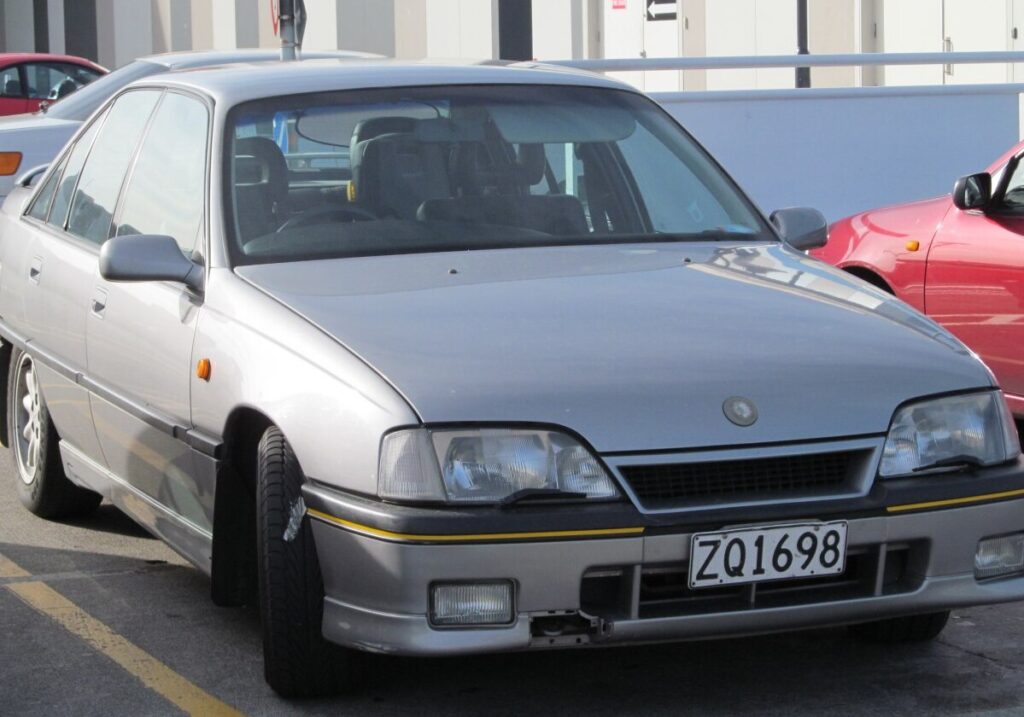
The Opel Omega A 2.4i CAT, produced between 1988 and 1993, represented a significant step forward for Opel’s flagship sedan. Positioned as a mid-range offering within the Omega A lineup – which also included 2.0L and 3.0L variants – the 2.4i CAT aimed to balance performance with affordability and fuel efficiency. It was a key model for Opel, intended to compete with established executive cars in the European market, offering a spacious interior and comfortable ride. The “CAT” designation refers to the catalytic converter, indicating an effort to meet increasingly stringent emissions regulations of the time.
Technical Specifications
| Brand | Opel |
| Model | Omega |
| Generation | Omega A |
| Type (Engine) | 2.4i CAT (125 Hp) |
| Start of production | 1988 |
| End of production | 1993 |
| Powertrain Architecture | Internal Combustion engine |
| Body type | Sedan |
| Seats | 5 |
| Doors | 4 |
| Fuel consumption (urban) | 12.8 l/100 km (18.4 US mpg) |
| Fuel consumption (extra urban) | 6.8 l/100 km (34.6 US mpg) |
| Fuel consumption (combined) | 8.3 l/100 km (28.3 US mpg) |
| Fuel Type | Petrol (Gasoline) |
| Acceleration 0 – 100 km/h | 10.8 sec |
| Acceleration 0 – 62 mph | 10.8 sec |
| Acceleration 0 – 60 mph | 10.3 sec |
| Maximum speed | 200 km/h (124.27 mph) |
| Weight-to-power ratio | 10.6 kg/Hp |
| Weight-to-torque ratio | 6.8 kg/Nm |
| Power | 125 Hp @ 4800 rpm |
| Torque | 195 Nm @ 2400 rpm (143.82 lb.-ft. @ 2400 rpm) |
| Engine layout | Front, Longitudinal |
| Engine Model/Code | C24NE |
| Engine displacement | 2410 cm3 (147.07 cu. in.) |
| Number of cylinders | 4 |
| Engine configuration | Inline |
| Cylinder Bore | 95 mm (3.74 in.) |
| Piston Stroke | 85 mm (3.35 in.) |
| Compression ratio | 9.2:1 |
| Number of valves per cylinder | 2 |
| Fuel injection system | Multi-port manifold injection |
| Engine aspiration | Naturally aspirated engine |
| Valvetrain | SOHC |
| Engine oil capacity | 4.5 l (4.76 US qt | 3.96 UK qt) |
| Coolant capacity | 7.8 l (8.24 US qt | 6.86 UK qt) |
| Kerb Weight | 1330 kg (2932.15 lbs.) |
| Max. weight | 1870 kg (4122.64 lbs.) |
| Max load | 540 kg (1190.5 lbs.) |
| Trunk (boot) space – minimum | 520 l (18.36 cu. ft.) |
| Trunk (boot) space – maximum | 870 l (30.72 cu. ft.) |
| Fuel tank capacity | 75 l (19.81 US gal | 16.5 UK gal) |
| Length | 4740 mm (186.61 in.) |
| Width | 1760 mm (69.29 in.) |
| Height | 1445 mm (56.89 in.) |
| Wheelbase | 2730 mm (107.48 in.) |
| Front track | 1445 mm (56.89 in.) |
| Rear track | 1460 mm (57.48 in.) |
| Minimum turning circle | 10.8 m (35.43 ft.) |
| Drivetrain Architecture | Rear wheel drive |
| Number of gears | 5 gears, manual transmission |
| Front suspension | Spring Strut |
| Rear suspension | Wishbone |
| Front brakes | Ventilated discs |
| Rear brakes | Disc |
| Assisting systems | ABS (Anti-lock braking system), Hydraulic Steering |
| Tires size | 195/65 R15 |
| Wheel rims size | 7J x 15 |
Powertrain & Engine Architecture
The heart of the Omega A 2.4i CAT was the C24NE engine, a 2.4-liter inline-four cylinder powerplant. This engine featured a single overhead camshaft (SOHC) valvetrain operating two valves per cylinder. It utilized Bosch multi-port fuel injection, a significant improvement over earlier carburetor-based systems, contributing to better fuel economy and reduced emissions. The catalytic converter, as indicated by the “CAT” designation, was a crucial component in meeting European emission standards. The engine produced 125 horsepower at 4800 rpm and 195 Nm (144 lb-ft) of torque at 2400 rpm. The engine was mounted longitudinally in the front of the vehicle, driving the rear wheels. The five-speed manual transmission was the standard offering, providing a balance between performance and fuel efficiency. While an automatic transmission was available, it was less common and often considered to diminish the driving experience.
Driving Characteristics
The 2.4i CAT offered a comfortable and refined driving experience, typical of a large Opel sedan. Acceleration from 0 to 60 mph took around 10.3 seconds, and it had a top speed of 124 mph. While not a sports car, the engine provided adequate power for highway cruising and overtaking. The manual transmission allowed for greater driver control, while the automatic, when equipped, prioritized ease of use. Compared to the 2.0L models, the 2.4i offered noticeably more power and torque, resulting in improved acceleration and a more relaxed driving experience at higher speeds. However, it lacked the outright performance of the 3.0L straight-six engine, which was the top-of-the-line option. The rear-wheel-drive configuration provided balanced handling, although it wasn’t as nimble as front-wheel-drive competitors.
Equipment & Trim Levels
The Omega A 2.4i CAT typically came with a reasonable level of standard equipment. This included central locking, electric windows, power steering, and an adjustable steering column. Interior upholstery was typically cloth, although leather options were available. Dashboard design was functional and straightforward, reflecting the car’s focus on practicality. Optional extras included a sunroof, upgraded audio systems, and air conditioning. The trim level often dictated the availability of these features, with higher trims offering more luxurious appointments.
Chassis & Braking
The Omega A featured a robust chassis with independent suspension at the front using spring struts and a wishbone setup at the rear. This suspension configuration provided a comfortable ride, absorbing bumps and imperfections in the road effectively. Braking was handled by ventilated discs at the front and solid discs at the rear. Anti-lock braking system (ABS) was standard, enhancing safety by preventing wheel lockup during hard braking. The car rode on 195/65 R15 tires, providing a good balance between grip and ride comfort.
Market Reception & Comparison
The Opel Omega A 2.4i CAT was generally well-received by automotive critics. It was praised for its spacious interior, comfortable ride, and relatively affordable price point. However, some critics noted that the styling was somewhat conservative compared to its rivals. In terms of fuel economy, the 2.4i CAT offered a reasonable compromise between performance and efficiency, achieving around 28.3 US mpg on the combined cycle. Compared to the 2.0L models, the 2.4i offered better performance with a slight penalty in fuel economy. The 3.0L models, while more powerful, were significantly more expensive and consumed more fuel.
Legacy
The Opel Omega A 2.4i CAT remains a relatively reliable and affordable classic car today. The C24NE engine is known for its durability, and parts availability is generally good. However, like any older vehicle, it requires regular maintenance to keep it in good condition. Rust can be a concern, particularly in areas with harsh winters. The Omega A 2.4i CAT represents a solid and dependable choice for those seeking a comfortable and spacious classic sedan, offering a taste of 1980s/early 1990s German engineering.
