
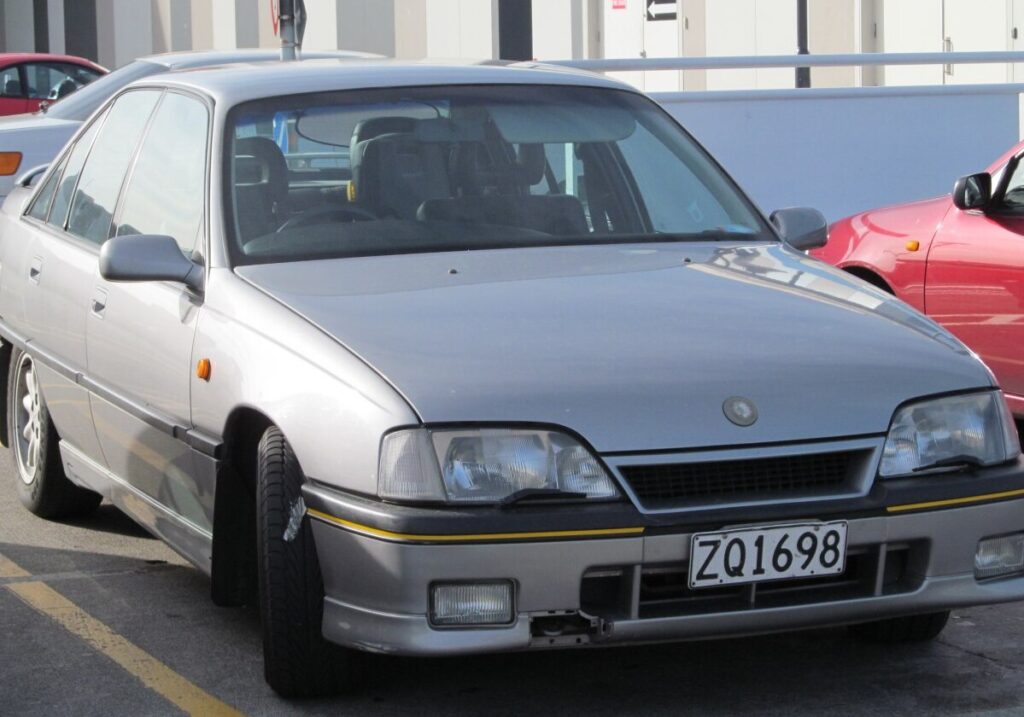
The Opel Omega A 3.0 24V, produced between 1989 and 1993, represented the flagship sedan offering from Opel during that period. Positioned as a premium executive car, it aimed to compete with models like the Ford Granada and BMW 5 Series. This particular variant, equipped with the 3.0-liter inline-six engine and a four-speed automatic transmission, was a mid-to-high range offering within the Omega A lineup, prioritizing comfort and effortless cruising over outright sporting performance. It was a key model in Opel’s attempt to establish a stronger presence in the upper-midsize segment, particularly in European markets.
Technical Specifications
| Brand | Opel |
| Model | Omega |
| Generation | Omega A |
| Type (Engine) | 3.0 24V 3000 CAT (204 Hp) Automatic |
| Start of production | 1989 |
| End of production | 1993 |
| Powertrain Architecture | Internal Combustion engine |
| Body type | Sedan |
| Seats | 5 |
| Doors | 4 |
| Fuel consumption (urban) | 14.5 l/100 km (16.2 US mpg, 19.5 UK mpg) |
| Fuel consumption (extra urban) | 7.9 l/100 km (29.8 US mpg, 35.8 UK mpg) |
| Fuel consumption (combined) | 9 l/100 km (26.1 US mpg, 31.4 UK mpg) |
| Fuel Type | Petrol (Gasoline) |
| Acceleration 0 – 100 km/h | 8.2 sec |
| Acceleration 0 – 62 mph | 8.2 sec |
| Acceleration 0 – 60 mph | 7.8 sec |
| Maximum speed | 235 km/h (146.02 mph) |
| Weight-to-power ratio | 7.1 kg/Hp |
| Weight-to-torque ratio | 5.4 kg/Nm |
| Power | 204 Hp @ 6000 rpm |
| Torque | 270 Nm @ 3600 rpm (199.14 lb.-ft. @ 3600 rpm) |
| Engine layout | Front, Longitudinal |
| Engine Model/Code | C30SE |
| Engine displacement | 2969 cm3 (181.18 cu. in.) |
| Number of cylinders | 6 |
| Engine configuration | Inline |
| Cylinder Bore | 95 mm (3.74 in.) |
| Piston Stroke | 69.8 mm (2.75 in.) |
| Compression ratio | 10:1 |
| Number of valves per cylinder | 4 |
| Fuel injection system | Multi-port manifold injection |
| Engine aspiration | Naturally aspirated |
| Engine oil capacity | 5.5 l (5.81 US qt, 4.84 UK qt) |
| Coolant capacity | 9.8 l (10.36 US qt, 8.62 UK qt) |
| Kerb Weight | 1450 kg (3196.7 lbs.) |
| Max. weight | 1970 kg (4343.11 lbs.) |
| Max load | 520 kg (1146.4 lbs.) |
| Trunk (boot) space – minimum | 520 l (18.36 cu. ft.) |
| Trunk (boot) space – maximum | 870 l (30.72 cu. ft.) |
| Fuel tank capacity | 75 l (19.81 US gal, 16.5 UK gal) |
| Length | 4740 mm (186.61 in.) |
| Width | 1760 mm (69.29 in.) |
| Height | 1445 mm (56.89 in.) |
| Wheelbase | 2730 mm (107.48 in.) |
| Front track | 1445 mm (56.89 in.) |
| Rear track | 1460 mm (57.48 in.) |
| Drivetrain Architecture | Rear wheel drive |
| Number of gears | 4 |
| Gearbox type | Automatic transmission |
| Front suspension | Spring Strut |
| Rear suspension | Wishbone |
| Front brakes | Ventilated discs |
| Rear brakes | Disc |
| Assisting systems | ABS (Anti-lock braking system), Hydraulic Power Steering |
| Tires size | 205/65 R15 |
| Wheel rims size | 7J x 15 |
INTRODUCTION
The Opel Omega A, launched in 1986, was a significant departure from its predecessor, the Opel Rekord. The 3.0 24V variant, produced from 1989-1993, represented a refined and powerful iteration of the Omega A. It was built on Opel’s ‘GM V platform’ (also known as the 1HX0/A3 platform), shared with other General Motors vehicles like the Saab 9000 and Vauxhall Carlton. This platform allowed for a spacious interior and a comfortable ride, key attributes for the target market of executive drivers and families seeking a large, reliable sedan. The 3.0 24V Automatic was positioned as a comfortable, well-equipped option, appealing to buyers who prioritized ease of driving over sporty handling.
Powertrain & Engine Architecture
The heart of the Omega A 3.0 24V is the C30SE engine, a 2,969 cc inline-six cylinder powerplant. This engine featured a dual overhead camshaft (DOHC) valvetrain with four valves per cylinder, contributing to its relatively high output for the time. The engine utilized Bosch Motronic fuel injection, a multi-port system that precisely meters fuel delivery for optimal performance and efficiency. The ‘24V’ designation refers to the total number of valves in the engine. The engine’s longitudinal mounting allowed for a rear-wheel-drive configuration, a traditional layout favored for its balanced handling characteristics. Paired with the C30SE was a four-speed automatic transmission, providing smooth and effortless gear changes. This transmission, while not known for its sportiness, was durable and well-suited to the engine’s torque curve.
Driving Characteristics
The Omega A 3.0 24V Automatic offered a distinctly comfortable and refined driving experience. The automatic transmission, while lacking the responsiveness of a manual gearbox, provided smooth acceleration and made it ideal for long-distance cruising. The 204 horsepower and 270 Nm (199 lb-ft) of torque provided ample power for overtaking and maintaining highway speeds. However, the car’s weight (1450 kg / 3197 lbs) meant that acceleration wasn’t particularly brisk compared to more modern vehicles. Compared to the manual transmission versions of the 3.0, the automatic sacrificed some performance, but gained in ease of use. Compared to the lower-powered 1.8 and 2.0-liter variants, the 3.0 offered a significant performance upgrade, but at the cost of increased fuel consumption.
Equipment & Trim Levels
The 3.0 24V Automatic typically came well-equipped, reflecting its position as a premium model. Standard features often included central locking, electric windows, power steering, and an anti-lock braking system (ABS). Interior upholstery was typically cloth, but leather options were available. Dashboard configuration was functional and straightforward, with a focus on ergonomics. Optional extras included a sunroof, upgraded audio systems, and climate control. The trim level often dictated the availability of these options, with higher trims offering more standard features.
Chassis & Braking
The Omega A featured a conventional chassis layout with a spring strut front suspension and a wishbone rear suspension. This setup prioritized ride comfort over sharp handling. The car was equipped with ventilated disc brakes at the front and solid disc brakes at the rear, providing adequate stopping power for its weight and performance. The ABS system further enhanced braking safety. Stabilizer bars were fitted to both the front and rear axles to reduce body roll during cornering, but the Omega A was not designed to be a particularly sporty vehicle.
Market Reception & Comparison
The Opel Omega A 3.0 24V Automatic was generally well-received by automotive critics. It was praised for its comfortable ride, spacious interior, and refined engine. However, some critics noted its relatively high fuel consumption and lack of sporty handling. Compared to rivals like the Ford Granada and BMW 5 Series, the Omega A offered a compelling value proposition, providing a similar level of comfort and features at a lower price point. Fuel economy was a common criticism, with the combined cycle figure of 9 l/100 km (26.1 US mpg) being relatively high for the time. Reliability was generally good, although maintenance costs could be higher than for smaller, less complex vehicles.
Legacy
The Opel Omega A 3.0 24V, while not a groundbreaking vehicle, remains a fondly remembered classic among enthusiasts. The C30SE engine is known for its durability and smooth operation. Today, well-maintained examples are becoming increasingly collectible. The automatic transmission, while not the most desirable configuration for performance enthusiasts, is generally reliable if properly maintained. The Omega A 3.0 24V represents a high point in Opel’s engineering and design, offering a blend of comfort, performance, and practicality that continues to appeal to drivers today. Finding parts can be challenging, but a dedicated community of owners and specialists helps to keep these cars on the road.
