
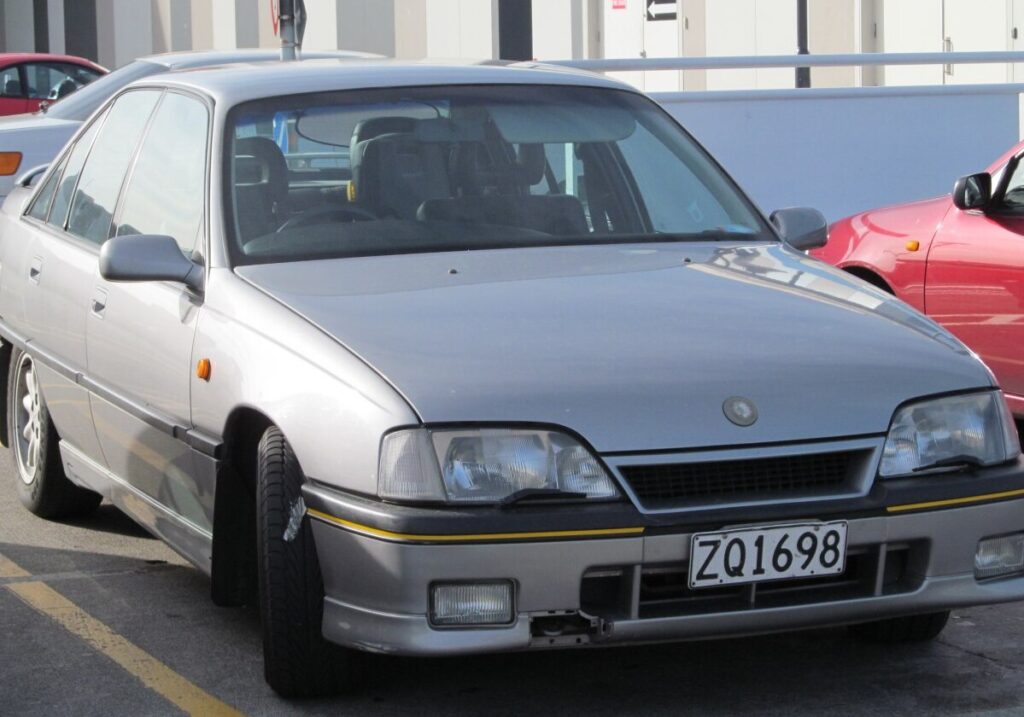
The Opel Omega A 3.0, produced between 1987 and 1988, represented the top-of-the-line offering in Opel’s flagship sedan range. Positioned as a premium executive car, the 3.0-liter variant with an automatic transmission aimed to provide a blend of performance and comfort. It was part of the first generation (Omega A) of the Omega line, which succeeded the Opel Commodore and Rekord. The Omega A was Opel’s attempt to compete with established luxury sedans from BMW and Mercedes-Benz, offering a spacious interior and a relatively modern design for its time. This particular 3.0L automatic configuration was the highest trim level available during its short production run.
Technical Specifications
| Brand | Opel |
| Model | Omega |
| Generation | Omega A |
| Type (Engine) | 3.0 3000 (177 Hp) Automatic |
| Start of production | 1987 |
| End of production | 1988 |
| Powertrain Architecture | Internal Combustion engine |
| Body type | Sedan |
| Seats | 5 |
| Doors | 4 |
| Fuel consumption (urban) | 15.2 l/100 km (15.5 US mpg, 18.6 UK mpg, 6.6 km/l) |
| Fuel consumption (extra urban) | 7.4 l/100 km (31.8 US mpg, 38.2 UK mpg, 13.5 km/l) |
| Fuel consumption (combined) | 9 l/100 km (26.1 US mpg, 31.4 UK mpg, 11.1 km/l) |
| Fuel Type | Petrol (Gasoline) |
| Acceleration 0 – 100 km/h | 9.8 sec |
| Acceleration 0 – 62 mph | 9.8 sec |
| Acceleration 0 – 60 mph | 9.3 sec |
| Maximum speed | 222 km/h (137.94 mph) |
| Weight-to-power ratio | 8.1 kg/Hp, 123.3 Hp/tonne |
| Weight-to-torque ratio | 6 kg/Nm, 167.2 Nm/tonne |
| Power | 177 Hp @ 5800 rpm |
| Power per litre | 59.6 Hp/l |
| Torque | 240 Nm @ 4200 rpm (177.01 lb.-ft. @ 4200 rpm) |
| Engine layout | Front, Longitudinal |
| Engine Model/Code | 30NE |
| Engine displacement | 2969 cm3 (181.18 cu. in.) |
| Number of cylinders | 6 |
| Engine configuration | Inline |
| Cylinder Bore | 95 mm (3.74 in.) |
| Piston Stroke | 69.8 mm (2.75 in.) |
| Compression ratio | 9.2:1 |
| Number of valves per cylinder | 2 |
| Fuel injection system | Multi-port manifold injection |
| Engine aspiration | Naturally aspirated engine |
| Engine oil capacity | 5.5 l (5.81 US qt | 4.84 UK qt) |
| Coolant capacity | 10.2 l (10.78 US qt | 8.97 UK qt) |
| Kerb Weight | 1435 kg (3163.63 lbs.) |
| Max. weight | 1955 kg (4310.04 lbs.) |
| Max load | 520 kg (1146.4 lbs.) |
| Trunk (boot) space – minimum | 520 l (18.36 cu. ft.) |
| Trunk (boot) space – maximum | 870 l (30.72 cu. ft.) |
| Fuel tank capacity | 75 l (19.81 US gal | 16.5 UK gal) |
| Length | 4740 mm (186.61 in.) |
| Width | 1760 mm (69.29 in.) |
| Height | 1445 mm (56.89 in.) |
| Wheelbase | 2730 mm (107.48 in.) |
| Front track | 1445 mm (56.89 in.) |
| Rear (Back) track | 1460 mm (57.48 in.) |
| Drivetrain Architecture | Rear wheel drive |
| Drive wheel | Rear wheel drive |
| Number of gears and type of gearbox | 4 gears, automatic transmission |
| Front suspension | Spring Strut |
| Rear suspension | Wishbone |
| Front brakes | Disc |
| Rear brakes | Disc |
| Assisting systems | ABS (Anti-lock braking system), Hydraulic Steering |
| Tires size | 195/65 R15 |
| Wheel rims size | 7J x 15 |
Powertrain & Engine Architecture
The heart of the Omega A 3.0 was the 30NE engine, a 2.969-liter inline-six cylinder gasoline engine. This engine featured a cast-iron block and an aluminum cylinder head, employing a single overhead camshaft (SOHC) design with two valves per cylinder. Fuel delivery was handled by Bosch Motronic multi-port fuel injection, a relatively advanced system for the time, contributing to improved fuel efficiency and smoother power delivery. The 30NE engine was known for its robust construction and relatively simple design, making it reasonably reliable. The automatic transmission was a four-speed unit, designed to provide comfortable shifting and ease of use, particularly appealing to drivers prioritizing convenience over outright performance. This transmission wasn’t known for being particularly sporty, focusing instead on smooth operation and durability.
Driving Characteristics
The 177 horsepower and 240 Nm (177 lb-ft) of torque provided by the 3.0-liter engine and automatic transmission resulted in a respectable, though not exhilarating, driving experience. Acceleration from 0 to 60 mph took around 9.3 seconds, and the car could reach a top speed of 137.94 mph. Compared to the manual transmission versions of the Omega A 3.0, the automatic suffered a slight performance penalty due to the inherent losses in the torque converter. The automatic transmission’s gear ratios were geared towards comfortable cruising rather than aggressive acceleration. The rear-wheel-drive configuration provided a balanced feel, but the Omega A wasn’t a particularly nimble car due to its size and weight. The focus was on providing a comfortable and refined ride, making it well-suited for long-distance journeys.
Equipment & Trim Levels
The Omega A 3.0 Automatic typically came well-equipped for its era. Standard features included central locking, electric windows, power steering, and an anti-lock braking system (ABS). Interior upholstery was typically cloth, though leather was available as an option. The dashboard featured a comprehensive instrument cluster with gauges for speed, engine temperature, fuel level, and other vital information. Optional extras included a sunroof, upgraded audio system, and climate control. The trim level was generally considered the highest available for the Omega A, offering a more luxurious experience than the lower-spec models.
Chassis & Braking
The Omega A 3.0 utilized a conventional chassis design with a MacPherson strut front suspension and a semi-trailing arm rear suspension. Disc brakes were fitted on all four wheels, providing adequate stopping power for the car’s weight and performance. The ABS system helped to prevent wheel lockup during hard braking, enhancing safety. Stabilizer bars were fitted to both the front and rear axles to reduce body roll during cornering. The suspension was tuned for comfort, prioritizing a smooth ride over sharp handling.
Market Reception & Comparison
The Opel Omega A 3.0 Automatic was generally well-received by automotive critics, who praised its spacious interior, comfortable ride, and relatively refined engine. However, it was often criticized for its somewhat bland styling and lack of sporting character compared to its rivals from BMW and Mercedes-Benz. Fuel economy was also a concern, with the 3.0-liter engine consuming a significant amount of fuel, especially in urban driving. Compared to the lower-displacement Omega models, the 3.0 offered significantly more performance but at the cost of increased fuel consumption and a higher purchase price. The 2.0 and 2.3-liter versions were more popular with buyers prioritizing fuel efficiency and affordability.
Legacy
The Opel Omega A 3.0, while not a sales blockbuster, established the Omega as a credible competitor in the executive car segment. The 30NE engine proved to be a durable and reliable unit, and many examples are still on the road today. However, finding parts can be increasingly challenging as the car ages. The automatic transmission, while comfortable, is not known for its longevity and may require rebuilding or replacement in older vehicles. In the used car market, the Omega A 3.0 is appreciated by enthusiasts for its classic styling, spacious interior, and relatively affordable price. It represents a piece of automotive history, showcasing Opel’s ambition to compete with the best in the European luxury car market.
