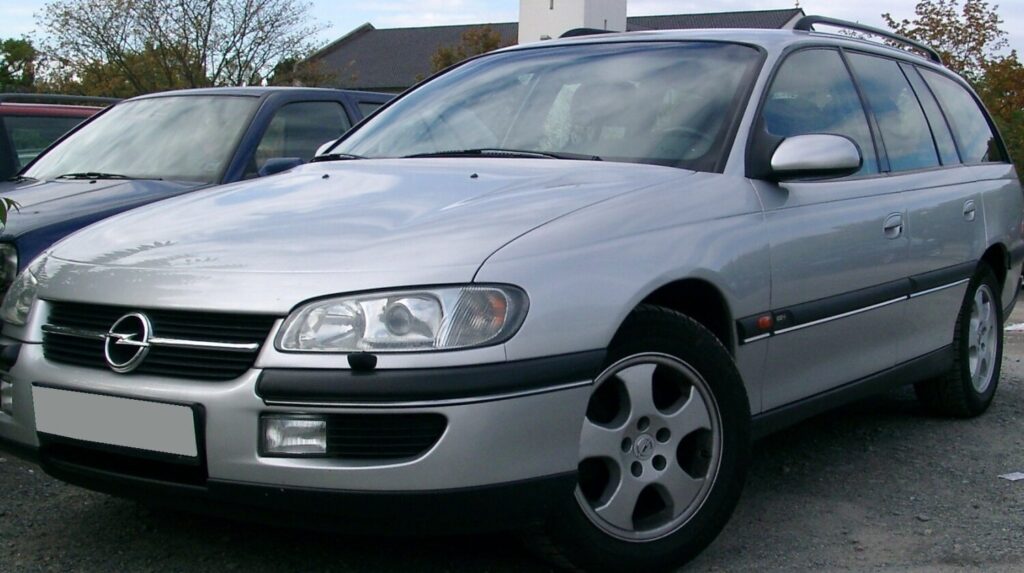
The Opel Omega B Caravan 2.0i 16V Automatic, produced between April 1994 and July 1999, was a key variant within the second generation (Omega B) of Opel’s flagship executive car. Positioned as a mid-range offering in the Caravan (estate) body style, it provided a balance between performance, practicality, and affordability within the Omega B lineup. The Omega B, built on the GM Epsilon platform (internally designated 1HX0/A3), aimed to modernize Opel’s image and compete with established rivals like the Ford Mondeo and Volkswagen Passat. This particular 2.0i 16V Automatic model catered to buyers seeking a comfortable and spacious family vehicle with the convenience of an automatic transmission.
Powertrain & Engine Architecture
The heart of the Omega B Caravan 2.0i 16V Automatic is the X20XEV engine, a 1998 cc (121.93 cu. in.) inline-four cylinder gasoline engine. This engine is characterized by its dual overhead camshafts (DOHC) and four valves per cylinder, contributing to its 16V designation. The X20XEV utilizes a multi-port fuel injection system, delivering fuel directly into the intake ports for optimized combustion. The engine produces 136 horsepower (Hp) at 5600 rpm and 188 Nm (138.66 lb.-ft.) of torque at 3200 rpm. The compression ratio is 10.8:1. Engine oil capacity is 4.5 liters (4.76 US qt | 3.96 UK qt) and coolant capacity is 8.8 liters (9.3 US qt | 7.74 UK qt).
Paired with the X20XEV engine is a four-speed automatic transmission. While not known for its cutting-edge technology, this transmission provided smooth and effortless gear changes, aligning with the Omega B’s focus on comfort. The transmission’s gear ratios were tuned for relaxed cruising and adequate acceleration, prioritizing drivability over outright performance. The drivetrain is rear-wheel drive, a configuration that was becoming less common in the mid-size segment during this period, offering a different driving experience compared to front-wheel drive competitors.
Engine Code Specifics
The X20XEV engine code is significant as it denotes a specific iteration of Opel’s 2.0-liter engine family. It represents an evolution of earlier 2.0-liter designs, incorporating improvements in fuel efficiency and emissions control. The X20XEV was known for its relative reliability, although regular maintenance, particularly regarding timing belt replacement, was crucial to prevent engine damage.
Driving Characteristics
The Omega B Caravan 2.0i 16V Automatic offered a comfortable and refined driving experience. Acceleration from 0 to 100 km/h (0-62 mph) took approximately 14 seconds, and 0-60 mph was achieved in around 13.3 seconds. While not particularly sporty, the engine provided sufficient power for everyday driving and highway cruising. The automatic transmission contributed to a relaxed driving style, particularly in urban environments. Compared to the more powerful Omega B variants, such as the 3.0L V6, the 2.0i 16V Automatic was noticeably slower, but it offered better fuel economy. Compared to the diesel options, like the 2.5 TDI, the 2.0i provided a smoother, quieter driving experience, albeit with higher fuel consumption.
The rear-wheel drive configuration provided balanced handling, although it wasn’t as nimble as front-wheel drive cars. The suspension, consisting of coil springs all around, prioritized ride comfort over sharp handling. The steering, utilizing a worm-reduction unit with hydraulic power assistance, felt somewhat indirect but was adequately weighted for most driving situations.
Equipment & Trim Levels
The Omega B Caravan 2.0i 16V Automatic typically came equipped with a reasonable level of standard features. These included central locking, electric front windows, power steering, and an anti-lock braking system (ABS). Interior upholstery was typically cloth, with options for upgraded velour or leather available. The dashboard layout was functional and straightforward, with clear instrumentation. Optional extras included air conditioning, a sunroof, upgraded audio systems, and alloy wheels. The trim level could vary depending on the market, but generally, this variant represented a step up from the base models, offering a more comfortable and well-equipped package.
Chassis & Braking
The Omega B Caravan’s chassis was designed to provide a comfortable ride and good stability. The front suspension utilized coil springs, while the rear also employed coil springs, a departure from earlier Omega models that used a semi-trailing arm setup. Braking was handled by disc brakes on all four wheels, providing adequate stopping power. The ABS system enhanced braking performance, particularly on slippery surfaces. Tire size was typically 195/65 R15, mounted on 6.5J x 15 inch wheel rims. Stabilizer bars were fitted to both the front and rear axles to reduce body roll during cornering.
Market Reception & Comparison
The Opel Omega B Caravan 2.0i 16V Automatic was generally well-received by automotive critics as a practical and comfortable family car. It was praised for its spacious interior, large cargo capacity, and smooth ride. However, it was often criticized for its somewhat uninspired styling and lack of sporting pretensions. Fuel consumption was considered average for its class, with urban figures around 14.7 l/100 km (16 US mpg / 19.2 UK mpg) and extra-urban figures around 7.9 l/100 km (29.8 US mpg / 35.8 UK mpg). Compared to the V6 models, the 2.0i offered significantly better fuel economy, but at the cost of performance. Compared to the diesel variants, the 2.0i provided a quieter and smoother driving experience, but with higher fuel costs.
Technical Specifications
| Brand | Opel |
| Model | Omega |
| Generation | Omega B Caravan |
| Type (Engine) | 2.0i 16V (136 Hp) Automatic |
| Start of production | April, 1994 |
| End of production | July, 1999 |
| Powertrain Architecture | Internal Combustion engine |
| Body type | Station wagon (estate) |
| Seats | 5 |
| Doors | 5 |
| Fuel consumption (urban) | 14.7 l/100 km (16 US mpg / 19.2 UK mpg) |
| Fuel consumption (extra urban) | 7.9 l/100 km (29.8 US mpg / 35.8 UK mpg) |
| Fuel Type | Petrol (Gasoline) |
| Acceleration 0 – 100 km/h | 14 sec |
| Acceleration 0 – 62 mph | 14 sec |
| Acceleration 0 – 60 mph | 13.3 sec |
| Maximum speed | 187 km/h (116.2 mph) |
| Weight-to-power ratio | 11.1 kg/Hp |
| Weight-to-torque ratio | 8.1 kg/Nm |
| Power | 136 Hp @ 5600 rpm |
| Torque | 188 Nm @ 3200 rpm (138.66 lb.-ft. @ 3200 rpm) |
| Engine layout | Front, Longitudinal |
| Engine Model/Code | X20XEV |
| Engine displacement | 1998 cm3 (121.93 cu. in.) |
| Number of cylinders | 4 |
| Engine configuration | Inline |
| Cylinder Bore | 86 mm (3.39 in.) |
| Piston Stroke | 86 mm (3.39 in.) |
| Compression ratio | 10.8:1 |
| Number of valves per cylinder | 4 |
| Fuel injection system | Multi-port manifold injection |
| Engine aspiration | Naturally aspirated engine |
| Valvetrain | DOHC |
| Engine oil capacity | 4.5 l (4.76 US qt | 3.96 UK qt) |
| Coolant | 8.8 l (9.3 US qt | 7.74 UK qt) |
| Kerb Weight | 1515 kg (3340 lbs.) |
| Max. weight | 2125 kg (4684.82 lbs.) |
| Max load | 610 kg (1344.82 lbs.) |
| Trunk (boot) space – minimum | 540 l (19.07 cu. ft.) |
| Trunk (boot) space – maximum | 1800 l (63.57 cu. ft.) |
| Fuel tank capacity | 75 l (19.81 US gal | 16.5 UK gal) |
| Length | 4820 mm (189.76 in.) |
| Width | 1785 mm (70.28 in.) |
| Height | 1500 mm (59.06 in.) |
| Wheelbase | 2730 mm (107.48 in.) |
| Drivetrain Architecture | Rear wheel drive |
| Number of gears and type of gearbox | 4 gears, automatic transmission |
Legacy
The Opel Omega B Caravan 2.0i 16V Automatic, while not a particularly rare or sought-after variant, remains a reasonably reliable and affordable used car option. The X20XEV engine, when properly maintained, can provide many years of service. However, potential buyers should be aware of the need for regular timing belt replacement to avoid catastrophic engine failure. The automatic transmission, while generally durable, may require servicing as it ages. Today, these Omegas are often found as practical and spacious family vehicles, appreciated for their comfort and cargo capacity. They represent a bygone era of large, rear-wheel drive European estates, offering a unique driving experience compared to more modern alternatives.