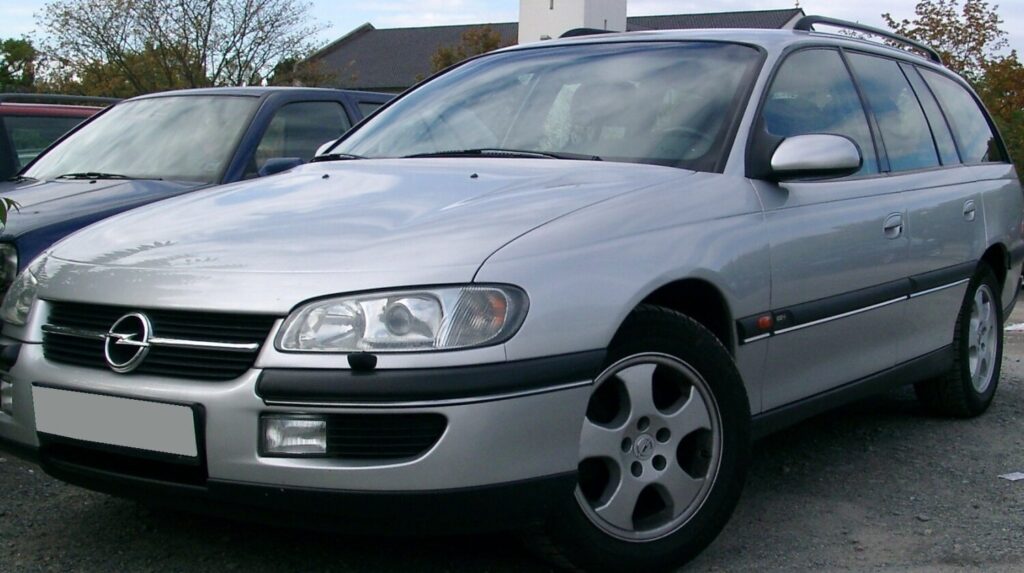
The Opel Omega B Caravan 2.5i V6 Automatic, produced between April 1994 and July 1999, represented a premium offering within the Omega B (1994-2003) range. This variant, built on the GM Epsilon platform (internally designated as the 1HX0/A3), was positioned as a comfortable and capable grand tourer, appealing to buyers seeking a spacious, well-equipped station wagon with strong performance. The Omega B Caravan, in general, aimed to replace the aging Opel Commodore and provide a flagship estate car for the brand, competing with vehicles like the Ford Mondeo Estate and Volvo V70.
Opel Omega B Caravan 2.5i V6: A Detailed Overview
The 2.5i V6 Automatic trim occupied a mid-to-high position in the Omega B Caravan lineup. Below it sat the more economical 1.8L and 2.0L four-cylinder models, both available with manual and automatic transmissions. Above it were the higher-performance 3.0L V6 and, in some markets, the 3.2L V6 variants. The 2.5i V6 struck a balance between performance, refinement, and cost, making it a popular choice for families and long-distance drivers.
Powertrain & Engine Architecture
At the heart of the Omega B Caravan 2.5i V6 Automatic lies the X25XE engine, a 2.5-liter (2498 cm3 or 152.44 cu. in.) naturally aspirated V6. This engine features a 60-degree V-angle, contributing to its smooth operation and relatively compact size. The X25XE utilizes a dual overhead camshaft (DOHC) valvetrain with four valves per cylinder, enhancing breathing and power output. Fuel delivery is managed by a multi-port manifold injection system, providing precise fuel metering for optimal combustion. Bore and stroke dimensions are 81.6 mm (3.21 in) and 79.6 mm (3.13 in) respectively, with a compression ratio of 10.8:1.
The engine is mated to a four-speed automatic transmission. While not the most modern transmission by today’s standards, it was a reliable unit designed to handle the V6’s torque output. The transmission’s gear ratios were tuned for comfortable cruising and reasonable acceleration, prioritizing smooth shifts over outright performance. The drivetrain is rear-wheel drive, a configuration that contributed to the Omega’s balanced handling characteristics.
Driving Characteristics
The 2.5i V6 Automatic offered a distinctly different driving experience compared to the lower-displacement Omega B Caravan models. With 170 hp (127 kW) at 5800 rpm and 230 Nm (169.64 lb.-ft.) of torque at 3200 rpm, the V6 provided ample power for effortless highway cruising and confident overtaking. Acceleration from 0 to 100 km/h (0-62 mph) took approximately 11 seconds, while 0-60 mph was achieved in around 10.5 seconds. Top speed was electronically limited to 212 km/h (131.73 mph).
The automatic transmission, while smooth, did result in some power loss compared to the available manual gearbox. The gear ratios were spaced to prioritize fuel economy and comfort, meaning the engine didn’t always feel as responsive as it could be. However, for drivers prioritizing a relaxed and refined driving experience, the automatic transmission was a suitable choice. The rear-wheel-drive layout provided a balanced feel, although it wasn’t as agile as front-wheel-drive competitors.
Equipment & Trim Levels
The Omega B Caravan 2.5i V6 Automatic typically came well-equipped, reflecting its position in the lineup. Standard features often included central locking, electric windows, power steering, an anti-lock braking system (ABS), and a basic audio system. Interior upholstery was typically cloth, although leather options were available. The dashboard layout was functional and straightforward, with clear instrumentation.
Optional extras included a sunroof, upgraded audio systems, climate control, heated seats, and alloy wheels. Higher trim levels, such as the ‘CD’ or ‘Elite’ variants, bundled many of these options together. The Caravan’s spacious interior and large trunk (540-1800 liters) were key selling points, making it a practical choice for families and those needing to transport large items.
Chassis & Braking
The Omega B Caravan 2.5i V6 Automatic utilized a coil spring suspension system at both the front and rear. The suspension was tuned for comfort, providing a smooth ride over a variety of road surfaces. Stabilizer bars were fitted to both axles to reduce body roll during cornering. The braking system consisted of disc brakes on all four wheels, providing adequate stopping power. The hydraulic power steering offered light and precise control.
The car rode on 205/65 R15 tires mounted on 6J x 15 inch steel or alloy wheels. The suspension setup was generally robust and reliable, although components could wear over time, particularly in areas with harsh road conditions. The rear disc brakes were a notable feature, as some lower-spec Omega B models were equipped with rear drum brakes.
Market Reception & Comparison
The Opel Omega B Caravan 2.5i V6 Automatic received generally positive reviews from automotive critics. It was praised for its spacious interior, comfortable ride, and strong performance. However, some critics noted that the automatic transmission could feel sluggish at times, and the fuel economy wasn’t particularly impressive (16.7 l/100 km urban, 8.6 l/100 km extra-urban).
Compared to other trims in the Omega B lineup, the 2.5i V6 Automatic offered a compelling balance of performance and refinement. The 1.8L and 2.0L models were more economical but lacked the V6’s power and smoothness. The 3.0L and 3.2L V6 models offered even greater performance but came at a higher price point. In terms of reliability, the X25XE engine was generally considered to be a robust unit, although regular maintenance was essential.
Technical Specifications
| Brand | Opel |
| Model | Omega |
| Generation | Omega B Caravan |
| Type (Engine) | 2.5i V6 (170 Hp) Automatic |
| Start of production | April, 1994 |
| End of production | July, 1999 |
| Fuel consumption (urban) | 16.7 l/100 km (14.1 US mpg, 16.9 UK mpg) |
| Fuel consumption (extra urban) | 8.6 l/100 km (27.4 US mpg, 32.8 UK mpg) |
| Fuel Type | Petrol (Gasoline) |
| Acceleration 0 – 100 km/h | 11 sec |
| Acceleration 0 – 62 mph | 11 sec |
| Acceleration 0 – 60 mph | 10.5 sec |
| Maximum speed | 212 km/h (131.73 mph) |
| Weight-to-power ratio | 9.7 kg/Hp |
| Power | 170 Hp @ 5800 rpm |
| Torque | 230 Nm @ 3200 rpm (169.64 lb.-ft. @ 3200 rpm) |
| Engine layout | Front, Longitudinal |
| Engine Model/Code | X25XE |
| Engine displacement | 2498 cm3 (152.44 cu. in.) |
| Number of cylinders | 6 |
| Engine configuration | V-engine |
| Cylinder Bore | 81.6 mm (3.21 in) |
| Piston Stroke | 79.6 mm (3.13 in) |
| Compression ratio | 10.8:1 |
| Engine oil capacity | 5.75 l (6.08 US qt | 5.06 UK qt) |
| Coolant capacity | 9.7 l (10.25 US qt | 8.53 UK qt) |
| Kerb Weight | 1645 kg (3626.6 lbs) |
| Max. weight | 2280 kg (5026.54 lbs) |
| Max load | 635 kg (1399.94 lbs) |
| Trunk (boot) space – minimum | 540 l (19.07 cu. ft) |
| Trunk (boot) space – maximum | 1800 l (63.57 cu. ft) |
| Fuel tank capacity | 75 l (19.81 US gal | 16.5 UK gal) |
| Length | 4820 mm (189.76 in) |
| Width | 1785 mm (70.28 in) |
| Height | 1500 mm (59.06 in) |
| Wheelbase | 2730 mm (107.48 in) |
| Drive wheel | Rear wheel drive |
| Number of gears | 4 |
| Gearbox type | Automatic transmission |
Legacy
Today, the Opel Omega B Caravan 2.5i V6 Automatic is a relatively rare sight on the roads. While generally reliable, these cars are now over two decades old, and finding well-maintained examples can be challenging. Common issues include wear and tear on suspension components, corrosion, and potential problems with the automatic transmission. However, for enthusiasts seeking a spacious, comfortable, and distinctive classic estate car, the Omega B Caravan 2.5i V6 Automatic remains an appealing option. The X25XE engine, when properly maintained, is known for its longevity and relatively straightforward mechanics, making it a viable choice for those willing to invest in its upkeep.