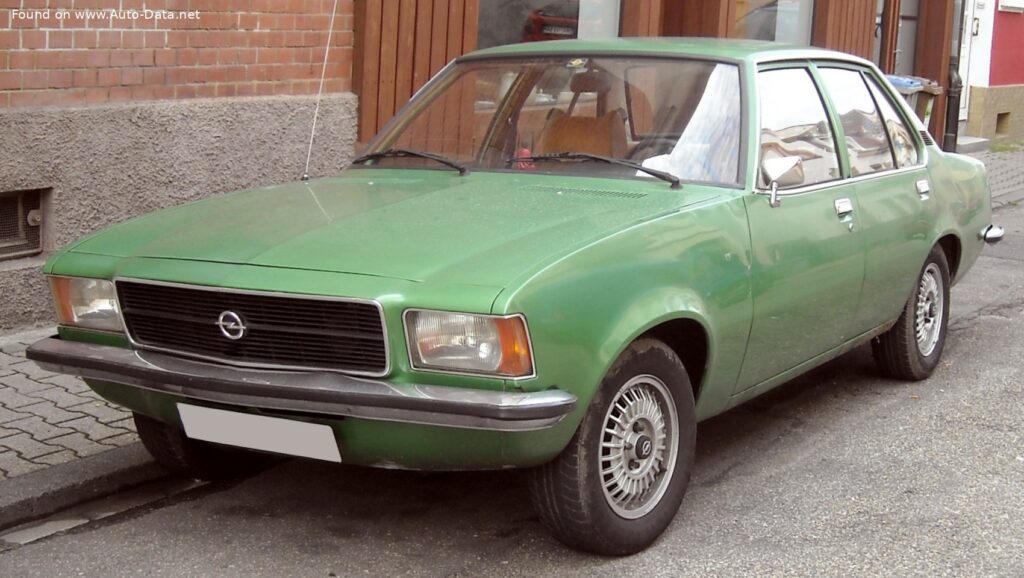
The Opel Rekord D 2.0, producing 100 horsepower, was a variant of the Rekord D series manufactured between 1975 and 1977. Positioned as a mid-range offering within the Rekord D lineup, it provided a step up in performance from the base models while remaining more accessible than the higher-specification versions. The Rekord D itself was a significant model for Opel, representing a modern, spacious family car built on the H-platform, and later the 1HX0 platform, offering a blend of comfort and practicality for the European market.
Powertrain & Engine Architecture
The heart of the Rekord D 2.0 was a 1,979 cc (120.77 cubic inches) inline-four cylinder gasoline engine. This engine, identifiable by its internal designation, utilized a single overhead camshaft (SOHC) valvetrain with two valves per cylinder. Fuel delivery was managed by a carburetor, a common setup for the era, rather than fuel injection. The engine produced a maximum power output of 100 hp (74.6 kW) at 5,200 rpm and 155 Nm (114.32 lb-ft) of torque between 3,400 and 3,800 rpm. The compression ratio was set at 9:1. Bore and stroke dimensions were 95 mm (3.74 in) and 69.8 mm (2.75 in) respectively. While a four-speed manual transmission was standard, an automatic transmission was also offered, though less common, impacting the vehicle’s acceleration and overall driving experience.
Transmission Details
The available automatic transmission was a three-speed unit, typical for the mid-1970s. It was designed to provide smooth, if not particularly rapid, gear changes. The gear ratios were optimized for comfortable cruising rather than outright performance. The automatic transmission contributed to a slightly higher fuel consumption compared to the manual version and a marginally slower 0-60 mph time.
Driving Characteristics
The Rekord D 2.0 offered a comfortable and predictable driving experience. With 100 hp propelling a curb weight of approximately 1,095 kg (2,414 lbs), acceleration was adequate for everyday driving, but not particularly sporty. Zero to 100 km/h (0-62 mph) took around 13 seconds, while 0-60 mph was achieved in approximately 12.4 seconds. The engine delivered its peak torque in the mid-range, providing sufficient power for overtaking maneuvers on open roads. The rear-wheel-drive configuration offered balanced handling, although it lacked the sophistication of more modern suspension systems. The automatic transmission, while convenient, resulted in some power loss and a less engaging driving experience compared to the manual counterpart. The car’s top speed was approximately 170 km/h (105.63 mph).
Equipment & Trim Levels
The Rekord D 2.0 typically came equipped with features considered standard for a mid-range family car of the time. These included cloth upholstery, basic instrumentation (speedometer, fuel gauge, temperature gauge), and a four-spoke steering wheel. The interior was designed with practicality in mind, offering ample space for passengers and luggage. Optional extras included a radio, upgraded upholstery, and a sunroof. Higher trim levels, often denoted by additional badging, could include features like power steering, improved sound insulation, and more luxurious interior appointments. The dashboard layout was functional and straightforward, prioritizing ease of use over aesthetic flair.
Chassis & Braking
The Rekord D 2.0 featured a conventional chassis layout with independent front suspension and a rigid axle rear suspension. The front suspension utilized coil springs and wishbones, while the rear suspension employed leaf springs. Disc brakes were fitted to the front wheels, providing adequate stopping power, while drum brakes were used on the rear wheels. The steering was a recirculating ball system, offering reasonable precision but lacking the feel of more modern steering technologies. The car’s ride height was approximately 130 mm (5.12 in). Stabilizer bars were often included, contributing to reduced body roll during cornering.
Market Reception & Comparison
The Opel Rekord D 2.0 was generally well-received by automotive critics as a practical and reliable family car. It offered a good balance of space, comfort, and affordability. Compared to the base models with smaller engines, the 2.0-liter version provided a noticeable improvement in performance, making it more suitable for long-distance journeys and carrying a full load of passengers. However, it was less sporty than some of its competitors, such as the Ford Taunus or the BMW 3 Series. Fuel economy was typical for the era, averaging around 11.4 l/100 km (20.6 US mpg). The Rekord D 2.0’s reliability was generally considered good, although maintenance costs could be moderate due to the carburetor and the relatively simple engine design. The automatic transmission version, while convenient, was often criticized for its sluggish performance and higher fuel consumption.
Technical Specifications
| Body type | Sedan, 2-4 Doors, 5 Seats |
| Fuel economy (combined) | 11.4 l/100 km (20.6 US mpg, 24.8 UK mpg, 8.8 km/l) |
| Maximum speed | 170 km/h (105.63 mph) |
| Acceleration 0-100 km/h | 13 sec |
| Acceleration 0-60 mph | 12.4 sec |
| Power | 100 Hp @ 5200 rpm |
| Torque | 155 Nm @ 3400-3800 rpm (114.32 lb.-ft. @ 3400-3800 rpm) |
| Engine displacement | 1979 cm3 (120.77 cu. in.) |
| Number of cylinders | 4 |
| Engine configuration | Inline |
| Cylinder Bore | 95 mm (3.74 in.) |
| Piston Stroke | 69.8 mm (2.75 in.) |
| Compression ratio | 9:1 |
| Number of valves per cylinder | 2 |
| Fuel injection system | Carburettor |
| Engine aspiration | Naturally aspirated |
| Valvetrain | SOHC |
| Kerb Weight | 1095 kg (2414.06 lbs.) |
| Max. weight | 1575 kg (3472.28 lbs.) |
| Max load | 480 kg (1058.22 lbs.) |
| Trunk (boot) space – minimum | 408 l (14.41 cu. ft.) |
| Fuel tank capacity | 70 l (18.49 US gal | 15.4 UK gal) |
| Length | 4567 mm (179.8 in.) |
| Width | 1718 mm (67.64 in.) |
| Height | 1415 mm (55.71 in.) |
| Wheelbase | 2668 mm (105.04 in.) |
Legacy
The Opel Rekord D 2.0, while not a particularly rare or collectible model today, remains a popular choice among classic car enthusiasts. The engine, while relatively simple, is known for its durability and ease of maintenance. Parts availability is generally good, although some components may be difficult to find. The automatic transmission version, while less desirable to some, offers a comfortable and convenient driving experience. In the used car market, Rekord D 2.0 models in good condition can fetch reasonable prices, reflecting their status as a well-built and reliable classic car. The Rekord D series as a whole played a significant role in establishing Opel as a major player in the European automotive market, and the 2.0-liter variant represents a well-rounded and practical option for those seeking a classic family car.