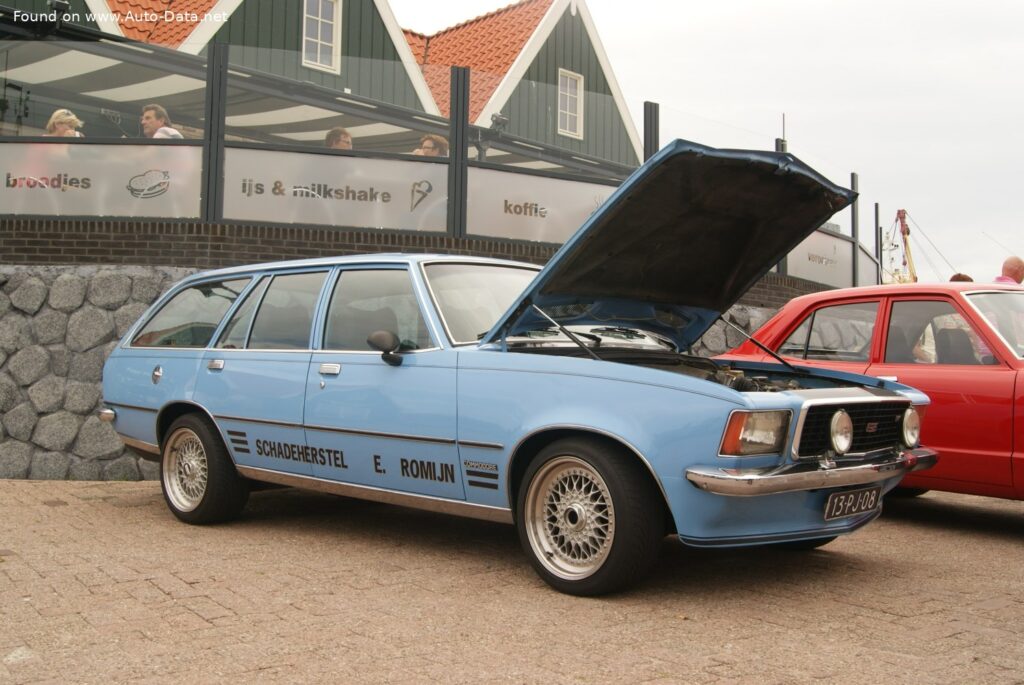
The Opel Rekord D Caravan 2.0 S (100 hp) was a variant of the Rekord D series, produced between 1975 and 1977. This model represented a mid-range offering within the Rekord D Caravan (estate) lineup, positioned above the base models with smaller engines and offering a balance between practicality, performance, and cost. The Rekord D, built on the GM’s H-platform (internally designated 1HX0/A3), was a significant model for Opel, representing a modern approach to family motoring in Europe during the mid-1970s. The Caravan body style, specifically, catered to buyers needing increased cargo capacity and versatility.
The 2.0 S Variant: Positioning and Overview
The “S” designation in the 2.0 S denoted a sportier trim level, though not in the modern high-performance sense. It indicated a higher level of equipment and, crucially, the larger 2.0-liter engine option. This engine provided a noticeable performance upgrade over the smaller 1.6 and 1.7-liter engines available in other Rekord D Caravan models. The 2.0 S was aimed at families and individuals who required a practical vehicle but also desired a degree of driving enjoyment and the ability to comfortably handle longer journeys with a full load. It was a popular choice for those who found the base models underpowered and the top-of-the-line models too expensive.
Powertrain & Engine Architecture
The heart of the Rekord D Caravan 2.0 S was the Opel inline-four cylinder engine, specifically the 20H variant. This engine displaced 1,979 cc (120.77 cubic inches) and produced 100 horsepower at 5,200 rpm, along with 155 Nm (114.32 lb-ft) of torque between 3,400 and 3,800 rpm. The engine featured a single overhead camshaft (SOHC) valvetrain with two valves per cylinder. Fuel delivery was managed by a Solex carburetor, a common setup for the era. The compression ratio was 9:1. The engine block was cast iron, while the cylinder head was aluminum, contributing to a reasonable weight for its size.
While a four-speed manual transmission was standard, the 2.0 S was also offered with a three-speed automatic transmission. This automatic, a General Motors-sourced unit, was a popular choice for buyers prioritizing convenience over outright performance. The automatic transmission featured a torque converter and provided smooth, if not particularly rapid, gear changes. The gear ratios were optimized for comfortable cruising and adequate acceleration, but the automatic did diminish the engine’s overall performance potential compared to the manual version.
Engine Codes and Variations
The 20H engine code is crucial for identifying this specific powerplant. While variations existed within the 20H family, the 100 hp output and carburetor setup were consistent for the 1975-1977 Rekord D Caravan 2.0 S. Later iterations of the 20H engine would see the introduction of fuel injection, increasing power output and improving efficiency, but the 2.0 S retained the carbureted version throughout its production run.
Driving Characteristics
The driving experience in the Rekord D Caravan 2.0 S was characterized by comfortable ride quality and predictable handling. The 100 hp engine provided adequate power for everyday driving, allowing for reasonably brisk acceleration and comfortable highway cruising. Acceleration from 0 to 100 km/h (0-62 mph) took approximately 13 seconds, while 0 to 60 mph was achieved in around 12.4 seconds. Top speed was rated at 167 km/h (103.77 mph). The automatic transmission, while convenient, did impact performance, resulting in slightly slower acceleration times compared to the manual transmission equipped models.
The rear-wheel-drive layout provided a balanced feel, although it lacked the modern stability control systems found in contemporary vehicles. Steering was relatively light, making it easy to maneuver in urban environments. The suspension, consisting of independent front suspension with coil springs and a live axle with leaf springs in the rear, provided a comfortable ride, but could feel somewhat soft and prone to body roll during spirited cornering.
Equipment & Trim Levels
The 2.0 S trim level included several standard features that distinguished it from the base Rekord D Caravan models. These typically included upgraded interior upholstery (often featuring patterned cloth or vinyl), a more comprehensive instrument cluster, and additional chrome trim on the exterior. Standard equipment also included features like a heater, windscreen wipers, and basic lighting. Optional extras available for the 2.0 S included a radio, upgraded sound system, power steering, and a sunroof. The interior dashboard configuration was typical of the era, featuring analog gauges and a straightforward layout.
Chassis & Braking
The Rekord D Caravan 2.0 S featured a robust chassis designed to handle the weight of the vehicle and its occupants, as well as the potential for carrying cargo. The kerb weight was 1,140 kg (2,513.27 lbs), with a maximum permissible weight of 1,740 kg (3,836.04 lbs). The front brakes were disc brakes, providing good stopping power, while the rear brakes were drum brakes. This combination was typical for vehicles of this era and weight class. The suspension system, as mentioned previously, consisted of independent front suspension and a live axle with leaf springs in the rear. A stabilizer bar was fitted to the front suspension to reduce body roll.
Market Reception & Comparison
The Opel Rekord D Caravan 2.0 S was generally well-received by automotive critics and buyers alike. It was praised for its practicality, comfortable ride, and reasonable performance. Compared to other trims in the Rekord D lineup, the 2.0 S offered a noticeable performance advantage over the smaller-engined models, while remaining more affordable than the top-of-the-line variants. Fuel economy was rated at 11.6 l/100 km (20.3 US mpg, 24.4 UK mpg), which was typical for a vehicle of this size and engine displacement in the 1970s. Reliability was generally good, although maintenance requirements were higher than more modern vehicles.
Compared to competitors like the Ford Taunus and Volvo 145, the Rekord D Caravan 2.0 S offered a competitive package in terms of price, features, and performance. It was considered a solid and dependable family vehicle that provided good value for money.
Technical Specifications
| Brand | Opel |
| Model | Rekord |
| Generation | Rekord D Caravan |
| Type (Engine) | 2.0 S (100 Hp) |
| Start of production | 1975 |
| End of production | 1977 |
| Engine Displacement | 1,979 cm3 (120.77 cu. in.) |
| Number of Cylinders | 4, Inline |
| Power | 100 Hp @ 5200 rpm |
| Torque | 155 Nm @ 3400-3800 rpm (114.32 lb.-ft.) |
| Fuel Type | Petrol (Gasoline) |
| Fuel Consumption (Combined) | 11.6 l/100 km (20.3 US mpg, 24.4 UK mpg) |
| Acceleration 0-100 km/h | 13 sec |
| Acceleration 0-60 mph | 12.4 sec |
| Maximum Speed | 167 km/h (103.77 mph) |
| Kerb Weight | 1140 kg (2513.27 lbs) |
| Max. Weight | 1740 kg (3836.04 lbs) |
| Fuel Tank Capacity | 70 l (18.49 US gal | 15.4 UK gal) |
| Transmission | 4-speed manual or 3-speed automatic |
| Brakes (Front/Rear) | Disc / Drum |
| Drag Coefficient (Cd) | 0.50 |
Legacy
The Opel Rekord D Caravan 2.0 S, while not a particularly rare or collectible vehicle today, holds a nostalgic appeal for enthusiasts of classic European cars. The 20H engine, when properly maintained, proved to be a durable and reliable powerplant. However, age and potential neglect mean that finding a well-preserved example can be challenging. Parts availability is generally good, although some specific trim pieces may be difficult to source. In the used car market, these vehicles are typically offered at affordable prices, making them an accessible entry point into the world of classic Opel ownership. The Rekord D Caravan 2.0 S remains a testament to Opel’s engineering prowess and its commitment to providing practical and dependable vehicles for families in the 1970s.