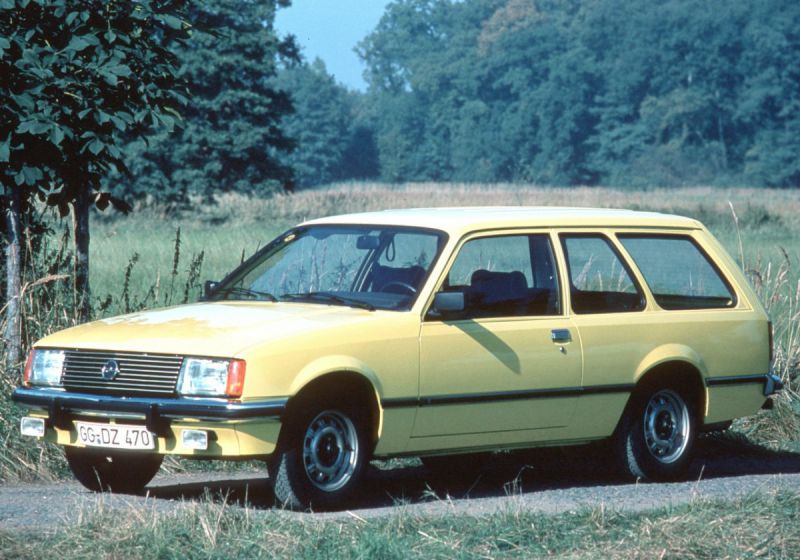
The Opel Rekord E Caravan 2.0 E, produced by the German automaker Opel, represents a significant chapter in European automotive history. Launched in 1977 as part of the Rekord E generation, this mid-size family station wagon (known as an “estate” in Europe) quickly established itself as a cornerstone of practicality and reliability across the continent. While never officially sold in the United States, the Rekord E Caravan embodies the European automotive philosophy of the late 1970s and early 1980s, prioritizing spaciousness, fuel efficiency, and robust engineering for everyday use. The 2.0 E variant, with its 110 horsepower engine, offered a commendable balance of performance and economy, making it a popular choice for families and businesses seeking a versatile and dependable vehicle.
The Opel Rekord E Caravan: A European Family Staple
The Opel Rekord, a nameplate that spanned several generations from 1953 to 1986, was Opel’s answer to the burgeoning demand for affordable, spacious, and reliable family cars in post-war Europe. The Rekord E, specifically, was introduced at a time of significant economic and social shifts, including the lingering effects of the 1973 oil crisis, which placed a greater emphasis on fuel economy and practical design. The Rekord E generation, produced from 1977 to 1986, was a modern evolution of its predecessors, featuring a more contemporary design with cleaner lines and improved aerodynamics, though still retaining a classic rear-wheel-drive layout.
The Caravan designation was Opel’s term for its station wagon models, and the Opel Rekord E Caravan was particularly noteworthy for its immense versatility. Available in both 3-door and 5-door configurations, it catered to a wide range of buyers. The 3-door variant was often preferred by tradespeople or those requiring maximum cargo accessibility with fewer passenger considerations, while the 5-door model served as the quintessential family hauler. Its design language was functional yet elegant for its era, eschewing overt styling flourishes in favor of a timeless, utilitarian aesthetic that resonated with European consumers.
Powertrain & Engine Architecture of the 2.0 E
Under the hood, the Opel Rekord E Caravan 2.0 E featured a robust 2.0-liter (1979 cm³ or 120.77 cu. in.) inline-four engine, designated by Opel as the ’20E’ code. This engine was a prime example of Opel’s engineering at the time: a naturally aspirated, single overhead camshaft (SOHC) unit. It utilized a Solex carburetor for fuel delivery, a common system before the widespread adoption of electronic fuel injection. This carburetor system, while reliable, required periodic adjustment to maintain optimal performance and fuel economy.
The 20E engine produced a respectable 110 horsepower at 5400 rpm, delivering a power-per-liter output of 55.6 Hp/l, which was competitive for a mainstream family car of the period. Torque figures stood at 159 Nm (117.27 lb.-ft.) at a relatively low 3000 rpm, indicating a flexible power band well-suited for daily driving and carrying heavy loads. The engine featured a two-valve per cylinder configuration and a compression ratio of 9.4:1.
The engine was typically mated to a 4-speed manual transmission, although a 3-speed automatic transmission was also available, albeit less common. The automatic transmission, a Borg-Warner unit, provided convenience but at the expense of some performance and fuel efficiency. The rear-wheel-drive architecture, a hallmark of traditional Opel sedans and wagons, provided predictable handling characteristics and a robust platform for the vehicle’s intended use. The rear axle was a solid axle design, contributing to the vehicle’s durability and load-carrying capacity.
Driving Characteristics of the 90 hp Automatic Variant
The Rekord E Caravan 2.0 E with the automatic transmission offered a comfortable, if not particularly sporty, driving experience. The 3-speed automatic transmission featured relatively tall gear ratios, prioritizing fuel economy and smooth cruising over rapid acceleration. First gear was geared for starting from a standstill with a load, while third gear was designed for relaxed highway driving. The automatic transmission lacked the responsiveness of a manual gearbox, and kickdown for overtaking required a deliberate application of the throttle.
Compared to the manual transmission version, the automatic variant experienced a noticeable reduction in acceleration. While the manual could reach 60 mph in approximately 12.4 seconds, the automatic typically took around 14-15 seconds. The automatic also resulted in slightly lower top speed, around 105 mph compared to the manual’s 109 mph. However, for the target audience – families and drivers prioritizing comfort and convenience – the trade-off in performance was generally acceptable. The automatic version was positioned as a mid-range offering, appealing to those willing to pay a premium for ease of use.
The rear-wheel-drive layout provided predictable handling, but the Rekord E Caravan was not a cornering machine. The suspension, while adequate, was tuned for comfort rather than sporty handling. Body roll was noticeable in corners, and the steering lacked the precision of more modern systems. However, the car felt stable and planted on the highway, making it a capable long-distance cruiser.
Equipment & Trim Levels
The Opel Rekord E Caravan 2.0 E, particularly in the automatic transmission configuration, typically came with a reasonable level of standard equipment. Base models featured cloth upholstery, vinyl flooring, and a basic instrument cluster. However, the 2.0 E trim often included upgrades such as a more comfortable seat fabric, a woodgrain-trimmed dashboard, and a more comprehensive instrument panel with additional gauges.
Optional extras included a sunroof, power windows, central locking, and a more sophisticated radio system. Higher-spec models could also be equipped with air conditioning, although this was a relatively rare option. The Caravan’s interior was designed with practicality in mind, featuring durable materials and a straightforward layout. The rear seats could be folded down to increase cargo capacity, and the tailgate offered a wide opening for easy loading and unloading. The 5-door version was naturally more convenient in this regard.
The trim level designation often included suffixes like “GL” (Grand Luxe) or “SR” (Sport), indicating a higher level of equipment and refinement. The GL trim, for example, typically included features such as upgraded upholstery, chrome trim, and additional sound insulation.
Chassis & Braking
The Opel Rekord E Caravan utilized a conventional chassis design for the era. It featured a body-on-frame construction, providing a robust and durable platform. The front suspension consisted of independent, coil-sprung wishbones, while the rear suspension employed a solid axle with leaf springs. This setup prioritized ride comfort and load-carrying capacity over sporty handling.
The braking system consisted of ventilated disc brakes on the front wheels and drum brakes on the rear wheels. This configuration was typical for family cars of the period, offering a balance of cost-effectiveness and stopping power. The braking system was not equipped with anti-lock brakes (ABS), which were still relatively uncommon in the late 1970s and early 1980s. The steering was a recirculating ball system, providing a relatively heavy but predictable feel.
Stabilizer bars were fitted to both the front and rear axles to reduce body roll during cornering. The thickness of the stabilizer bars varied depending on the trim level and optional equipment. The Rekord E Caravan’s tires were typically steel-belted radials, providing a good balance of grip, durability, and ride comfort.
Market Reception & Comparison
Critics generally viewed the Opel Rekord E Caravan 2.0 E as a competent and practical family car. It was praised for its spacious interior, comfortable ride, and robust engineering. However, it was also criticized for its somewhat dated styling and lack of sporty handling. The automatic transmission version was often seen as a compromise, offering convenience at the expense of performance and fuel economy.
Compared to other trims in the Rekord E lineup, the 2.0 E Automatic occupied a middle ground. The base models with smaller engines offered lower purchase prices but lacked the power and refinement of the 2.0 E. The higher-spec models with larger engines and more luxurious features were more expensive and targeted a different segment of the market. In terms of fuel economy, the 2.0 E Automatic achieved a combined rating of around 25.3 US mpg (9.3 l/100 km), which was comparable to other cars in its class.
Reliability was generally good, although the carburetor required periodic adjustment to maintain optimal performance. The Rekord E Caravan was known for its durability and ease of maintenance, making it a popular choice among budget-conscious buyers.
Technical Specifications: Opel Rekord E Caravan 2.0 E (110 Hp)
| Category | Specification |
| Brand | Opel |
| Model | Rekord E Caravan |
| Engine Type | 2.0 E (110 Hp) |
| Production Years | 1977 – 1982 |
| Body Type | Station Wagon (Estate), 3-5 Doors, 5 Seats |
| Powertrain Architecture | Internal Combustion Engine, Rear Wheel Drive |
| Performance Specs | |
| Fuel Consumption (Combined) | 25.3 US mpg (9.3 l/100 km) |
| Fuel Type | Petrol (Gasoline) |
| Acceleration 0-60 mph | 14-15 seconds (Automatic) |
| Maximum Speed | 105 mph (169 km/h) (Automatic) |
| Weight-to-Power Ratio | 10.4 kg/Hp |
| Engine Specs | |
| Power | 110 Hp @ 5400 rpm |
| Torque | 117.27 lb.-ft. (159 Nm) @ 3000 rpm |
| Engine Model/Code | 20E |
| Engine Displacement | 2.0 liters (1979 cm³, 120.77 cu. in.) |
| Number of Cylinders | 4, Inline |
| Cylinder Bore | 3.74 in. (95 mm) |
| Piston Stroke | 2.75 in. (69.8 mm) |
| Compression Ratio | 9.4:1 |
| Valves per Cylinder | 2 |
| Fuel Injection System | Carburetor |
| Engine Aspiration | Naturally Aspirated |
| Valvetrain | SOHC |
| Dimensions, Space, Volume & Weights | |
| Kerb Weight | 2524.29 lbs. (1145 kg) |
| Max. Weight | 3891.16 lbs. (1765 kg) |
| Max Load | 1366.87 lbs. (620 kg) |
| Trunk (Boot) Space – Minimum | 31.11 cu. ft. (881 l) |
| Fuel Tank Capacity | 18.49 US gal (70 l) |
| Permitted Trailer Load with Brakes (12%) | 3306.93 lbs. (1500 kg) |
| Permitted Trailer Load without Brakes | 1289.7 lbs. (585 kg) |
| Length | 181.89 in. (4620 mm) |
| Width | 67.95 in. (1726 mm) |
| Height | 57.87 in. (1470 mm) |
| Wheelbase | 105.04 in. (2668 mm) |
| Front Track | 56.5 in. (1435 mm) |
| Rear Track | 55.59 in. (1412 mm) |
| Drag Coefficient (Cd) | 0.48 |
| Minimum Turning Circle | 35.43 ft. (10.8 m) |
| Drivetrain, Brakes & Suspension Specs | |
| Drive Wheel | Rear Wheel Drive |
| Number of Gears & Type of Gearbox | 3 gears, Automatic Transmission |
| Front Brakes | Ventilated Discs |
| Rear Brakes | Drum |
Legacy
The Opel Rekord E Caravan, particularly in its 2.0 E guise, carved out a significant niche in the European automotive landscape. It was a car that embodied the aspirations of the middle class, offering a blend of space, comfort, and affordability that few rivals could match. Its reputation for robustness and ease of maintenance made it a favorite among families, small businesses, and even taxi operators across Germany and other European countries. It was a workhorse, a family friend, and a reliable partner, all rolled into one.
Today, the Opel Rekord E Caravan 2.0 E is remembered as a classic example of a utilitarian European family car. While not a collector’s item in the same vein as some exotic sports cars, it holds a special place in the hearts of those who grew up with it, representing a period of automotive history when practicality, durability, and straightforward engineering were paramount. The 20E engine, while not known for being particularly high-revving or powerful, proved to be remarkably durable, and many examples are still running today. The automatic transmission, while less desirable to enthusiasts, remains relatively reliable with proper maintenance. Its enduring presence on European roads, even decades after its production ceased, is a testament to its quality and the indelible mark it left on the automotive culture of its time.