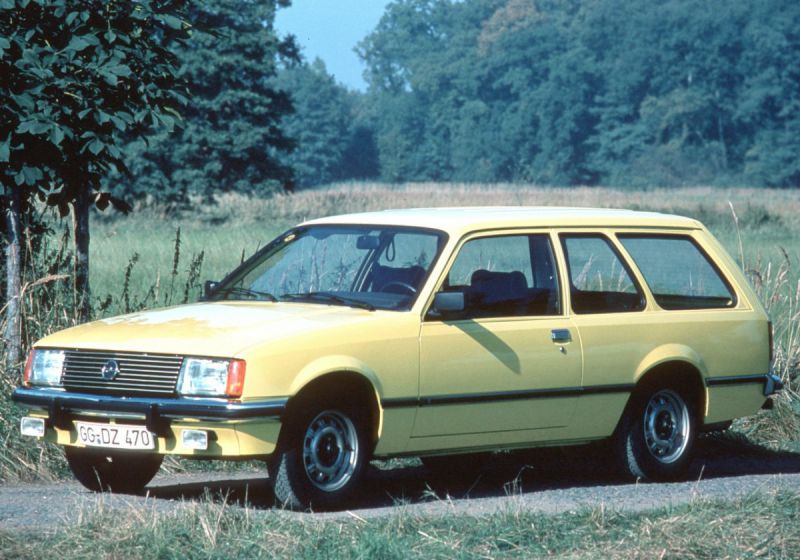
The Opel Rekord E Caravan 2.1 D (60 Hp) represents a pivotal offering from German automaker Opel during a transformative period for the automotive industry. Launched in 1977 as part of the Rekord E generation, this particular variant, with its 2.1-liter diesel engine, was a testament to the growing demand for fuel efficiency and practicality in the European mid-size segment. While Opel, a subsidiary of General Motors at the time, was a familiar name across the Atlantic, the Rekord E Caravan was primarily designed for and sold within the European market, where it served as a reliable and economical family station wagon, or “estate” as it’s known across the pond.
The Rekord E Generation and the Caravan’s Role
The Rekord E series, produced from 1977 to 1986, marked a significant evolution for Opel’s long-running Rekord lineage, which had been a cornerstone of their model range since the 1950s. The Caravan body style, specifically, highlighted its utility-focused design, offering substantial cargo capacity alongside comfortable seating for five. The introduction of the 2.1 D engine in 1977, though short-lived in production until 1978, underscored Opel’s response to the energy crises of the 1970s, providing a robust and economical alternative to gasoline powertrains for families and businesses alike. This variant occupied the entry-level position within the Rekord E Caravan lineup, appealing to buyers prioritizing fuel economy and practicality over outright performance. Higher trims featured larger gasoline engines, offering more power but at the expense of fuel efficiency.
Powertrain & Engine Architecture
At the heart of the Opel Rekord E Caravan 2.1 D was a naturally aspirated, inline four-cylinder diesel engine, designated with the model code “21D.” With an engine displacement of 2068 cubic centimeters (approximately 2.1 liters or 126.2 cubic inches), this powerplant was engineered for durability and efficiency rather than outright speed. It produced a modest 60 horsepower at 4400 rpm, reflecting the typical power output for a diesel engine of its era and size. The power per liter stood at 29 hp/l, a respectable figure for a non-turbocharged diesel from the late 1970s.
More crucial for a vehicle of its intended purpose was its torque output. The 2.1 D engine delivered 118 Newton-meters (87.03 lb-ft) of torque at a relatively low 2500 rpm. This low-end torque was instrumental in providing adequate pulling power for a fully loaded station wagon, whether traversing city streets or cruising on the autobahn. The engine utilized a precombustion chamber injection system, a common technology for early indirect injection diesels, known for its smoother operation compared to direct injection systems of the time, albeit at a slight efficiency trade-off. The valvetrain was a Single Overhead Camshaft (SOHC) design with two valves per cylinder, a straightforward and reliable configuration. The engine’s robust construction and relatively simple design contributed to its longevity and ease of maintenance.
Power was delivered to the rear wheels via a robust 4-speed manual transmission, a standard setup for family cars of this period. While a 4-speed gearbox might seem limited by modern standards, it was perfectly adequate for the Rekord’s performance envelope, emphasizing fuel economy over rapid acceleration. The transmission was chosen for its durability and simplicity, aligning with the overall ethos of the vehicle.
Driving Characteristics
The Opel Rekord E Caravan 2.1 D, with its 60 hp and 4-speed manual transmission, offered a driving experience focused on practicality and economy. Acceleration was modest, with a 0-60 mph time estimated around 18-20 seconds. Compared to the gasoline-powered Rekord E variants, particularly those equipped with the 1.9 or 2.0-liter engines, the diesel model felt significantly slower. However, the diesel’s superior torque delivery provided a more relaxed driving experience, especially when fully loaded or tackling inclines. The gear ratios were optimized for fuel efficiency, meaning the engine often operated at lower RPMs during cruising. The manual transmission allowed for greater driver control, but the shift quality was typical for the era – not particularly precise or sporty. The overall driving experience was best described as comfortable and predictable, rather than engaging or dynamic.
Equipment & Trim Levels
The 2.1 D Caravan typically represented the base trim level. Standard features included cloth upholstery, basic instrumentation (speedometer, fuel gauge, temperature gauge), and a simple two-spoke steering wheel. The interior was functional and durable, prioritizing practicality over luxury. Optional extras included a radio, upgraded upholstery, and a sunroof. The 3-door version often featured a more utilitarian interior, lacking some of the comfort features found in the 5-door model. The dashboard configuration was straightforward, with clearly labeled controls and a focus on ease of use. Power steering and central locking were not typically standard on this base trim, but could be added as options.
Chassis & Braking
The Rekord E Caravan featured a traditional body-on-frame construction, providing a robust and durable chassis. The suspension consisted of independent front suspension with coil springs and a rigid rear axle with leaf springs. This setup prioritized ride comfort and load-carrying capacity over sporty handling. The front brakes were ventilated discs, providing adequate stopping power, while the rear utilized drum brakes, a common and cost-effective solution for family vehicles of the period. Stabilizer bars were typically fitted to the front axle, helping to reduce body roll during cornering. The steering was a recirculating ball system, offering a relatively heavy but precise feel. The suspension was tuned to provide a comfortable ride, even on rough roads, and to maintain stability when carrying a full load.
Market Reception & Comparison
Critics generally viewed the Opel Rekord E Caravan 2.1 D as a sensible and practical choice for families and businesses. Its fuel economy was a major selling point, particularly in the context of the late 1970s energy crisis. However, its modest performance was often criticized, especially when compared to the more powerful gasoline-powered alternatives. Compared to the Volkswagen Passat, the Rekord offered a more spacious interior and a more robust chassis, but the Passat benefited from a more modern front-wheel-drive layout. The Ford Granada offered a similar level of comfort and space, but was generally more expensive. In terms of reliability, the 2.1 D engine proved to be remarkably durable, but the precombustion chamber injection system required regular maintenance to ensure optimal performance. Fuel economy was rated at approximately 29 US miles per gallon, making it one of the most fuel-efficient vehicles in its class.
Technical Specifications
| Category | Specification |
| Brand | Opel |
| Model | Rekord |
| Generation | Rekord E Caravan |
| Type (Engine) | 2.1 D (60 Hp) |
| Production Start | 1977 |
| Production End | 1978 |
| Powertrain Architecture | Internal Combustion Engine |
| Body Type | Station wagon (estate) |
| Seats | 5 |
| Doors | 3-5 |
| Fuel Type | Diesel |
| Combined Fuel Economy | 29 US mpg (8.1 l/100 km) |
| Maximum Speed | 83.89 mph (135 km/h) |
| Power | 60 Hp @ 4400 rpm |
| Power per Liter | 29 Hp/l |
| Torque | 87.03 lb-ft (118 Nm) @ 2500 rpm |
| Engine Model/Code | 21D |
| Engine Displacement | 2.1 Liters (2068 cm3 / 126.2 cu. in.) |
| Number of Cylinders | 4 |
| Engine Configuration | Inline |
| Cylinder Bore | 3.46 in. (88 mm) |
| Piston Stroke | 3.35 in. (85 mm) |
| Compression Ratio | 22:1 |
| Valves per Cylinder | 2 |
| Fuel Injection System | Precombustion chamber injection |
| Engine Aspiration | Naturally aspirated |
| Valvetrain | SOHC |
| Kerb Weight | 2799.87 lbs (1270 kg) |
| Max. Weight | 4166.74 lbs (1890 kg) |
| Max Load | 1366.87 lbs (620 kg) |
| Trunk (Boot) Space – minimum | 31.11 cu. ft. (881 l) |
| Fuel Tank Capacity | 18.49 US gal (70 l) |
| Permitted Trailer Load (with brakes) | 2755.78 lbs (1250 kg) |
| Permitted Trailer Load (without brakes) | 1444.03 lbs (655 kg) |
| Length | 181.89 in. (4620 mm) |
| Width | 67.95 in. (1726 mm) |
| Height | 57.87 in. (1470 mm) |
| Wheelbase | 105.04 in. (2668 mm) |
| Front Track | 56.5 in. (1435 mm) |
| Rear Track | 55.59 in. (1412 mm) |
| Drag Coefficient (Cd) | 0.48 |
| Minimum Turning Circle | 36.75 ft (11.2 m) |
| Drive Wheel | Rear-wheel drive |
| Number of Gears & Type | 4 gears, manual transmission |
| Front Brakes | Ventilated discs |
| Rear Brakes | Drum |
Legacy
The Opel Rekord E Caravan, particularly its diesel variants like the 2.1 D, carved out a significant niche in the European automotive landscape. Its reputation was built on a foundation of reliability, practicality, and cost-effectiveness. In an era marked by fluctuating fuel prices and a growing awareness of running costs, the diesel Rekord offered a compelling proposition for families and fleet operators alike. It was often seen as a no-nonsense, dependable workhorse, capable of enduring the rigors of daily use. Today, surviving examples are relatively rare, but are sought after by classic car enthusiasts who appreciate their simplicity and durability. The 21D engine, while not known for its high performance, is considered a robust and reliable unit, and well-maintained examples can still provide years of service. The Rekord E Caravan remains a symbol of a bygone era of European automotive design, representing a time when practicality and affordability were prioritized over luxury and performance.