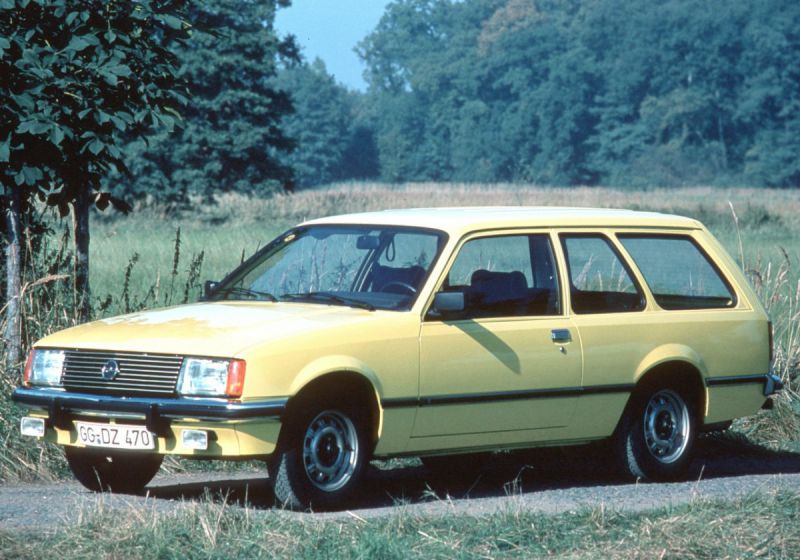
The Opel Rekord E Caravan 2.3 D (65 Hp) represents a significant chapter in European automotive history, serving as a reliable and practical family and utility vehicle during a pivotal era for the industry. Produced by German automaker Opel, a subsidiary of General Motors, the Rekord line had long been a staple in the mid-size segment across the continent. The “E” generation, launched in 1977, continued this tradition, evolving with the times while retaining its core values of durability and functionality. The Caravan, or station wagon variant, was particularly popular for its generous cargo capacity and versatility, making it a common sight on European roads from its introduction in 1978 until the end of its production run in 1982.
The Opel Rekord E Caravan 2.3 D: A Detailed Overview
In an automotive landscape increasingly concerned with fuel efficiency following the oil crises of the 1970s, the 2.3 D (65 Hp) diesel engine offered a compelling proposition for buyers prioritizing economy and longevity over outright performance. While not sold in the United States, the Opel Rekord E Caravan played a crucial role in Europe, providing an accessible and robust option for families and businesses alike, embodying the pragmatic approach to motoring that defined much of the European market. This article will delve into the technical specifications, design philosophies, and lasting impact of this quintessential European classic.
Powertrain & Engine Architecture
At the heart of the Opel Rekord E Caravan 2.3 D (65 Hp) was a robust 2.3-liter (2260 cubic centimeters, or 137.91 cubic inches) naturally aspirated inline-four diesel engine, designated as the 23D. This powerplant was engineered for reliability and fuel economy, characteristics highly valued in its primary European market during the late 1970s and early 1980s. It produced a modest 65 horsepower at 4200 revolutions per minute (rpm) and 93.67 pound-feet of torque at a low 2500 rpm. While these figures might seem humble by modern standards, they were entirely adequate for the vehicle’s intended purpose as a family hauler and long-distance cruiser.
The engine featured a single overhead camshaft (SOHC) valvetrain with two valves per cylinder, a common and proven design for durability and ease of maintenance. Its precombustion chamber injection system was a standard diesel technology of the era, contributing to its characteristic diesel clatter but also to its impressive fuel efficiency. With a high compression ratio of 22:1, the engine was designed to maximize thermodynamic efficiency, resulting in a combined fuel economy rating of approximately 27.7 US miles per gallon.
The 23D engine was a workhorse, designed for longevity rather than performance. The precombustion chamber design, while less efficient than direct injection systems that would come later, was incredibly robust and tolerant of lower quality fuel, a significant advantage in some European markets. Maintenance was relatively straightforward, focusing on regular oil changes, filter replacements, and valve adjustments. The engine’s simplicity contributed to its reputation for reliability.
Driving Characteristics
Performance-wise, the Rekord E Caravan 2.3 D was not built for speed. Its acceleration from 0 to 60 miles per hour was a leisurely 23.8 seconds, and its top speed reached approximately 86.99 mph. These figures underscored its role as a practical, rather than performance-oriented, vehicle. Power was sent to the rear wheels via a durable 4-speed manual transmission, a setup that provided a direct and engaging driving experience while also being simple and robust. The vehicle’s weight-to-power ratio stood at 19.5 kilograms per horsepower, or 51.2 horsepower per tonne, reflecting its focus on utility over acceleration.
Compared to other Rekord E variants, such as the 1.6 or 2.0-liter gasoline engines, the 2.3 D offered significantly less horsepower but considerably more torque at lower engine speeds. This made it a more relaxed cruiser, particularly when fully loaded with passengers and luggage. The manual transmission, while not offering the convenience of an automatic, allowed the driver to make the most of the available power and maintain reasonable speeds on inclines. The diesel’s torque delivery meant that it didn’t require frequent gear changes, contributing to a more comfortable driving experience on long journeys. The gasoline-powered Rekords offered quicker acceleration and higher top speeds, but at the expense of fuel economy and long-term durability.
Equipment & Trim Levels
The Opel Rekord E Caravan 2.3 D (65 Hp) typically occupied the entry-level or mid-range position within the Rekord E lineup. Standard equipment was relatively basic, reflecting its focus on affordability and practicality. Interior upholstery was typically cloth, often in durable, patterned fabrics designed to withstand heavy use. The dashboard was functional, featuring a straightforward instrument cluster with speedometer, fuel gauge, and temperature indicator. A basic AM/FM radio was often included, with options for cassette players available.
Optional extras included power steering, upgraded audio systems, tinted glass, and a sunroof. Higher trim levels, available with the gasoline engines, offered more luxurious features such as velour upholstery, electric windows, and central locking. However, the 2.3 D variant prioritized functionality over luxury, appealing to buyers who valued reliability and economy above all else. The Caravan body style itself was considered a premium feature, offering significantly more cargo space than the standard Rekord sedan.
Chassis & Braking
The Rekord E Caravan 2.3 D utilized a conventional chassis design with a body-on-frame construction. The front suspension featured independent coil springs and wishbones, providing a comfortable ride and reasonable handling. The rear suspension employed a solid axle with leaf springs, a robust and durable setup well-suited to carrying heavy loads.
Braking was provided by ventilated disc brakes on the front wheels and drum brakes on the rear wheels. This configuration was typical for vehicles of this era and weight class. The braking system was adequate for normal driving conditions, but lacked the stopping power of more modern systems. Stabilizer bars were often included, particularly on higher trim levels, to reduce body roll during cornering. The steering was a recirculating ball system, offering a relatively direct feel but requiring some effort at low speeds.
Market Reception & Comparison
Critics generally viewed the Opel Rekord E Caravan 2.3 D (65 Hp) as a sensible and practical choice for families and businesses. While it wasn’t praised for its performance, it was lauded for its fuel economy, reliability, and spacious interior. Comparisons with rivals like the Ford Granada and Volvo 240 often highlighted the Rekord’s affordability and straightforward mechanics.
Fuel economy was a key selling point, with the diesel engine offering significantly better mileage than the gasoline alternatives. Reliability was also a strong suit, with the 23D engine proving to be remarkably durable. However, the Rekord’s styling was often criticized as being somewhat bland and uninspired. The diesel engine’s characteristic noise and vibration were also drawbacks for some buyers. Despite these criticisms, the Rekord E Caravan 2.3 D remained a popular choice in Europe throughout its production run, offering a compelling combination of practicality, economy, and durability.
Technical Specifications: Opel Rekord E Caravan 2.3 D (65 Hp)
| Category | Specification |
| General Information | |
| Brand | Opel |
| Model | Rekord |
| Generation | Rekord E Caravan |
| Type (Engine) | 2.3 D (65 Hp) |
| Start of production | 1978 year |
| End of production | 1982 year |
| Powertrain Architecture | Internal Combustion engine |
| Body type | Station wagon (estate) |
| Seats | 5 |
| Doors | 3-5 |
| Performance Specs | |
| Fuel consumption (economy) – combined | 8.5 l/100 km |
| Fuel consumption (economy) – combined | 27.7 US mpg |
| Fuel Type | Diesel |
| Acceleration 0 – 60 mph | 23.8 sec |
| Maximum speed | 140 km/h |
| Maximum speed | 86.99 mph |
| Weight-to-power ratio | 19.5 kg/Hp |
| Weight-to-power ratio | 51.2 Hp/tonne |
| Weight-to-torque ratio | 10 kg/Nm |
| Weight-to-torque ratio | 100 Nm/tonne |
| Engine Specs | |
| Power | 65 Hp @ 4200 rpm. |
| Power per liter | 28.8 Hp/l |
| Torque | 127 Nm @ 2500 rpm. |
| Torque | 93.67 lb.-ft. @ 2500 rpm. |
| Engine Model/Code | 23D |
| Engine displacement | 2260 cm3 |
| Engine displacement | 137.91 cu. in. |
| Number of cylinders | 4 |
| Engine configuration | Inline |
| Cylinder Bore | 92 mm |
| Cylinder Bore | 3.62 in. |
| Piston Stroke | 85 mm |
| Piston Stroke | 3.35 in. |
| Compression ratio | 22:1 |
| Number of valves per cylinder | 2 |
| Fuel injection system | Precombustion chamber injection |
| Engine aspiration | Naturally aspirated engine |
| Valvetrain | SOHC |
| Space, Volume and Weights | |
| Kerb Weight | 1270 kg |
| Kerb Weight | 2799.87 lbs. |
| Max. weight | 1890 kg |
| Max. weight | 4166.74 lbs. |
| Max load | 620 kg |
| Max load | 1366.87 lbs. |
| Trunk (boot) space – minimum | 881 l |
| Trunk (boot) space – minimum | 31.11 cu. ft. |
| Fuel tank capacity | 70 l |
| Fuel tank capacity | 18.49 US gal |
| Permitted trailer load with brakes (12%) | 1250 kg |
| Permitted trailer load with brakes (12%) | 2755.78 lbs. |
| Permitted trailer load without brakes | 655 kg |
| Permitted trailer load without brakes | 1444.03 lbs. |
| Dimensions | |
| Length | 4620 mm |
| Length | 181.89 in. |
| Width | 1726 mm |
| Width | 67.95 in. |
| Height | 1470 mm |
| Height | 57.87 in. |
| Wheelbase | 2668 mm |
| Wheelbase | 105.04 in. |
| Front track | 1435 mm |
| Front track | 56.5 in. |
| Rear (Back) track | 1412 mm |
| Rear (Back) track | 55.59 in. |
| Drag coefficient (Cd) | 0.48 |
| Minimum turning circle (turning diameter) | 11.2 m |
| Minimum turning circle (turning diameter) | 36.75 ft. |
| Drivetrain, Brakes and Suspension Specs | |
| Drivetrain Architecture | The Internal combustion engine (ICE) drives the rear wheels of the vehicle. |
| Drive wheel | Rear wheel drive |
| Number of gears and type of gearbox | 4 gears, manual transmission |
| Front brakes | Ventilated discs |
| Rear brakes | Drum |
Legacy
The Opel Rekord E Caravan 2.3 D (65 Hp) has proven to be a remarkably durable vehicle, with many examples still surviving today. The 23D diesel engine, while not known for its refinement, is renowned for its longevity and ability to withstand high mileage. Its simplicity makes it relatively easy to maintain, even by amateur mechanics.
In the used car market, the Rekord E Caravan 2.3 D is appreciated by enthusiasts for its historical significance and practicality. Values remain relatively affordable, making it an accessible entry point into the world of classic European cars. However, potential buyers should be aware of the challenges associated with owning an older diesel vehicle, such as potential issues with fuel injection systems and emissions controls. Despite these challenges, the Rekord E Caravan 2.3 D remains a testament to Opel’s commitment to building reliable and practical vehicles, securing its place as a beloved classic among European car enthusiasts.