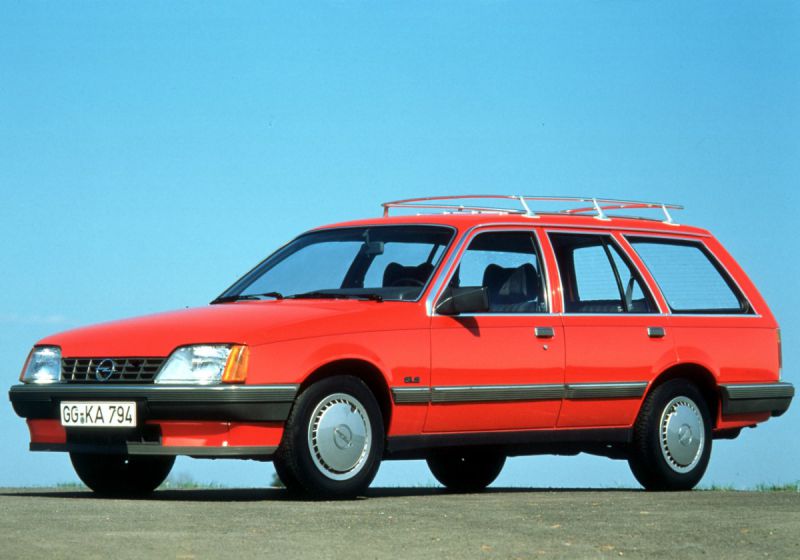
The Opel Rekord E Caravan, a cornerstone of European family motoring for decades, reached its final iteration with the E generation. This article focuses specifically on the 1.8 E CAT variant, produced from August 1985 to August 1986, representing Opel’s commitment to efficiency and practicality in the mid-1980s European market. As a five-door, five-seat station wagon (or “estate”), the Rekord E Caravan was a common sight on European roads, serving as a dependable vehicle for families and businesses. While never officially sold in the United States, its engineering and design reflected global automotive trends, emphasizing robust mechanics, spacious interiors, and a straightforward driving experience. The Rekord E Caravan was built on the 1HX0 platform, a chassis shared with other Opel and Vauxhall models of the era.
Evolution of the Opel Rekord E Caravan
The Rekord E debuted in 1977, succeeding the Rekord D. Its design was a contemporary take on Opel’s styling, featuring clean lines and a functional aesthetic. A significant facelift in 1982 brought a more aerodynamic front fascia, revised taillights, and updated interior appointments, aiming to remain competitive against rivals like the Ford Sierra and Volkswagen Passat. The introduction of the ‘CAT’ (Catalytic Converter) designation in models like the 1.8 E CAT in 1985 marked a crucial step towards addressing growing environmental concerns in Europe. This variant, therefore, represents not only the Rekord’s enduring practicality but also a transitional period in automotive engineering, balancing traditional ruggedness with emerging environmental responsibility.
Powertrain & Engine Architecture: The C18NV
The Opel Rekord E Caravan 1.8 E CAT was powered by the C18NV engine, a 1.8-liter (1796 cm3 or 109.6 cu. in.) inline-four cylinder unit. This naturally aspirated engine featured a Single Overhead Camshaft (SOHC) valvetrain with two valves per cylinder, a common and reliable configuration for mass-market vehicles. Fuel delivery was managed by a multi-port fuel injection system, a more advanced setup than carburetors, contributing to improved fuel efficiency and emissions control. The engine produced 100 horsepower at 5800 rpm and 103.26 lb.-ft. of torque at 3000 rpm. A relatively low compression ratio of 8.9:1 indicated an engine designed for durability and smooth operation, perfectly suiting its family-oriented mission.
The engine utilized a Bosch L-Jetronic fuel injection system, a sophisticated system for its time that precisely metered fuel delivery based on engine load and speed. The C18NV also featured a three-way catalytic converter, reducing harmful emissions by converting them into less harmful substances. The five-speed manual transmission, standard on this model, was a robust unit designed to handle the engine’s torque output. The transmission featured a conventional gear layout with synchromesh on all forward gears, ensuring smooth and precise shifting. The rear-wheel-drive configuration was a hallmark of Opel’s larger vehicles for many years, providing predictable handling characteristics.
Driving Characteristics
The 1.8 E CAT powertrain delivered adequate performance for the era. Acceleration from 0-60 mph took approximately 13.3 seconds, and the top speed was around 106.88 mph. While not particularly sporty, these figures were competitive for a mid-size family station wagon in the mid-1980s. The engine’s torque curve was relatively flat, providing usable power across a wide range of engine speeds. The five-speed manual transmission allowed drivers to keep the engine in its optimal power band, enhancing responsiveness. Compared to the more powerful 2.0-liter or 2.2-liter Rekord variants, the 1.8 E CAT offered a more economical driving experience, prioritizing fuel efficiency over outright performance. The rear-wheel-drive layout provided a balanced feel, although it lacked the cornering agility of more modern front-wheel-drive designs. The gear ratios were optimized for cruising, making it a comfortable vehicle for long-distance travel.
Equipment & Trim Levels
The 1.8 E CAT variant of the Rekord E Caravan was positioned as a mid-range offering in the lineup. Standard features included the multi-port fuel injection system, catalytic converter, and a five-speed manual transmission. The interior typically featured cloth upholstery, a straightforward dashboard layout with analog gauges, and a four-spoke steering wheel. Power-assisted steering was often included as standard equipment. Optional extras included a sunroof, upgraded audio system, and power windows. The exterior trim was relatively understated, with chrome accents on the bumpers and window surrounds. The Caravan’s defining feature was its spacious cargo area, accessible through a large rear tailgate. The rear seats could be folded down to create an even larger cargo space, enhancing its versatility.
Chassis & Braking
The Rekord E Caravan featured a robust chassis with a separate body-on-frame construction. The front suspension utilized independent coil springs and MacPherson struts, providing a comfortable ride and good handling. The rear suspension employed a solid axle with leaf springs, a cost-effective and durable design. Braking duties were handled by ventilated discs at the front, offering good stopping power, while the rear utilized drum brakes, a common solution for non-performance-oriented vehicles. The steering system was a recirculating ball type, providing a relatively direct feel. The vehicle’s kerb weight of 2546.34 lbs contributed to its stable handling characteristics. Stabilizer bars were fitted to both the front and rear axles to reduce body roll during cornering.
Market Reception & Comparison
Critics generally viewed the 1.8 E CAT Rekord E Caravan as a practical and reliable family vehicle. It was praised for its spacious interior, comfortable ride, and fuel efficiency. However, it was also noted that its performance was not particularly exciting compared to some of its rivals. Fuel economy was a strong point, with a combined rating of 27.7 US mpg (8.5 l/100 km), making it an economical choice for long-distance travel. Compared to the higher-output Rekord variants, the 1.8 E CAT offered a lower purchase price and reduced running costs. The Ford Sierra Estate and Volkswagen Passat Variant were its main competitors, offering similar levels of practicality and reliability. The Rekord E Caravan’s rear-wheel-drive layout was seen as a traditional feature, while the Sierra and Passat were transitioning to front-wheel drive, offering improved space efficiency and handling.
Technical Specifications: Opel Rekord E Caravan (facelift 1982) 1.8 E CAT (100 Hp)
| Category | Specification |
| General Information | |
| Brand | Opel |
| Model | Rekord E Caravan (facelift 1982) |
| Type (Engine) | 1.8 E CAT (100 Hp) |
| Production Start | August, 1985 |
| Production End | August, 1986 |
| Powertrain Architecture | Internal Combustion Engine, Rear Wheel Drive |
| Body Type | Station Wagon (Estate) 5 Doors, 5 Seats |
| Performance Specifications | |
| Fuel Consumption (Combined) | 27.7 US mpg (8.5 l/100 km) |
| Fuel Type | Petrol (Gasoline) |
| Acceleration 0-60 mph | 13.3 sec |
| Acceleration 0-100 km/h | 14 sec |
| Maximum Speed | 106.88 mph (172 km/h) |
| Weight-to-Power Ratio | 11.6 kg/Hp (86.6 Hp/tonne) |
| Weight-to-Torque Ratio | 8.3 kg/Nm (121.2 Nm/tonne) |
| Engine Specifications | |
| Power | 100 Hp @ 5800 rpm |
| Torque | 103.26 lb.-ft. (140 Nm) @ 3000 rpm |
| Engine Model/Code | C18NV |
| Engine Displacement | 1.8 liters (1796 cm3 / 109.6 cu. in.) |
| Number of Cylinders | 4 Inline |
| Cylinder Bore | 3.34 in. (84.8 mm) |
| Piston Stroke | 3.13 in. (79.5 mm) |
| Compression Ratio | 8.9:1 |
| Valves per Cylinder | 2 |
| Fuel Injection System | Multi-port manifold injection |
| Engine Aspiration | Naturally aspirated |
| Valvetrain | SOHC |
| Engine Oil Capacity | 3.17 US qt (3 l) |
| Coolant Capacity | 7.93 US qt (7.5 l) |
| Space, Volume, and Weights | |
| Kerb Weight | 2546.34 lbs (1155 kg) |
| Max. Weight | 3902.18 lbs (1770 kg) |
| Max Load | 1355.84 lbs (615 kg) |
| Fuel Tank Capacity | 18.49 US gal (70 l) |
| Permitted Trailer Load (with brakes) | 2204.62 lbs (1000 kg) |
| Permitted Trailer Load (without brakes) | 1179.47 lbs (535 kg) |
| Dimensions | |
| Length | 184.17 in. (4678 mm) |
| Width | 67.72 in. (1720 mm) |
| Height | 58.07 in. (1475 mm) |
| Wheelbase | 105.04 in. (2668 mm) |
| Front Track | 56.5 in. (1435 mm) |
| Rear Track | 56.38 in. (1432 mm) |
| Ride Height (Ground Clearance) | 5.51 in. (140 mm) |
| Minimum Turning Circle | 35.43 ft. (10.8 m) |
| Drivetrain, Brakes, and Suspension | |
| Drive Wheel | Rear Wheel Drive |
| Gearbox | 5-speed manual transmission |
| Front Brakes | Ventilated discs |
| Rear Brakes | Drum |
Legacy
The Opel Rekord E Caravan, particularly the 1.8 E CAT variant, holds a significant place in European automotive history. It was one of the last mainstream rear-wheel-drive family cars from a major European manufacturer before the widespread adoption of front-wheel drive. The Rekord series had built a reputation for reliability, spaciousness, and straightforward engineering, qualities that resonated with European consumers. The E generation, and especially the Caravan variant, embodied this philosophy, offering a practical and unpretentious package. In the used car market today, well-maintained Rekord E Caravans are sought after by enthusiasts and collectors, representing a nostalgic reminder of a bygone era of automotive design. The C18NV engine is known for its durability, and examples with reasonable mileage can still provide reliable transportation. While parts availability may be limited, the Rekord E Caravan’s simple construction makes it relatively easy to maintain for those with mechanical skills. The Rekord E Caravan ultimately paved the way for the Opel Omega, continuing the legacy of providing a spacious and comfortable platform for family motoring.