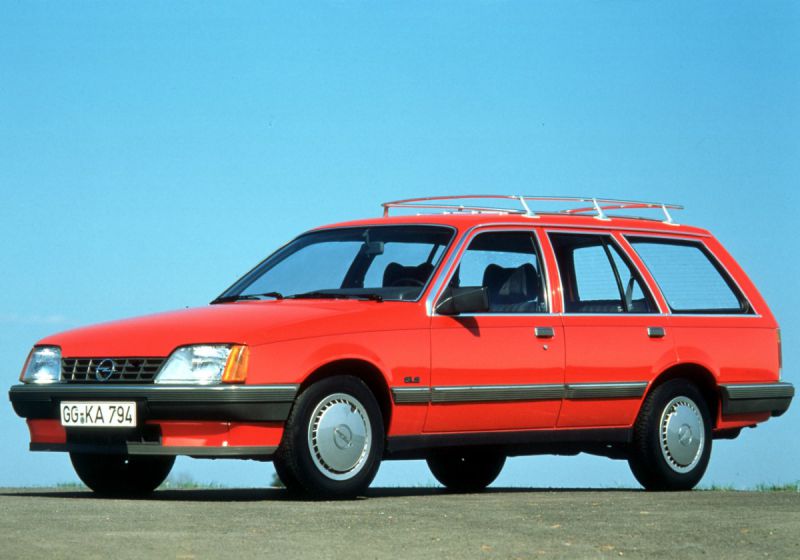
The Opel Rekord E Caravan (facelift 1982) 2.0 S (101 Hp) represents a significant chapter in European automotive history, embodying the practical, reliable, and value-oriented ethos that defined Opel for decades. Launched in September 1982 as a refreshed version of the fifth-generation Rekord (E2), this particular variant, the 2.0 S, was a popular choice for families and businesses across the continent. While never officially imported to the United States, the Rekord E played a crucial role in Opel’s strategy as a mainstream, rear-wheel-drive family car, offering a blend of spaciousness, straightforward engineering, and respectable performance for its era. This station wagon, known as “Caravan” in Opel’s nomenclature, was designed to be a versatile vehicle, combining passenger comfort with substantial cargo capacity, making it a ubiquitous sight on European roads during the early to mid-1980s.
The Opel Rekord E Caravan: Engineering and Evolution
The Rekord E series, introduced in 1977, was Opel’s answer to the evolving demands of the European market, succeeding the long-running Rekord D. The 1982 facelift, often referred to as the Rekord E2, brought a series of aesthetic and mechanical refinements aimed at keeping the model competitive against rivals from Ford, Volkswagen, and Volvo. This refresh was characterized by a more aerodynamic front end, revised taillights, and interior updates, enhancing its modern appeal. The Opel Rekord E Caravan, in its 2.0 S guise, was positioned as a capable and economical option within the lineup, balancing power with fuel efficiency for everyday use. Its robust, rear-wheel-drive architecture, a hallmark of Opel’s larger models at the time, contributed to its reputation for durability and predictable handling.
Powertrain & Engine Architecture
Under the hood of the Opel Rekord E Caravan (facelift 1982) 2.0 S lay a reliable 2.0-liter (1979 cm3 or 120.77 cu. in.) naturally aspirated inline-four engine, designated with the code “20S.” This powerplant, featuring a single overhead camshaft (SOHC) and a carburetor fuel injection system, delivered a respectable 101 horsepower at 5400 rpm. Torque output stood at 115.06 lb.-ft. (156 Nm) at a relatively low 3800 rpm, providing ample pulling power for daily driving and highway cruising, even when fully loaded. The carburetor system, while less sophisticated than fuel injection systems found in some contemporary vehicles, was known for its simplicity and ease of maintenance.
The 20S engine featured a 95 mm bore and 69.8 mm piston stroke, along with a 9:1 compression ratio, ensuring a balance of responsiveness and longevity. The SOHC valvetrain utilized a single camshaft to operate the intake and exhaust valves, a common configuration for engines of this era. The engine was paired with a four-speed manual transmission, although a three-speed automatic transmission was also available as an option. The automatic transmission, while offering convenience, typically resulted in slightly reduced fuel economy and acceleration compared to the manual version.
Driving Characteristics
The Opel Rekord E Caravan 2.0 S with the four-speed manual transmission offered a reasonably engaging driving experience for its time. Acceleration from 0 to 60 mph was calculated at 12.8 seconds, with a top speed of approximately 108.74 mph (175 km/h). While these figures may seem modest by modern standards, they were competitive for a family station wagon in the early 1980s. The engine’s torque output at lower rpm provided good responsiveness for everyday driving, making it easy to navigate city streets and maintain highway speeds. The rear-wheel-drive layout contributed to a balanced feel, particularly when the vehicle was loaded with passengers or cargo.
Compared to the higher-output versions of the Rekord E, such as those equipped with the 2.1-liter engine, the 2.0 S offered a more economical driving experience. The 2.1-liter engines provided more power but at the expense of fuel efficiency. The automatic transmission version of the 2.0 S, while convenient, resulted in slightly slower acceleration and reduced fuel economy compared to the manual version. The gear ratios in the four-speed manual transmission were well-suited for both city and highway driving, providing a good balance of acceleration and cruising ability.
Equipment & Trim Levels
The 2.0 S trim level of the Opel Rekord E Caravan was positioned as a mid-range offering, providing a good balance of features and affordability. Standard equipment typically included basic heating and ventilation, comfortable cloth seating, and a simple radio. The interior was designed with practicality in mind, featuring durable materials and straightforward ergonomics. Optional extras available for the 2.0 S included a more advanced radio with cassette player, power windows, and a sunroof. The exterior featured chrome trim and relatively simple styling, reflecting the car’s focus on functionality rather than luxury.
The Caravan body style itself was a key feature, offering a large rear cargo area accessible via a wide tailgate. The interior could comfortably seat five occupants, making it ideal for families. The dashboard layout was typical of Opel vehicles of the period, with clearly labeled gauges and controls. The steering wheel was typically made of plastic, and the seats were upholstered in durable cloth fabric. The overall interior ambiance was functional and practical, prioritizing durability and ease of use.
Chassis & Braking
The Opel Rekord E Caravan 2.0 S utilized a robust chassis and suspension system designed to provide a comfortable ride and predictable handling. The front suspension featured independent coil springs and wishbones, while the rear suspension employed a solid axle with leaf springs. This configuration provided a good balance of ride comfort and load-carrying capacity. The steering was a recirculating ball system, which offered a relatively direct feel.
The braking system consisted of ventilated discs at the front and drum brakes at the rear. This configuration provided adequate stopping power for the vehicle’s weight and performance. The braking system was a dual-circuit design, providing a degree of redundancy in case of a failure in one circuit. The wheels were typically steel rims with hubcaps, and the tires were sized to provide a good balance of grip and durability. Stabilizer bars were fitted to both the front and rear axles to reduce body roll during cornering.
Market Reception & Comparison
The Opel Rekord E Caravan 2.0 S was generally well-received by critics and consumers alike. It was praised for its practicality, reliability, and affordability. While it wasn’t the most exciting car to drive, it provided a comfortable and dependable transportation solution for families and businesses. Fuel economy was a notable strong suit, with a combined consumption rating of 25.8 US mpg (9.1 l/100 km).
Compared to other trims in the Rekord E lineup, the 2.0 S offered a good balance of performance and economy. The higher-output versions provided more power but at the expense of fuel efficiency. The automatic transmission version of the 2.0 S was less popular than the manual version, as it resulted in slightly reduced performance and fuel economy. In terms of reliability, the 2.0 S engine was generally considered to be very durable and long-lasting, requiring minimal maintenance. It faced competition from rivals such as the Ford Granada Turnier, the Volkswagen Passat B2 Variant, and the Volvo 240 Estate, but it carved out its niche by offering a compelling combination of features and affordability.
Technical Specifications
| General Information | |
| Brand | Opel |
| Model | Rekord |
| Generation | Rekord E Caravan (facelift 1982) |
| Type (Engine) | 2.0 S (101 Hp) |
| Start of Production | September, 1982 |
| End of Production | August, 1984 |
| Powertrain Architecture | Internal Combustion engine |
| Body type | Station wagon (estate) |
| Seats | 5 |
| Doors | 3-5 |
| Performance Specs | |
| Fuel consumption (combined) | 25.8 US mpg (9.1 l/100 km) |
| Fuel Type | Petrol (Gasoline) |
| Acceleration 0 – 60 mph | 12.8 sec |
| Acceleration 0 – 62 mph (100 km/h) | 13.5 sec |
| Maximum speed | 108.74 mph (175 km/h) |
| Weight-to-power ratio | 11.4 kg/Hp (87.8 Hp/tonne) |
| Weight-to-torque ratio | 7.4 kg/Nm (135.7 Nm/tonne) |
| Engine Specs | |
| Power | 101 Hp @ 5400 rpm |
| Power per liter | 51 Hp/l |
| Torque | 115.06 lb.-ft. (156 Nm) @ 3800 rpm |
| Engine Model/Code | 20S |
| Engine displacement | 2.0 l (1979 cm3, 120.77 cu. in.) |
| Number of cylinders | 4 |
| Engine configuration | Inline |
| Cylinder Bore | 3.74 in. (95 mm) |
| Piston Stroke | 2.75 in. (69.8 mm) |
| Compression ratio | 9:1 |
| Number of valves per cylinder | 2 |
| Fuel injection system | Carburetor |
| Engine aspiration | Naturally aspirated engine |
| Valvetrain | SOHC |
| Engine oil capacity | 4.02 US qt (3.8 l) |
| Coolant capacity | 6.45 US qt (6.1 l) |
| Space, Volume and Weights | |
| Kerb Weight | 2535.32 lbs. (1150 kg) |
| Max. weight | 3968.32 lbs. (1800 kg) |
| Max load | 1433 lbs. (650 kg) |
| Fuel tank capacity | 18.49 US gal (70 l) |
| Permitted trailer load with brakes (12%) | 2755.78 lbs. (1250 kg) |
| Permitted trailer load without brakes | 1179.47 lbs. (535 kg) |
| Dimensions | |
| Length | 184.17 in. (4678 mm) |
| Width | 67.72 in. (1720 mm) |
| Height | 58.07 in. (1475 mm) |
| Wheelbase | 105.04 in. (2668 mm) |
| Front track | 56.5 in. (1435 mm) |
| Rear (Back) track | 56.38 in. (1432 mm) |
| Ride height (ground clearance) | 5.51 in. (140 mm) |
| Drag coefficient (Cd) | 0.40 |
| Minimum turning circle (turning diameter) | 35.43 ft. (10.8 m) |
| Drivetrain, Brakes and Suspension Specs | |
| Drivetrain Architecture | The Internal combustion engine (ICE) drives the rear wheels of the vehicle. |
| Drive wheel | Rear wheel drive |
| Number of gears and type of gearbox | 4 gears, manual transmission |
| Front brakes | Ventilated discs |
| Rear brakes | Drum |
Legacy
The Opel Rekord E Caravan (facelift 1982) cemented its place as a cornerstone of the European automotive landscape during its production run from 1982 to 1984. As a true workhorse, it was widely appreciated for its rugged dependability, generous interior space, and cost-effectiveness, appealing to a broad spectrum of buyers from families needing practical transport to businesses requiring a reliable fleet vehicle. Its rear-wheel-drive layout, while becoming less common in mainstream sedans and wagons by the mid-1980s, offered a traditional driving feel and excellent towing capabilities, with a permitted trailer load of up to 2755.78 lbs. (1250 kg) with brakes.
In the used car market today, well-maintained examples of the Rekord E Caravan are becoming increasingly sought after by collectors and enthusiasts. The 2.0 S engine is known for its durability and relatively simple maintenance requirements. While finding parts can be challenging, a dedicated community of Opel enthusiasts exists to provide support and resources. The Rekord E Caravan represents a bygone era of automotive engineering, characterized by its robust construction, practical design, and enduring reliability. It remains a testament to Opel’s commitment to building dependable, affordable vehicles for the masses.