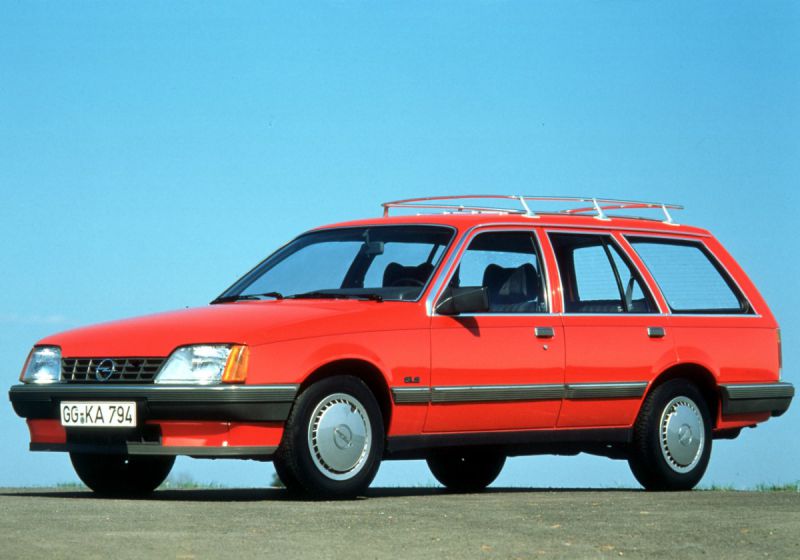
The Opel Rekord E Caravan (facelift 1982) 2.0 S represents a pivotal moment in the history of Opel, General Motors’ European subsidiary. Launched in 1982, this particular iteration was part of the refreshed E-generation Rekord, a ubiquitous sight on European roads throughout the late 1970s and early 1980s. The Rekord series, dating back to 1953, consistently served as Opel’s mid-size workhorse, offering a blend of practicality, reliability, and conservative styling that appealed to a broad demographic, from families to small businesses. The “Caravan” designation proudly indicated its station wagon body style, emphasizing its utility and cargo-carrying capabilities – a highly popular vehicle type in Europe. The 2.0 S variant, with its 98 horsepower engine, was a well-balanced offering, providing adequate performance for the era without sacrificing fuel economy, making it a sensible choice for the European market where fuel prices were a constant consideration. While never officially sold in the United States, the Rekord E Caravan played a crucial role in shaping the perception of robust, no-nonsense family transportation across the Atlantic, embodying the pragmatic design and engineering principles characteristic of German automotive manufacturing.
Powertrain & Engine Architecture
At the heart of the Opel Rekord E Caravan (facelift 1982) 2.0 S was Opel’s venerable 2.0-liter (120.77 cubic inch) inline-four engine, designated with the code 20S. This naturally aspirated gasoline powerplant, a staple across various Opel models of the period, featured a single overhead camshaft (SOHC) valvetrain with two valves per cylinder, a common and reliable configuration for mass-market vehicles of the early 1980s. Fuel delivery was managed by a Solex carburetor system, reflecting the prevailing technology before widespread adoption of electronic fuel injection. The engine produced a respectable 98 horsepower at 5400 rpm and 112.85 lb.-ft. of torque at 3800 rpm. This power output, while modest by today’s standards, was entirely competitive for a mainstream family station wagon of its time, especially when considering the vehicle’s curb weight of 2535.32 lbs.
The 20S engine utilized a cast iron block and an aluminum cylinder head, a common construction method for durability and weight reduction. The carburetor, a Solex 32 PHN, was tuned for optimal fuel economy and drivability, prioritizing smooth operation over outright performance. The engine’s cooling system consisted of a conventional water-cooled setup with a radiator and thermostat. The five-speed manual transmission, a key component of the 2.0 S, was a rear-wheel-drive unit, providing efficient power transfer and contributing to the vehicle’s overall fuel efficiency. The transmission’s gear ratios were optimized for both city driving and highway cruising, offering a balance between acceleration and relaxed long-distance travel.
Driving Characteristics
The Opel Rekord E Caravan 2.0 S offered a driving experience that prioritized comfort and practicality over sporty handling. The 98 horsepower engine, coupled with the five-speed manual transmission, provided adequate acceleration for everyday driving, but it wasn’t a particularly quick vehicle. Acceleration from 0 to 60 mph took approximately 12.8 seconds, and the top speed was around 108.74 mph. The rear-wheel-drive layout contributed to predictable handling, but the relatively soft suspension setup and the vehicle’s weight meant that it wasn’t particularly agile in corners.
Compared to other Rekord E variants, such as the 1.8-liter models, the 2.0 S offered a noticeable improvement in performance, particularly when fully loaded with passengers or cargo. The 2.0 S also differed from the more powerful, but less common, 2.3-liter versions, which provided significantly more horsepower but at the expense of fuel economy. The five-speed manual transmission allowed drivers to keep the engine in its optimal power band, maximizing efficiency and responsiveness. The gear ratios were spaced to provide good acceleration in lower gears and relaxed cruising in higher gears. Overall, the driving experience was characterized by a smooth ride, predictable handling, and sufficient power for most everyday driving situations.
Equipment & Trim Levels
The Opel Rekord E Caravan 2.0 S occupied a mid-range position within the Rekord E lineup. It was positioned above the base models with smaller engines and fewer features, but below the more luxurious and powerful variants. Standard equipment included cloth upholstery, a basic AM/FM radio, and manual windows and door locks. The interior was functional and durable, with a focus on practicality rather than luxury.
Optional extras available for the 2.0 S included upgraded upholstery, a sunroof, power windows, and a more sophisticated audio system. Metallic paint finishes were also available at an extra cost. The dashboard layout was straightforward and easy to use, with clearly labeled controls and a comprehensive instrument cluster. The Caravan body style offered a spacious interior and a large cargo area, making it ideal for families and those who needed to transport bulky items. The rear seats could be folded down to create an even larger cargo space, further enhancing the vehicle’s versatility.
Chassis & Braking
The Opel Rekord E Caravan 2.0 S utilized a traditional body-on-frame construction, providing a robust and durable chassis. The suspension system consisted of independent front suspension with MacPherson struts and a solid rear axle with leaf springs. This setup provided a comfortable ride, but it wasn’t particularly sophisticated in terms of handling. The front suspension featured anti-roll bar to reduce body roll during cornering.
The braking system consisted of ventilated disc brakes on the front wheels and drum brakes on the rear wheels. This configuration was typical for vehicles of its size and era. The braking performance was adequate for everyday driving, but it wasn’t particularly powerful by modern standards. The steering system was a recirculating ball system, providing a relatively heavy but precise steering feel. The tires were typically 175/70 R14, providing a good balance between grip and ride comfort.
Market Reception & Comparison
The Opel Rekord E Caravan 2.0 S was generally well-received by critics and consumers alike. It was praised for its practicality, reliability, and spacious interior. However, it was also criticized for its somewhat conservative styling and its lack of sporty handling. Compared to other trims in the Rekord E lineup, the 2.0 S offered a good balance of performance and fuel economy. The 1.8-liter models were more fuel-efficient but lacked the power of the 2.0 S, while the 2.3-liter models offered more power but at the expense of fuel economy.
In terms of fuel economy, the 2.0 S achieved approximately 21.4 US mpg in combined driving, which was competitive for a station wagon of its size and era. Reliability was also a strong point, with the 20S engine proving to be durable and long-lasting. The Rekord E Caravan 2.0 S was a popular choice for families and businesses who needed a practical and reliable vehicle.
Technical Specifications
| Category | Specification |
| Brand | Opel |
| Model | Rekord |
| Generation | Rekord E Caravan (facelift 1982) |
| Engine Type | 2.0 S (98 Hp) |
| Production Start | 1982 |
| Production End | 1984 |
| Powertrain Architecture | Internal Combustion Engine |
| Body Type | Station wagon (estate) |
| Seats | 5 |
| Doors | 3-5 |
| Fuel Consumption (Combined) | 11 l/100 km (21.4 US mpg) |
| Fuel Type | Petrol (Gasoline) |
| Acceleration 0-60 mph | 12.8 sec |
| Acceleration 0-62 mph (0-100 km/h) | 13.5 sec |
| Maximum Speed | 175 km/h (108.74 mph) |
| Weight-to-Power Ratio | 11.7 kg/Hp |
| Weight-to-Torque Ratio | 7.5 kg/Nm |
| Power | 98 Hp @ 5400 rpm |
| Torque | 153 Nm @ 3800 rpm (112.85 lb.-ft. @ 3800 rpm) |
| Engine Model/Code | 20S |
| Engine Displacement | 1979 cm3 (120.77 cu. in.) |
| Number of Cylinders | 4 |
| Cylinder Bore | 95 mm (3.74 in.) |
| Piston Stroke | 69.8 mm (2.75 in.) |
| Compression Ratio | 9:1 |
| Fuel Injection System | Carburetor |
| Kerb Weight | 1150 kg (2535.32 lbs.) |
| Length | 4678 mm (184.17 in.) |
| Width | 1720 mm (67.72 in.) |
| Height | 1475 mm (58.07 in.) |
| Wheelbase | 2668 mm (105.04 in.) |
Legacy
The Opel Rekord E Caravan 2.0 S, and the Rekord E series as a whole, holds a significant place in European automotive history. Its robust construction, reliable engine, and spacious interior made it a popular choice for families and businesses for many years. While it may not be remembered for its groundbreaking technology or sporty performance, it was a car that consistently delivered on its promise of practicality and dependability.
In the used car market today, the Rekord E Caravan 2.0 S is a relatively rare sight, but well-maintained examples are sought after by collectors and enthusiasts. The 20S engine is known for its durability, and many examples have covered high mileage without major issues. However, like any classic car, the Rekord E Caravan requires regular maintenance and attention to prevent rust and other age-related problems. Its legacy is one of a dependable, no-nonsense family vehicle that played a vital role in the lives of countless Europeans during the 1980s.