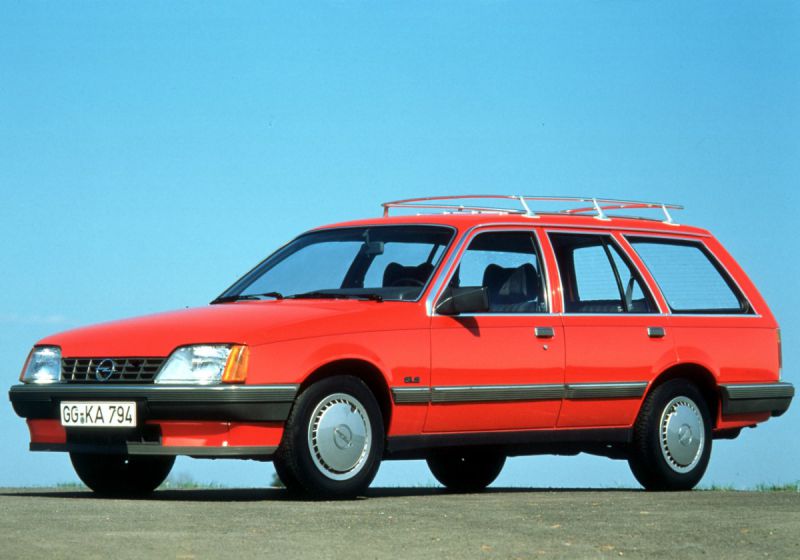
The Opel Rekord E Caravan (facelift 1982) represents a significant chapter in European automotive history, serving as a reliable and practical family and utility vehicle across the continent. Produced by the German automaker Opel, this particular iteration, known internally as the Rekord E2, was the updated version of the fifth-generation Rekord, which originally launched in 1977. The facelifted model, introduced in September 1982, brought subtle yet effective enhancements, refining its design and mechanics to keep pace with the evolving demands of the European market. As a classic car, its legacy is rooted in its role as an accessible, durable, and spacious station wagon, a staple for families and businesses alike in its primary European operating environment. Though never officially sold in the United States, the Rekord E2 exemplified the practical, rear-wheel-drive sedan and wagon architecture that was common in Europe during the era, offering a blend of sturdy engineering and no-nonsense utility.
The 2.3 D (65 Hp) Automatic: Positioning and Overview
The 2.3 D (65 hp) Automatic variant of the Opel Rekord E Caravan (facelift 1982) occupied the entry-level position within the Rekord E2 lineup. It was designed for buyers prioritizing fuel economy and durability over outright performance. While higher-trim Rekords offered larger gasoline engines and more luxurious appointments, the 2.3 Diesel Automatic appealed to a pragmatic customer base – families, small business owners, and those covering long distances where fuel costs were a significant concern. It was a workhorse, built to provide reliable transportation without demanding a premium price.
Powertrain & Engine Architecture
The heart of this Rekord E Caravan is the 2.3-liter (2260 cm³) naturally aspirated inline-four diesel engine, designated with the model code 23D. This engine was a mainstay of Opel’s diesel offerings during the period. It featured a robust cast iron block and cylinder head, designed for longevity. The 23D employed a precombustion chamber injection system, a common diesel technology of the time. This system utilized a small precombustion chamber within each cylinder head, where fuel was injected and ignited by the compression heat, then used to ignite the main combustion chamber. This design aided in smoother combustion and reduced engine noise compared to direct injection systems.
The engine’s valvetrain consisted of a single overhead camshaft (SOHC) operating two valves per cylinder. This configuration simplified the engine’s design and contributed to its reliability. The 23D produced 65 horsepower at 4200 rpm and 93.67 lb-ft (127 Nm) of torque at 2500 rpm. Power was transmitted to the rear wheels through a three-speed automatic transmission. This transmission, while not offering the sophistication of modern automatics, was known for its durability and smooth operation. It featured a torque converter for smooth launches and gear changes. The gear ratios were optimized for fuel efficiency and everyday drivability, rather than sporty acceleration.
Driving Characteristics
The driving experience in the 2.3 D Automatic Rekord E Caravan was characterized by its relaxed and unhurried nature. Acceleration was modest, with a 0-60 mph time estimated around 26.6 seconds. This was significantly slower than the gasoline-powered Rekords, or even the manual diesel versions. However, the engine’s torque delivery at low rpm provided adequate pulling power for everyday driving and hauling loads. The three-speed automatic transmission contributed to a smooth, if somewhat leisurely, driving experience. Upshifts were generally seamless, but downshifts could be slow and deliberate. Compared to the manual transmission versions, the automatic offered greater convenience, particularly in urban traffic, but at the expense of performance and fuel economy. The rear-wheel-drive layout provided predictable handling, but the car wasn’t designed for spirited cornering.
Equipment & Trim Levels
The 2.3 D Automatic trim level was generally considered the base model. Standard equipment typically included cloth upholstery, basic instrumentation (speedometer, fuel gauge, temperature gauge), and a simple two-spoke steering wheel. The interior was functional and durable, with hard-wearing plastics and vinyl surfaces. Optional extras included a radio, upgraded upholstery, power windows, and a sunroof. The Caravan body style itself was a key feature, offering a large cargo area accessible through a rear tailgate. The rear seats could be folded down to further increase cargo capacity. The dashboard layout was straightforward and easy to use, prioritizing functionality over aesthetics.
Chassis & Braking
The Rekord E Caravan featured a traditional body-on-frame construction, providing a robust and durable chassis. The front suspension utilized independent coil springs and wishbones, while the rear suspension employed a solid axle with leaf springs. This setup provided a comfortable ride, but wasn’t particularly sporty. The braking system consisted of ventilated disc brakes at the front and drum brakes at the rear. While adequate for the car’s weight and performance, the drum brakes on the rear wheels were less effective than disc brakes, particularly in wet conditions. The steering was a recirculating ball system, providing a relatively heavy but precise feel. Stabilizer bars were typically fitted to both the front and rear axles to reduce body roll during cornering.
Market Reception & Comparison
The Opel Rekord E Caravan 2.3 D Automatic received generally positive reviews for its practicality, fuel economy, and durability. Critics praised its spacious interior and large cargo area, making it an ideal vehicle for families and businesses. However, the engine’s modest power output and the three-speed automatic transmission were often criticized for their lack of refinement. Compared to the gasoline-powered Rekords, the diesel version offered significantly better fuel economy, but at the expense of performance. Compared to competitors like the Ford Granada and Volkswagen Passat, the Rekord offered a competitive price point and a reputation for reliability. The diesel engine, while not as refined as some of its competitors, was known for its longevity and low maintenance costs. The automatic transmission, while not cutting-edge, provided a level of convenience that appealed to many buyers.
Technical Specifications
| Category | Specification |
| General Information | |
| Brand | Opel |
| Model | Rekord |
| Generation | Rekord E Caravan (facelift 1982) |
| Type (Engine) | 2.3 D (65 Hp) Automatic |
| Start of Production | September, 1982 |
| End of Production | July, 1983 |
| Powertrain Architecture | Internal Combustion engine |
| Body Type | Station wagon (estate) |
| Seats | 5 |
| Doors | 3-5 |
| Performance Specs | |
| Fuel Consumption (combined) | 8.1 l/100 km (29 US mpg) |
| Fuel Type | Diesel |
| Acceleration 0 – 60 mph | 26.6 sec |
| Acceleration 0 – 62 mph (0 – 100 km/h) | 28 sec |
| Maximum Speed | 88.86 mph (143 km/h) |
| Weight-to-power ratio | 19.9 kg/Hp, 50.2 Hp/tonne |
| Weight-to-torque ratio | 10.2 kg/Nm, 98.1 Nm/tonne |
| Engine Specs | |
| Power | 65 Hp @ 4200 rpm |
| Power per liter | 28.8 Hp/l |
| Torque | 93.67 lb.-ft. (127 Nm) @ 2500 rpm |
| Engine Model/Code | 23D |
| Engine Displacement | 2.3 liters (2260 cm³ / 137.91 cu. in.) |
| Number of Cylinders | 4 Inline |
| Cylinder Bore | 3.62 in. (92 mm) |
| Piston Stroke | 3.35 in. (85 mm) |
| Compression Ratio | 22:1 |
| Number of valves per cylinder | 2 |
| Fuel Injection System | Precombustion chamber injection |
| Engine Aspiration | Naturally aspirated engine |
| Valvetrain | SOHC |
| Engine Oil Capacity | 5.81 US qt (5.5 l) |
| Coolant Capacity | 12.15 US qt (11.5 l) |
| Space, Volume and Weights | |
| Kerb Weight | 2854.99 lbs. (1295 kg) |
| Max. Weight (Gross Vehicle Weight) | 4188.78 lbs. (1900 kg) |
| Max Load | 1333.8 lbs. (605 kg) |
| Fuel Tank Capacity | 18.49 US gal (70 l) |
| Permitted trailer load with brakes (12%) | 2204.62 lbs. (1000 kg) |
| Permitted trailer load without brakes | 1179.47 lbs. (535 kg) |
| Dimensions | |
| Length | 184.17 in. (4678 mm) |
| Width | 67.72 in. (1720 mm) |
| Height | 58.07 in. (1475 mm) |
| Wheelbase | 105.04 in. (2668 mm) |
| Front Track | 56.5 in. (1435 mm) |
| Rear (Back) Track | 56.38 in. (1432 mm) |
| Ride Height (Ground Clearance) | 5.51 in. (140 mm) |
| Minimum Turning Circle (Turning Diameter) | 35.43 ft. (10.8 m) |
| Drivetrain, Brakes and Suspension Specs | |
| Drivetrain Architecture | The Internal combustion engine (ICE) drives the rear wheels of the vehicle. |
| Drive Wheel | Rear wheel drive |
| Number of gears and type of gearbox | 3 gears, automatic transmission |
| Front Brakes | Ventilated discs |
| Rear Brakes | Drum |
Legacy
The Opel Rekord E Caravan 2.3 D Automatic, while not a performance icon, has earned a reputation as a durable and reliable classic. The 23D diesel engine, when properly maintained, is known for its longevity. Today, these vehicles are increasingly sought after by classic car enthusiasts who appreciate their simplicity and practicality. Parts availability can be a challenge, but a dedicated community of owners and suppliers exists to support the preservation of these vehicles. The 2.3 D Automatic variant, in particular, represents an accessible entry point into the world of classic Opel ownership, offering a comfortable and economical driving experience for those seeking a taste of 1980s European motoring.