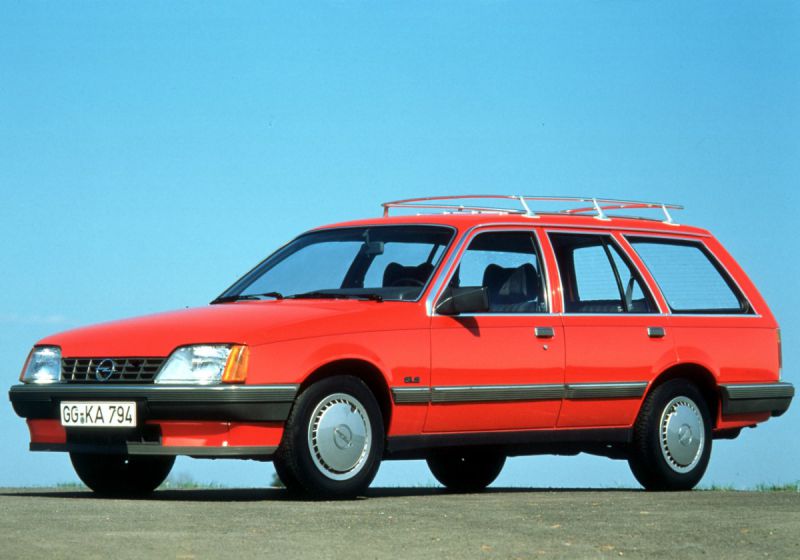
The Opel Rekord E Caravan (facelift 1982) 2.3 D represents a significant chapter in European automotive history, embodying the practical, durable, and economical ethos of a mid-size family car from the early 1980s. Produced by the German automaker Opel, a subsidiary of General Motors, the Rekord series was a ubiquitous sight on European roads for decades. The E generation, launched in 1977, received a notable facelift in 1982, which refined its aesthetics and updated its mechanical offerings. This particular variant, the 2.3 D, was a diesel-powered station wagon, known in Europe as an “estate,” designed to offer robust utility, impressive fuel economy, and ample space for families and businesses alike. While never officially sold in the United States, the Rekord E Caravan played a crucial role in Opel’s market strategy across the European continent, serving as a reliable and cost-effective alternative to more premium or performance-oriented vehicles.
Evolution and Market Positioning of the Opel Rekord E Caravan
The Opel Rekord series, spanning multiple generations, established itself as a cornerstone of Opel’s product lineup, consistently delivering a blend of practicality, comfort, and affordability. The E generation, in particular, was a direct competitor to other European mid-size vehicles such as the Ford Sierra and Volkswagen Passat. The 1982 facelift introduced subtle but effective changes, modernizing the vehicle’s appearance to align with evolving design trends while retaining its fundamental robust character. The Caravan, or station wagon, body style was especially popular, catering to the strong demand for versatile vehicles capable of hauling both passengers and cargo. The choice of a diesel engine for the 2.3 D variant was a strategic move, capitalizing on the growing preference for fuel-efficient powertrains in Europe, particularly in an era of fluctuating fuel prices. This trim level occupied a position as a value-oriented, practical choice within the Rekord E lineup, appealing to buyers prioritizing economy and utility over performance or luxury.
Powertrain & Engine Architecture: The 23D Diesel
At the heart of the Opel Rekord E Caravan (facelift 1982) 2.3 D lies a naturally aspirated, inline-four diesel engine, designated with the model code 23D. This 2.3-liter (2260 cm³ or 137.91 cubic inches) powerplant was designed for durability and efficiency rather than outright speed. It produced a modest 71 horsepower at 4400 rpm, which was a respectable output for a diesel engine of its time and displacement. More significantly, it generated 135 Nm (99.57 lb.-ft.) of torque at a relatively low 2400 rpm, providing the necessary pulling power for a family station wagon, especially when laden with cargo or towing. The engine featured a SOHC (Single Overhead Camshaft) valvetrain and a precombustion chamber injection system, characteristic of diesel technology from that era, emphasizing reliable operation and reasonable fuel consumption. This precombustion chamber system, common in European diesels of the period, involved injecting fuel into a small chamber connected to the main cylinder, promoting more complete combustion and reducing engine noise. The engine block itself was constructed from cast iron, contributing to its longevity and robustness. The 23D engine was known for its relatively simple design, making it easier to maintain and repair compared to more complex gasoline engines.
Transmission
The 2.3 D variant was typically paired with a 5-speed manual transmission, although a 3-speed automatic transmission was also available as an option. The manual transmission offered precise control and maximized fuel efficiency, while the automatic provided added convenience, particularly for urban driving. The automatic transmission, while less common, was a three-speed unit designed to provide smooth shifts and adequate performance for the engine’s torque characteristics. The rear-wheel-drive configuration was standard for the Rekord E, providing a traditional driving experience and contributing to the vehicle’s overall stability.
Driving Characteristics
The Opel Rekord E Caravan 2.3 D was not designed for sporty driving. Its focus was on providing a comfortable and reliable transportation experience. Acceleration was modest, with a 0-60 mph time of approximately 20.4 seconds and a top speed of around 95 mph. However, the engine’s ample torque at low RPMs made it well-suited for everyday driving and hauling loads. The 5-speed manual transmission allowed drivers to keep the engine in its optimal power band, while the optional automatic transmission offered a more relaxed driving experience. Compared to the gasoline-powered Rekord variants, the 2.3 D offered significantly better fuel economy but lacked the responsiveness and higher top speed. The manual transmission versions felt more engaging to drive, while the automatic prioritized ease of use. The rear-wheel-drive layout provided predictable handling, although it wasn’t as nimble as front-wheel-drive competitors.
Equipment & Trim Levels
The 2.3 D Caravan was generally positioned as a base or mid-range trim level. Standard equipment typically included basic cloth upholstery, a simple dashboard layout with analog gauges, and manual windows and door locks. Power steering was often an optional extra, as was air conditioning. The interior was designed for durability and practicality, with hard-wearing materials and a focus on functionality. The Caravan body style offered a generous cargo area, with the rear seats folding down to provide even more space. Optional extras included a sunroof, upgraded audio systems, and different wheel covers. The overall interior ambiance was functional rather than luxurious, reflecting the vehicle’s value-oriented positioning.
Chassis & Braking
The Opel Rekord E Caravan featured a traditional body-on-frame construction, providing a robust and durable chassis. The suspension consisted of independent front suspension with MacPherson struts and a rigid axle rear suspension with leaf springs. This setup provided a comfortable ride, although it wasn’t particularly sporty. The braking system featured ventilated disc brakes at the front and drum brakes at the rear. While adequate for the vehicle’s weight and performance, the drum brakes on the rear wheels were less effective than disc brakes in demanding situations. A stabilizer bar was fitted to the front suspension to reduce body roll during cornering. The steering was a recirculating ball system, providing a relatively heavy but precise feel.
Market Reception & Comparison
The Opel Rekord E Caravan 2.3 D was generally well-received by European consumers and automotive critics. It was praised for its fuel economy, reliability, and spaciousness. However, its modest performance and somewhat dated design were also noted. Compared to other trims in the Rekord E lineup, the 2.3 D offered the best fuel economy but lacked the performance of the gasoline-powered variants. It was a popular choice for families and businesses who prioritized practicality and cost-effectiveness. In terms of fuel economy, the 2.3 D consistently outperformed the gasoline engines, achieving around 34.1 US mpg in combined driving. Reliability was also a strong point, with the 23D engine proving to be durable and long-lasting. Compared to competitors like the Ford Sierra and Volkswagen Passat, the Rekord E Caravan 2.3 D offered a compelling combination of value, practicality, and reliability.
Technical Specifications: Opel Rekord E Caravan (facelift 1982) 2.3 D (71 Hp)
| Category | Specification |
| Brand | Opel |
| Model | Rekord |
| Generation | Rekord E Caravan (facelift 1982) |
| Type (Engine) | 2.3 D (71 Hp) |
| Start of production | 1982 year |
| End of production | 1986 year |
| Powertrain Architecture | Internal Combustion engine |
| Body type | Station wagon (estate) |
| Seats | 5 |
| Doors | 3-5 |
| Fuel consumption (combined) | 6.9 l/100 km |
| Fuel Type | Diesel |
| Acceleration 0 – 60 mph | 20.4 sec |
| Maximum speed | 153 km/h |
| Weight-to-power ratio | 17.7 kg/Hp |
| Engine Model/Code | 23D |
| Engine displacement | 2260 cm³ |
| Power | 71 Hp @ 4400 rpm |
| Torque | 135 Nm @ 2400 rpm |
| Number of cylinders | 4 |
| Fuel injection system | Precombustion chamber injection |
| Kerb Weight | 1260 kg |
| Fuel tank capacity | 70 l |
| Minimum turning circle (turning diameter) | 10.8 m |
| Front brakes | Ventilated discs |
| Rear brakes | Drum |
Legacy
The Opel Rekord E Caravan 2.3 D has become a sought-after classic among enthusiasts and collectors. Its robust construction and simple mechanicals make it relatively easy to maintain and repair. The 23D diesel engine, while not particularly powerful, is known for its durability and longevity. Today, well-maintained examples of the Rekord E Caravan 2.3 D are increasingly rare and command a premium in the used car market. The vehicle’s enduring appeal lies in its practicality, reliability, and nostalgic charm. It represents a bygone era of automotive engineering, when cars were built to last and prioritize functionality over flashiness. The Rekord E Caravan 2.3 D remains a testament to Opel’s commitment to providing affordable and dependable transportation for the masses.