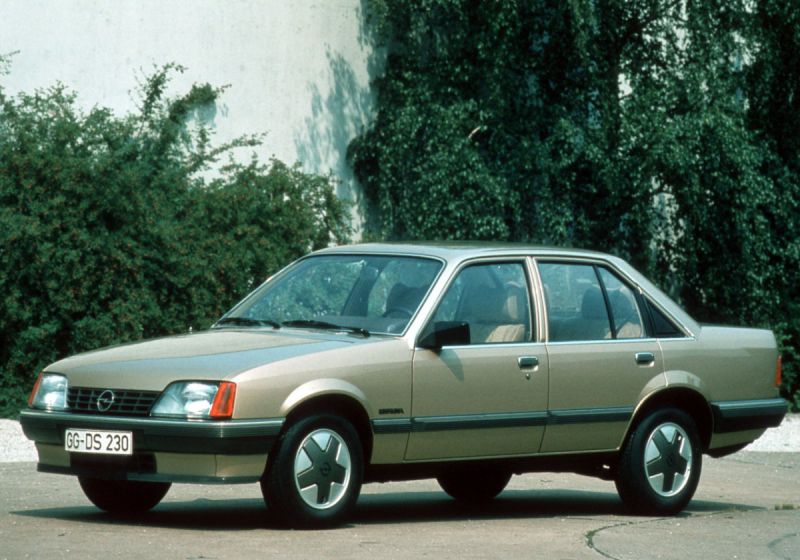
The Opel Rekord E (facelift 1982) 1.8 S (90 Hp) represents a significant chapter in the history of European mid-size to large family sedans. Produced by the German automaker Opel, a subsidiary of General Motors, the Rekord line had been a staple across the continent for decades, known for its robust construction, practicality, and reliable performance. The E-generation, initially launched in 1977, received a crucial facelift in September 1982, bringing subtle but effective updates that sustained its competitiveness in the fiercely contested European market until its discontinuation in August 1986. This particular variant, the 1.8 S, was a popular choice, striking a balance between adequate power and commendable fuel economy, making it a workhorse for families and business fleets alike. While never officially sold in the United States, the Rekord E played a vital role in defining the automotive landscape in Europe during the early to mid-1980s, embodying the pragmatic approach to motoring that characterized the era.
The 1.8 S: Positioning within the Rekord E Lineup
The 1.8 S occupied a crucial middle ground within the Rekord E range. It wasn’t the entry-level model – that distinction belonged to the 1.6-liter variants – but it wasn’t positioned as a performance flagship either. Higher-spec Rekords included the 2.0-liter and 2.2-liter engines, offering more power and often featuring more luxurious appointments. The 1.8 S was aimed at buyers who prioritized fuel efficiency and everyday usability over outright speed. It was a common choice for company car fleets and families seeking a reliable and reasonably economical vehicle for long distances. Compared to the more powerful Rekords, the 1.8 S offered a lower purchase price and reduced running costs, making it an attractive option for budget-conscious buyers.
Powertrain and Engine Architecture
Under the hood, the Opel Rekord E (facelift 1982) 1.8 S featured a naturally aspirated, inline four-cylinder gasoline engine, designated by the code 18S. This unit boasted a displacement of 1,796 cubic centimeters (approximately 1.8 liters or 109.6 cu. in.). Adhering to the common engineering practices of its time, the engine utilized a Solex carburetor fuel injection system and a Single Overhead Camshaft (SOHC) valvetrain with two valves per cylinder, a configuration renowned for its simplicity and durability. The carburetor system, while less sophisticated than fuel injection systems found in later vehicles, was relatively easy to maintain and provided acceptable performance for the intended application.
The 1.8 S engine delivered a respectable 90 horsepower at 5,400 rpm, which, for a family sedan of the early 1980s, provided sufficient motivation for daily driving and highway cruising. Torque output stood at 143 Nm (105.47 lb.-ft.), available across a useful band from 3,000 to 3,400 rpm. This broad torque curve ensured decent tractability and reduced the need for frequent gear changes, contributing to a relaxed driving experience. Power was transmitted to the rear wheels via a four-speed automatic transmission, a relatively common pairing for this engine. The automatic transmission offered convenience, particularly in urban driving, but at the expense of some fuel economy and performance compared to the available five-speed manual gearbox.
In terms of raw performance, the Rekord 1.8 S with the automatic transmission could accelerate from 0 to 60 mph in approximately 13.3 seconds, with a maximum speed of around 107.5 mph. While these figures might seem modest by today’s standards, they were competitive for its segment and purpose. More importantly for its target audience, the vehicle achieved a combined fuel economy rating of approximately 29 US mpg (8.1 liters per 100 km), which was a strong selling point in an era increasingly conscious of fuel costs. The weight-to-power ratio of 12.4 kg/Hp (80.7 Hp/tonne) further underscores its balanced performance for its class.
Driving Characteristics
The driving experience in the Rekord E 1.8 S with the automatic transmission was characterized by smoothness and ease of use. The automatic gearbox, while not offering the responsiveness of a modern transmission, provided seamless shifts under normal driving conditions. Acceleration was adequate for merging onto highways and overtaking slower traffic, but it wasn’t particularly brisk. The engine felt most comfortable in the mid-range, providing sufficient power for everyday driving. Compared to the manual transmission version, the automatic resulted in a slight performance decrease, but it offered a more relaxed and convenient driving experience. The suspension, tuned for comfort, absorbed bumps and imperfections in the road well, providing a comfortable ride for passengers. However, this comfort came at the expense of sharp handling; the Rekord E wasn’t designed to be a sporty vehicle.
Equipment and Trim Levels
The 1.8 S trim level offered a reasonable level of standard equipment for the early 1980s. Interior upholstery typically consisted of cloth seats, available in a variety of colors and patterns. The dashboard featured a straightforward layout with analog gauges for speed, fuel level, coolant temperature, and clock. Power steering was often included as standard, making maneuvering easier, particularly in urban environments. Other standard features included a radio (often a basic AM/FM unit), heated rear window, and front and rear windshield wipers. Optional extras included a sunroof, upgraded audio system, and more luxurious interior trim options. The Rekord E generally prioritized functionality over lavish features, reflecting its target audience of practical-minded buyers.
Chassis and Braking
The Rekord E 1.8 S utilized a conventional chassis design with a body-on-frame construction. The front suspension consisted of MacPherson struts, while the rear suspension employed a solid axle with leaf springs. This setup prioritized ride comfort and durability over handling precision. The braking system featured ventilated disc brakes at the front and drum brakes at the rear, a common configuration for vehicles of this era. While adequate for the vehicle’s performance, the drum brakes on the rear wheels offered less stopping power and fade resistance compared to disc brakes. The steering system was a recirculating ball system, providing a relatively indirect steering feel.
Market Reception and Comparison
The Opel Rekord E 1.8 S was generally well-received by automotive critics and buyers alike. It was praised for its reliability, practicality, and fuel efficiency. However, some critics noted its somewhat bland styling and lack of sporty handling. Compared to other vehicles in its class, such as the Ford Taunus and the Volkswagen Passat, the Rekord E offered a good balance of features and value. The 1.8 S variant, in particular, was seen as a sensible choice for buyers who prioritized economy and usability over performance. The automatic transmission, while convenient, was often criticized for reducing fuel economy and performance compared to the manual gearbox.
Technical Specifications
| Brand | Opel |
| Model | Rekord |
| Generation | Rekord E (facelift 1982) |
| Type (Engine) | 1.8 S (90 Hp) |
| Start of Production | September, 1982 |
| End of Production | August, 1986 |
| Powertrain Architecture | Internal Combustion engine |
| Body Type | Sedan |
| Seats | 5 |
| Doors | 4 |
| Fuel Consumption (combined) | 8.1 l/100 km (29 US mpg) |
| Fuel Type | Petrol (Gasoline) |
| Acceleration 0 – 60 mph | 13.3 sec |
| Maximum Speed | 173 km/h (107.5 mph) |
| Weight-to-Power Ratio | 12.4 kg/Hp (80.7 Hp/tonne) |
| Power | 90 Hp @ 5400 rpm |
| Torque | 143 Nm (105.47 lb.-ft.) @ 3000-3400 rpm |
| Engine Model/Code | 18S |
| Engine Displacement | 1796 cm3 (1.8 Liters / 109.6 cu. in.) |
| Number of Cylinders | 4 |
| Engine Configuration | Inline |
| Fuel Injection System | Carburetor |
Legacy
The Opel Rekord E 1.8 S, while not a particularly groundbreaking vehicle, remains a fondly remembered example of 1980s European motoring. The 18S engine, while simple in design, proved to be remarkably durable and reliable. Today, well-maintained examples are sought after by classic car enthusiasts. The automatic transmission, while not the most desirable configuration for performance enthusiasts, remains relatively reliable if properly maintained. The Rekord E’s legacy lies in its practicality, affordability, and robust construction, making it a popular and dependable family car for a generation of European drivers.