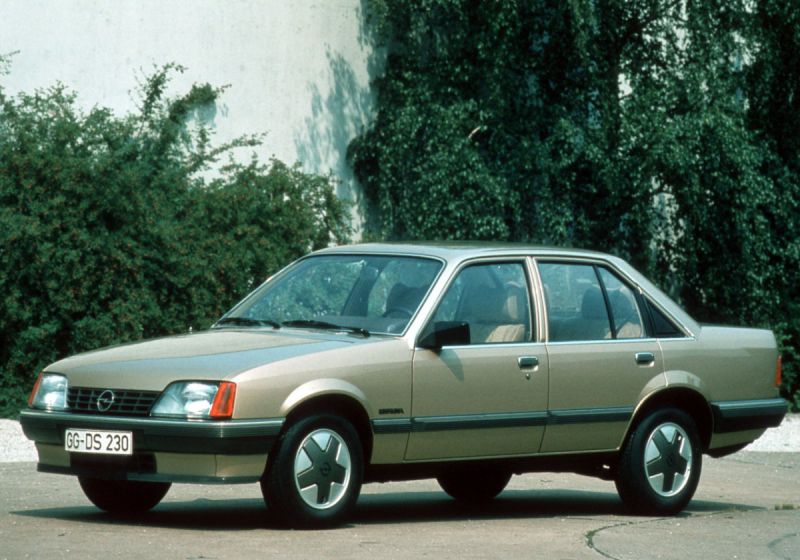
The Opel Rekord E (facelift 1982) 2.0 E represents a significant iteration of the fifth-generation Opel Rekord, a prominent mid-size executive car manufactured by the German automaker Opel. Introduced in September 1982, this facelifted model of the Rekord E series served as a crucial offering in the European market, particularly in Germany and other parts of Western Europe, before its production concluded in August 1984. While never officially sold in the United States, the Rekord E played a vital role in its home market, embodying the practical, robust, and moderately upscale family sedan segment. This particular variant, equipped with the 2.0 E engine, was a popular choice, blending respectable performance with a focus on fuel efficiency for its time.
The Rekord E Facelift and Variant Positioning
The Rekord E, initially launched in 1977, received a substantial refresh in 1982, bringing updated styling cues, improved aerodynamics, and refined powertrains. The 2.0 E model, with its fuel-injected engine, stood out as a capable and economical option within the lineup, appealing to a broad demographic of buyers seeking a reliable and comfortable vehicle for both personal and business use. It occupied a mid-range position in the Rekord E lineup. Below it were the models with smaller displacement engines like the 1.6 and 1.8, geared towards budget-conscious buyers. Above it were the more powerful and luxurious versions, though these were less common. Its rear-wheel-drive architecture and conventional sedan body style were hallmarks of European automotive design during this era.
Powertrain & Engine Architecture
Under the hood, the Opel Rekord E (facelift 1982) 2.0 E featured a naturally aspirated 2.0-liter (1979 cm³ or 120.77 cu. in.) inline four-cylinder engine, designated by the code 20E. This powerplant was a sophisticated unit for its time, employing a Bosch multi-port manifold fuel injection system – specifically the Bosch Jetronic system – which contributed to both its power output and improved fuel efficiency compared to carbureted alternatives. With a single overhead camshaft (SOHC) valvetrain and two valves per cylinder, the engine produced a healthy 110 horsepower at 5400 revolutions per minute (rpm).
Torque delivery was equally impressive for a car of its class and era, peaking at 119.49 lb.-ft. (162 Nm) at a relatively low 3000 rpm. This meant that the 2.0 E offered good pulling power from lower engine speeds, making it responsive in everyday driving conditions and capable of handling highway cruising with ease. The engine’s compression ratio stood at 9:1, indicative of its design for regular unleaded gasoline, which was becoming more prevalent in Europe. The 20E engine was known for its durability and relatively simple design, making it easier to maintain than some of its more complex contemporaries.
The standard transmission for the 2.0 E was a robust 5-speed manual gearbox, providing precise shifts and allowing the driver to fully utilize the engine’s powerband. A 3-speed automatic transmission was also available as an option, though it was less common and generally resulted in slightly reduced performance and fuel economy. The automatic transmission was a traditional hydraulic control unit, lacking the electronic sophistication of later automatic gearboxes.
Driving Characteristics
The Opel Rekord E 2.0 E offered a balanced driving experience. The 5-speed manual transmission allowed for precise control and efficient cruising, while the automatic provided convenience for urban driving. Compared to the lower-powered 1.6L and 1.8L Rekord E models, the 2.0 E offered noticeably more responsive acceleration and a greater sense of confidence when overtaking. However, it didn’t possess the outright performance of the larger-displacement six-cylinder engines available in other Rekord E variants.
The gear ratios in the 5-speed manual were well-spaced, providing good acceleration in each gear. First gear was relatively low for easy starts, while fifth gear was geared for comfortable highway cruising. The automatic transmission, while smooth, had wider gear ratios and resulted in a slight decrease in acceleration. The rear-wheel-drive layout provided a traditional driving feel, with predictable handling characteristics. The suspension, tuned for comfort, absorbed bumps well, but the car wasn’t particularly sporty in its handling.
Equipment & Trim Levels
The 2.0 E trim level typically included features such as cloth upholstery, a basic radio, and a heated rear window. Power steering was often an optional extra, as was air conditioning. The dashboard layout was functional and straightforward, with clearly marked gauges and easy-to-use controls. Higher trim levels, such as the GL, offered additional features like upgraded upholstery, a more comprehensive instrument cluster, and additional chrome trim. Optional extras included a sunroof, upgraded sound system, and alloy wheels.
Interior color schemes varied, but typically included shades of blue, gray, and brown. The seats were generally comfortable and supportive, providing adequate cushioning for long journeys. The Rekord E’s interior was designed with practicality in mind, offering ample storage space and a user-friendly layout.
Chassis & Braking
The Rekord E 2.0 E utilized a traditional body-on-frame construction, providing a robust and durable chassis. The suspension consisted of independent front suspension with MacPherson struts and a solid rear axle with leaf springs. This setup prioritized ride comfort over sporty handling. The steering was a recirculating ball system, offering a relatively heavy but precise feel.
Braking duties were handled by ventilated disc brakes at the front and drum brakes at the rear. The dual-circuit braking system provided a degree of redundancy in case of a brake line failure. While adequate for the car’s weight and performance, the braking system wasn’t particularly powerful by modern standards. The Rekord E 2.0 E’s kerb weight of 2502.25 pounds (1135 kg) was relatively moderate for a car of its size and class.
Market Reception & Comparison
Critics generally viewed the Opel Rekord E 2.0 E favorably, praising its blend of performance, fuel efficiency, and practicality. It was considered a solid and reliable family car, offering good value for money. Compared to the smaller-engined Rekord E models, the 2.0 E provided a noticeable improvement in performance, making it a more enjoyable car to drive. However, it didn’t offer the same level of refinement or prestige as more expensive competitors like the Mercedes-Benz W123 or BMW 5 Series.
Fuel economy was a strong point for the 2.0 E, with a combined rating of 27.4 US miles per gallon (8.6 l/100 km). This was competitive with other mid-size sedans of the early 1980s. Reliability was also a key strength, with the 20E engine proving to be durable and relatively trouble-free. Maintenance costs were generally reasonable, thanks to the engine’s straightforward design.
Technical Specifications
| Category | Specification |
| General Information | |
| Brand | Opel |
| Model | Rekord E (facelift 1982) 2.0 E (110 Hp) |
| Production Start | September, 1982 |
| Production End | August, 1984 |
| Body Type | Sedan |
| Doors | 4 |
| Seats | 5 |
| Drivetrain Architecture | Internal Combustion engine, Rear-wheel drive |
| Performance Specs | |
| Fuel Consumption (Combined) | 8.6 l/100 km (27.4 US mpg) |
| Fuel Type | Petrol (Gasoline) |
| Acceleration 0-60 mph | 11.4 seconds |
| Acceleration 0-62 mph (0-100 km/h) | 12 seconds |
| Maximum Speed | 116.2 mph (187 km/h) |
| Weight-to-Power Ratio | 10.3 kg/Hp (96.9 Hp/tonne) |
| Weight-to-Torque Ratio | 7 kg/Nm (142.7 Nm/tonne) |
| Engine Specs | |
| Power | 110 Hp @ 5400 rpm |
| Power per liter | 55.6 Hp/l |
| Torque | 119.49 lb.-ft. (162 Nm) @ 3000 rpm |
| Engine Model/Code | 20E |
| Engine Displacement | 1979 cm³ (120.77 cu. in.) |
| Number of Cylinders | 4, Inline |
| Cylinder Bore | 3.74 in. (95 mm) |
| Piston Stroke | 2.75 in. (69.8 mm) |
| Compression Ratio | 9:1 |
| Valves per Cylinder | 2 |
| Fuel Injection System | Multi-port manifold injection |
| Engine Aspiration | Naturally aspirated |
| Valvetrain | SOHC |
| Engine Oil Capacity | 4.02 US qt (3.8 l) |
| Coolant Capacity | 6.45 US qt (6.1 l) |
| Dimensions, Volume & Weights | |
| Kerb Weight | 2502.25 lbs. (1135 kg) |
| Maximum Weight | 3714.79 lbs. (1685 kg) |
| Maximum Load | 1212.54 lbs. (550 kg) |
| Trunk (Boot) Space – Minimum | 17.3 cu. ft. (490 l) |
| Fuel Tank Capacity | 17.17 US gal (65 l) |
| Permitted Trailer Load (with brakes, 12%) | 2755.78 lbs. (1250 kg) |
| Length | 183.15 in. (4652 mm) |
| Width | 67.95 in. (1726 mm) |
| Height | 55.91 in. (1420 mm) |
| Wheelbase | 105.04 in. (2668 mm) |
| Front Track | 56.5 in. (1435 mm) |
| Rear Track | 55.59 in. (1412 mm) |
| Ride Height (Ground Clearance) | 5.51 in. (140 mm) |
| Drag Coefficient (Cd) | 0.36 |
| Minimum Turning Circle | 35.43 ft. (10.8 m) |
| Drivetrain, Brakes & Suspension | |
| Drive Wheel | Rear wheel drive |
| Gearbox Type | 5-speed manual transmission |
| Front Brakes | Ventilated discs |
| Rear Brakes | Drum |
Legacy
The Opel Rekord series, and particularly the E generation, held a formidable position in the European automotive landscape. The Opel Rekord E (facelift 1982) 2.0 E continued this legacy, cementing Opel’s reputation as a manufacturer of reliable, well-built, and practical family cars. The 20E engine, while not a high-performance unit, proved to be exceptionally durable. Well-maintained examples can still be found today, often with surprisingly high mileage.
In the used car market, the Rekord E 2.0 E is appreciated by enthusiasts for its classic styling, straightforward mechanics, and affordability. Parts availability is generally good, although some trim-specific items can be difficult to find. The car’s relatively simple construction makes it a good candidate for restoration projects. While not a collector’s item in the same vein as some more exotic European cars, the Rekord E 2.0 E represents a significant piece of automotive history, embodying the spirit of European motoring in the early 1980s.