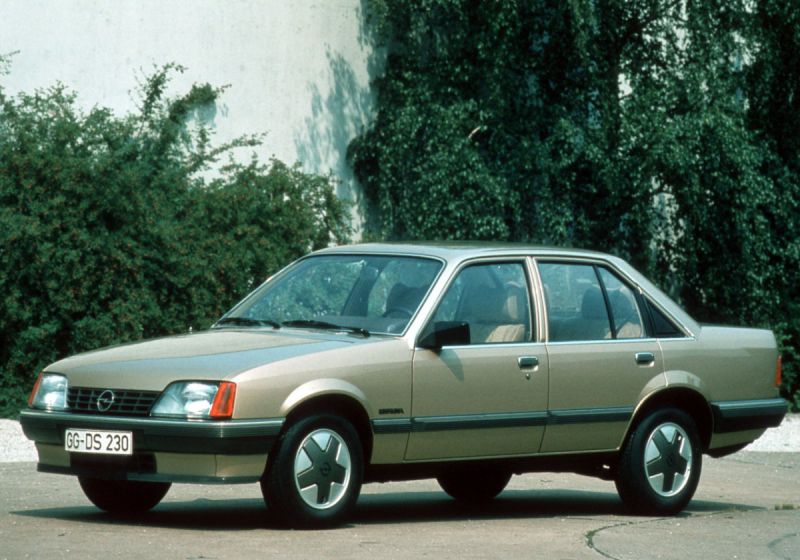
The Opel Rekord E (facelift 1982) 2.0 S (98 Hp) represents a significant chapter in Opel’s long and storied history, particularly within the European automotive landscape. As a product of General Motors’ German subsidiary, Opel, the Rekord series consistently served as a cornerstone of the mid-size to executive car segment across the continent for decades. The E-generation, launched in 1977, received a substantial facelift in 1982, bringing updated styling, improved aerodynamics, and refined powertrains to maintain its competitive edge against a rapidly evolving market. This specific variant, the 2.0 S, was a popular choice, offering a balanced blend of performance, economy, and practicality that resonated with a broad spectrum of European buyers.
Unlike its American counterparts from GM, the Opel Rekord was never officially sold in the United States, yet it played a crucial role in shaping the European automotive identity. It was renowned for its robust construction, straightforward engineering, and family-friendly attributes, embodying the practicality and reliability that German engineering was often associated with. The 1982 facelift model, produced until 1984, marked one of the final iterations of Opel’s traditional rear-wheel-drive mid-size sedans before the industry’s widespread shift towards front-wheel-drive architectures. Its legacy is one of a dependable workhorse, a comfortable family transporter, and a ubiquitous presence on European roads throughout the 1980s.
Powertrain & Engine Architecture
Under the hood of the Opel Rekord E (facelift 1982) 2.0 S was a tried-and-true 2.0-liter (1979 cm³ or 120.77 cu. in.) inline four-cylinder engine, designated by the code 20S. This naturally aspirated unit featured a Single Overhead Camshaft (SOHC) valvetrain with two valves per cylinder, a common and reliable configuration for the era. Fuel delivery was handled by a carburetor, a technology that was still prevalent in the early 1980s before the widespread adoption of electronic fuel injection. With a compression ratio of 9:1, the engine produced a respectable 98 horsepower at 5400 rpm, translating to a power output of 49.5 horsepower per liter. Torque figures stood at 153 Newton-meters (112.85 lb.-ft.) at a relatively low 3800 rpm, indicating good mid-range pulling power suitable for daily driving and highway cruising.
The 2.0 S was typically paired with either a 4-speed automatic transmission or a 5-speed manual transmission. The automatic transmission, a three-speed unit, was designed for smooth operation and ease of use, catering to drivers who prioritized comfort over outright performance. It featured a traditional torque converter and hydraulic control system. The automatic was a popular choice for those seeking a relaxed driving experience, particularly in urban environments. The manual transmission, while offering more driver engagement, was less commonly selected for this specific trim level.
Driving Characteristics
The Opel Rekord E 2.0 S with the automatic transmission delivered a comfortable, if not particularly sporty, driving experience. The automatic’s gear ratios were optimized for fuel efficiency and smooth acceleration rather than rapid sprints. The car felt capable on the open road, providing sufficient power for overtaking maneuvers, but it wasn’t designed for aggressive driving. Compared to the 5-speed manual version, the automatic resulted in slightly slower acceleration times due to the inherent power loss in the torque converter and the less direct connection between the engine and the wheels. The automatic transmission also contributed to a slightly higher fuel consumption figure.
The rear-wheel-drive layout provided balanced handling characteristics, although it lacked the agility of more modern front-wheel-drive cars. Steering was relatively light and precise, making it easy to maneuver in city traffic. The suspension, tuned for comfort, absorbed bumps and imperfections in the road surface effectively, providing a smooth ride for passengers. The overall driving experience was characterized by its predictability and ease of use, making it an ideal vehicle for everyday commuting and long-distance family trips.
Equipment & Trim Levels
The 2.0 S trim level occupied a mid-range position within the Rekord E lineup. It offered a step up in terms of features and refinement compared to the base models, but it wasn’t as luxurious as the top-of-the-line variants. Standard equipment typically included cloth upholstery, a basic radio, and heated rear window. The interior was functional and well-built, with a focus on durability rather than lavish appointments.
Optional extras available for the 2.0 S included a sunroof, upgraded stereo system, power windows, and central locking. Metallic paint finishes were also available at an extra cost. The interior trim could be customized with different cloth patterns and color schemes. The 2.0 S was often chosen by buyers who wanted a comfortable and well-equipped car without the expense of the more premium trims.
Chassis & Braking
The Opel Rekord E (facelift 1982) 2.0 S utilized a traditional body-on-frame construction, providing a robust and durable chassis. The suspension consisted of independent front suspension with coil springs and a rigid rear axle with leaf springs. This setup prioritized ride comfort and load-carrying capacity. The steering was a recirculating ball system, offering a good balance of feel and assistance.
The braking system featured ventilated discs at the front and drum brakes at the rear. While adequate for the car’s weight and performance, the drum brakes on the rear wheels were a limitation compared to all-disc setups found on some competitors. The braking system was hydraulically assisted, providing sufficient stopping power for most driving conditions. Stabilizer bars were fitted to both the front and rear axles to reduce body roll during cornering.
Market Reception & Comparison
The Opel Rekord E (facelift 1982) 2.0 S was generally well-received by automotive critics. It was praised for its reliability, practicality, and comfortable ride. However, some critics noted that its styling was somewhat conservative and that its performance was not as exciting as some of its rivals. Fuel economy was considered to be reasonable for the time, but it wasn’t class-leading.
Compared to other trims in the Rekord E lineup, the 2.0 S offered a good balance of performance and economy. The smaller-engined models were more fuel-efficient but lacked the power for confident highway cruising. The larger-engined models offered more performance but were more expensive to run. The 2.0 S was often seen as the sweet spot in the range, appealing to a broad range of buyers. Compared to the manual transmission version, the automatic offered greater convenience but at the expense of slightly reduced performance and fuel economy.
Technical Specifications
| Attribute | Value |
| Brand | Opel |
| Model | Rekord E (facelift 1982) 2.0 S (98 Hp) |
| Start of Production | 1982 |
| End of Production | 1984 |
| Powertrain Architecture | Internal Combustion engine |
| Body Type | Sedan |
| Seats | 5 |
| Doors | 4 |
| Fuel Type | Petrol (Gasoline) |
| Fuel Consumption (Combined) | 10.8 l/100 km (21.8 US mpg) |
| Acceleration 0-60 mph | 11.9 sec |
| Acceleration 0-100 km/h | 12.5 sec |
| Maximum Speed | 111.85 mph (180 km/h) |
| Power | 98 Hp @ 5400 rpm |
| Torque | 153 Nm (112.85 lb.-ft.) @ 3800 rpm |
| Engine Model/Code | 20S |
| Engine Displacement | 1979 cm³ (2.0 liters / 120.77 cu. in.) |
| Number of Cylinders | 4, Inline |
| Cylinder Bore | 95 mm (3.74 in.) |
| Piston Stroke | 69.8 mm (2.75 in.) |
| Compression Ratio | 9:1 |
| Valves per Cylinder | 2 |
| Fuel Injection System | Carburetor |
| Engine Aspiration | Naturally aspirated |
| Valvetrain | SOHC |
| Engine Oil Capacity | 3.8 l (4.02 US qt) |
| Coolant Capacity | 6.1 l (6.45 US qt) |
| Kerb Weight | 1135 kg (2502.25 lbs) |
| Max. Weight | 1685 kg (3714.79 lbs) |
| Max Load | 550 kg (1212.54 lbs) |
| Trunk (Boot) Space – Minimum | 490 l (17.3 cu. ft.) |
| Fuel Tank Capacity | 65 l (17.17 US gal) |
| Permitted Trailer Load (with brakes, 12%) | 1000 kg (2204.62 lbs) |
| Length | 4652 mm (183.15 in.) |
| Width | 1726 mm (67.95 in.) |
| Height | 1420 mm (55.91 in.) |
| Wheelbase | 2668 mm (105.04 in.) |
| Front Track | 1435 mm (56.5 in.) |
| Rear Track | 1412 mm (55.59 in.) |
| Ride Height (Ground Clearance) | 140 mm (5.51 in.) |
| Drag Coefficient (Cd) | 0.36 |
| Minimum Turning Circle | 10.8 m (35.43 ft.) |
| Drivetrain Architecture | Rear wheel drive |
| Number of Gears and Gearbox Type | 3 gears, automatic transmission |
| Front Brakes | Ventilated discs |
| Rear Brakes | Drum |
Legacy
The Opel Rekord E (facelift 1982) 2.0 S, particularly with the automatic transmission, enjoys a reputation for long-term reliability. The 20S engine, while not particularly powerful, is known for its durability and relatively simple maintenance requirements. Parts availability remains reasonable, making it a viable option for classic car enthusiasts. However, like all vehicles of this age, rust can be a significant issue, particularly in regions with harsh winters.
In the used car market today, the Rekord E 2.0 S is considered a collectible classic. Well-maintained examples command a modest but growing price. It appeals to those seeking a nostalgic driving experience and a tangible connection to a bygone era of automotive engineering. While it may not offer the performance or features of modern cars, its simplicity, reliability, and classic styling continue to resonate with enthusiasts and collectors alike.