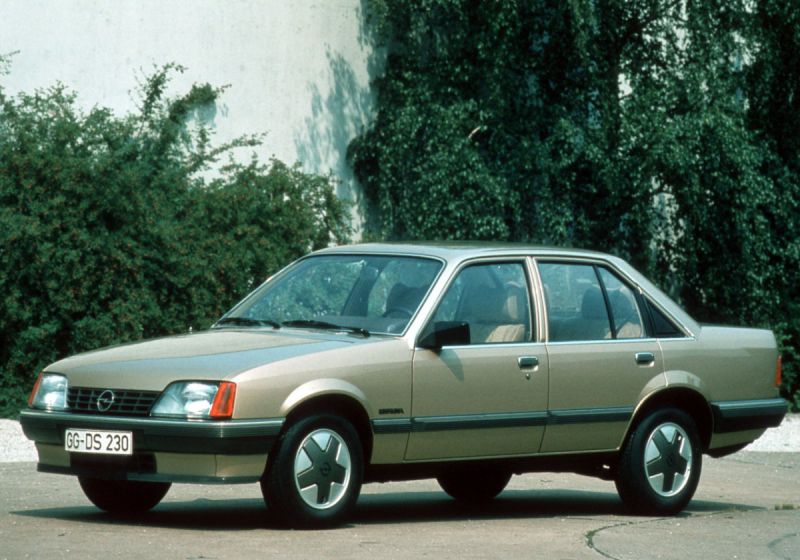
The Opel Rekord E (facelift 1982) 2.0 S Automatic represents a significant chapter in European automotive history. As a prominent mid-size car from German manufacturer Opel, a subsidiary of General Motors at the time, the Rekord E served as a workhorse for families and businesses across the continent. This particular variant embodies the practical, robust, and moderately comfortable ethos that characterized many European sedans of the early 1980s. While never officially sold in the United States, its design and engineering principles reflect a global influence from GM, adapted to European tastes and regulations. It competed in a fiercely contested segment, offering a sensible balance of space, performance, and economy for its era, making it a ubiquitous sight on European roads during its production run from 1982 to 1984.
Powertrain & Engine Architecture
Powering the Opel Rekord E (facelift 1982) 2.0 S Automatic was Opel’s well-regarded 2.0-liter (1979 cm³ or 120.77 cu. in.) inline-four engine, designated by the code 20S. This naturally aspirated unit featured a single overhead camshaft (SOHC) and a two-barrel carburetor fuel system, a common setup for mainstream vehicles of the period. The carburetor, typically a Solex or Pierburg model, managed fuel delivery based on airflow and throttle position. It produced a respectable 98 horsepower at 5400 rpm, delivering a power-per-liter figure of 49.5 hp/l, which was competitive for a non-performance-oriented family sedan.
Torque output stood at 153 Nm (112.85 lb.-ft.) at 3800 rpm, indicating a powerplant designed for accessible low-to-mid-range grunt rather than high-revving excitement. The engine block was constructed from cast iron, contributing to its durability, while the cylinder head was made of aluminum alloy to reduce weight. The valvetrain employed pushrods to actuate the valves, a cost-effective and reliable design. The 20S engine was known for its relatively simple design, making it easier to maintain and repair compared to more complex fuel-injected engines of the time.
Mated to this engine was a 3-speed automatic transmission, a configuration chosen for its ease of use and smooth power delivery, catering to the comfort-oriented driver. This transmission, often a Borg-Warner unit or a similar GM-sourced automatic, featured a torque converter for smooth engagement and hydraulic control for gear changes. The drivetrain architecture was traditional, with the engine driving the rear wheels, a layout favored for its robust nature and balanced handling characteristics. While the 3-speed automatic might seem rudimentary by modern standards, it offered a relaxed driving experience, particularly in urban environments and on the then-developing highway networks of Europe.
Driving Characteristics
The Opel Rekord E 2.0 S Automatic provided adequate, if not exhilarating, acceleration. It could accelerate from 0 to 60 mph in an estimated 13.3 seconds, with 0 to 100 km/h (0-62 mph) taking 14 seconds. The maximum speed was rated at 175 km/h (108.74 mph). These figures positioned the Rekord as a capable cruiser, perfectly suited for the daily commute or longer family trips. The automatic transmission’s gear ratios were optimized for comfortable cruising rather than rapid acceleration. First gear provided reasonable off-the-line acceleration, while second and third gears were geared for efficient highway driving.
Compared to the manual transmission versions of the Rekord E 2.0 S, the automatic variant offered a more relaxed driving experience, eliminating the need for constant gear changes. However, it did come at the cost of some performance and fuel economy. The manual transmission allowed for more precise control over engine speed and power delivery, resulting in slightly quicker acceleration and better fuel efficiency. Compared to the larger-engined Rekord models, such as the 2.3-liter or the later 2.2-liter versions, the 2.0 S Automatic offered a more economical and accessible option, sacrificing some outright power for improved fuel consumption and a lower purchase price.
Equipment & Trim Levels
The Opel Rekord E (facelift 1982) 2.0 S Automatic occupied a mid-range position within the Rekord E lineup. It sat above the base models (typically 1.6 or 1.8-liter engines) and below the more luxurious and powerful variants (such as the 2.3-liter or the GTE). Standard equipment included cloth upholstery, a basic AM/FM radio, and manual windows and door locks. The interior was typically finished in muted colors, reflecting the car’s practical and understated character.
Optional extras available for the 2.0 S Automatic included a sunroof, upgraded stereo systems, power windows, and central locking. Some models also featured a trip computer, a relatively advanced feature for the early 1980s. The dashboard configuration was straightforward and functional, with clearly labeled gauges for speed, fuel level, coolant temperature, and battery voltage. The steering wheel was typically made of plastic, although leather-wrapped options were available. The seats offered reasonable comfort for long journeys, although they lacked the bolstering and support found in more sporty vehicles.
Chassis & Braking
The Opel Rekord E (facelift 1982) 2.0 S Automatic featured a traditional body-on-frame construction, providing a robust and durable chassis. The suspension consisted of independent front suspension with MacPherson struts and a live rear axle with leaf springs. This setup offered a good balance of ride comfort and handling, although it wasn’t as sophisticated as the independent rear suspension found on some of its competitors.
The braking system consisted of ventilated disc brakes on the front wheels and drum brakes on the rear wheels. The dual-circuit braking system provided a degree of redundancy in case of a brake line failure. The steering was a recirculating ball system, offering a relatively heavy but precise feel. The stabilizer bar thickness was moderate, providing adequate roll control without compromising ride comfort. The tires were typically 175/80 R14 or 185/70 R14, offering a good compromise between grip and fuel efficiency.
Market Reception & Comparison
Critics generally viewed the Opel Rekord E (facelift 1982) 2.0 S Automatic as a sensible and reliable family car. It was praised for its spacious interior, comfortable ride, and robust construction. However, it was also criticized for its somewhat dated styling and lack of advanced features. Fuel economy was considered reasonable for a carbureted 2.0-liter engine with an automatic transmission, averaging around 18.2 US mpg in combined driving.
Compared to other trims in the Rekord E lineup, the 2.0 S Automatic offered a good balance of performance and economy. The smaller-engined models were more fuel-efficient but lacked the power for comfortable highway cruising, while the larger-engined models offered more performance but at the cost of increased fuel consumption. In terms of reliability, the 2.0 S Automatic was generally considered to be a dependable powertrain, with relatively few major issues. The automatic transmission was known to be durable, although it required regular fluid changes to maintain optimal performance.
Technical Specifications: Opel Rekord E (facelift 1982) 2.0 S Automatic
| Category | Specification |
| General Information | |
| Brand | Opel |
| Model | Rekord E (facelift 1982) |
| Type | 2.0 S (98 Hp) Automatic |
| Production Start | 1982 |
| Production End | 1984 |
| Body Type | Sedan |
| Doors / Seats | 4 Doors / 5 Seats |
| Performance Specs | |
| Fuel Type | Petrol (Gasoline) |
| Fuel Consumption (Combined) | 12.9 l/100 km (18.2 US mpg) |
| Acceleration 0-60 mph | 13.3 sec |
| Acceleration 0-100 km/h (0-62 mph) | 14 sec |
| Maximum Speed | 175 km/h (108.74 mph) |
| Weight-to-Power Ratio | 11.8 kg/Hp (84.5 Hp/tonne) |
| Weight-to-Torque Ratio | 7.6 kg/Nm (131.9 Nm/tonne) |
| Engine Specs | |
| Power | 98 Hp @ 5400 rpm |
| Torque | 153 Nm (112.85 lb.-ft.) @ 3800 rpm |
| Engine Model/Code | 20S |
| Engine Displacement | 1979 cm³ (120.77 cu. in.) |
| Number of Cylinders | 4, Inline |
| Cylinder Bore | 95 mm (3.74 in.) |
| Piston Stroke | 69.8 mm (2.75 in.) |
| Compression Ratio | 9:1 |
| Valves per Cylinder | 2 |
| Fuel Injection System | Carburetor |
| Engine Aspiration | Naturally aspirated |
| Valvetrain | SOHC |
| Engine Oil Capacity | 3.8 l (4.02 US qt) |
| Coolant Capacity | 6.1 l (6.45 US qt) |
| Space, Volume and Weights | |
| Kerb Weight | 1160 kg (2557.36 lbs) |
| Max. Weight | 1685 kg (3714.79 lbs) |
| Max Load | 525 kg (1157.43 lbs) |
| Trunk (Boot) Space – Minimum | 490 l (17.3 cu. ft.) |
| Fuel Tank Capacity | 65 l (17.17 US gal) |
| Dimensions | |
| Length | 4652 mm (183.15 in.) |
| Width | 1726 mm (67.95 in.) |
| Height | 1420 mm (55.91 in.) |
| Wheelbase | 2668 mm (105.04 in.) |
| Front Track | 1435 mm (56.5 in.) |
| Rear Track | 1412 mm (55.59 in.) |
| Ride Height (Ground Clearance) | 140 mm (5.51 in.) |
| Drag Coefficient (Cd) | 0.36 |
| Minimum Turning Circle | 10.8 m (35.43 ft.) |
| Drivetrain, Brakes and Suspension | |
| Drivetrain Architecture | Internal Combustion engine drives the rear wheels. |
| Drive Wheel | Rear wheel drive |
| Number of Gears / Gearbox Type | 3 gears, automatic transmission |
| Front Brakes | Ventilated discs |
| Rear Brakes | Drum |
Legacy
The Opel Rekord E, particularly its facelifted version from 1982, enjoyed a strong reputation in its primary European markets for its reliability, durability, and straightforward engineering. It was a car that didn’t aspire to be flashy but excelled at being a dependable means of transport, whether for the daily commute, family duties, or as a fleet vehicle for businesses and government agencies. Its robust construction and ease of maintenance contributed to its popularity and longevity, with many Rekord models serving their owners for well over a decade.
Today, the Opel Rekord E (facelift 1982) 2.0 S Automatic is increasingly sought after by classic car enthusiasts. While not as highly valued as some of its more sporting counterparts, it represents a well-preserved example of a mainstream European sedan from the early 1980s. The 20S engine, while not particularly powerful, is known for its reliability and relatively simple maintenance requirements. The automatic transmission, if properly maintained, can provide years of trouble-free service. Finding well-maintained examples can be challenging, as many were used as everyday transportation and subjected to wear and tear. However, for those seeking a classic European car that is both affordable and reliable, the Rekord E 2.0 S Automatic offers a compelling option.