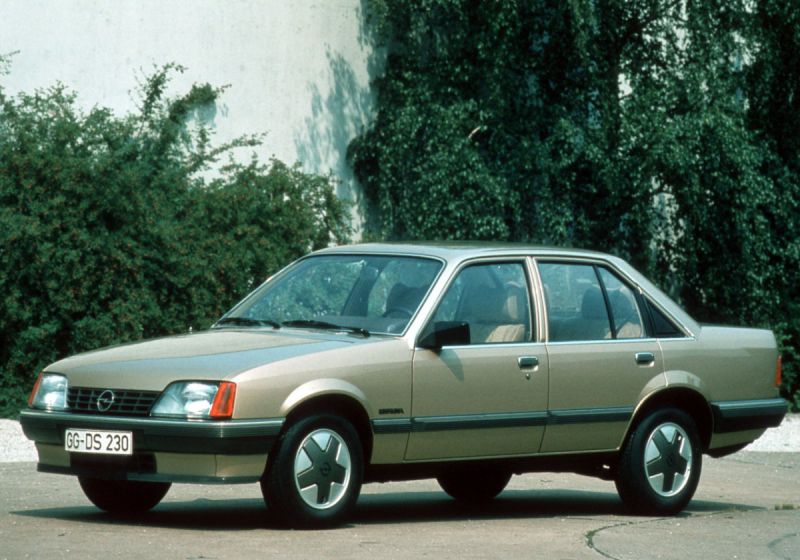
The Opel Rekord E (facelift 1982) 2.2 E (115 Hp) represents a pivotal moment in European automotive history. Produced from September 1984 to August 1986, this iteration of the Rekord E, a four-door sedan, was a cornerstone of Opel’s lineup – a brand operating under the General Motors (GM) umbrella. The Rekord served as a robust, mid-size family car, widely recognized and popular throughout Europe. While never officially sold in the United States, it offered a blend of practicality, dependable performance, and traditional rear-wheel-drive dynamics appealing to a broad range of customers, from families to business professionals. This 2.2 E variant occupied a mid-range position within the Rekord E lineup, offering a step up in performance and refinement compared to the base models, but remaining more accessible than the top-of-the-line trims.
Powertrain & Engine Architecture
The heart of the Opel Rekord E (facelift 1982) 2.2 E is its 2.2-liter (2197 cm³) inline-four gasoline engine, internally designated as the 22E. This naturally aspirated unit showcased Opel’s commitment to balancing power and efficiency in its mainstream models. The engine featured a single overhead camshaft (SOHC) valvetrain operating two valves per cylinder. This configuration produced 115 horsepower at 4800 rpm and 134.24 lb-ft of torque at 2800 rpm. The multi-port fuel injection system, a relatively modern feature for the mid-1980s, contributed to smoother power delivery and improved fuel economy compared to earlier carbureted Opel engines.
Power was transmitted to the rear wheels through a four-speed automatic transmission. This transmission, while offering convenience, differed significantly from the five-speed manual option available on other Rekord E models. The automatic gearbox featured a torque converter and a traditional hydraulic control system. While the manual transmission provided a more engaging driving experience and better fuel economy, the automatic was favored by drivers prioritizing ease of use, particularly in urban environments. The engine was mounted longitudinally in the front of the vehicle, a common configuration for rear-wheel-drive cars of the era.
Driving Characteristics
The Rekord E 2.2 E with the automatic transmission delivered a comfortable and predictable driving experience. Acceleration from 0 to 60 mph took approximately 11.5 seconds, and the vehicle reached a top speed of around 112 mph. Compared to the manual transmission version of the 2.2 E, the automatic resulted in a slight performance decrease due to the power loss through the torque converter. However, the automatic’s smooth gear changes and relaxed cruising ability made it well-suited for long-distance journeys. The rear-wheel-drive layout provided balanced handling, although it lacked the agility of front-wheel-drive competitors. The automatic transmission’s gear ratios were optimized for fuel efficiency and comfortable cruising, rather than outright performance. The steering was relatively light, making maneuvering easy, but it lacked the direct feel of some other European sedans.
Equipment & Trim Levels
The Rekord E (facelift 1982) 2.2 E automatic typically came equipped with a reasonable level of standard features for a mid-range vehicle of the time. Interior upholstery was generally cloth, available in a variety of colors and patterns. The dashboard featured a straightforward layout with analog gauges for speed, fuel level, coolant temperature, and clock. Power-assisted steering was standard, as were central locking and electric windows. Optional extras included a sunroof, upgraded audio system, and air conditioning. The 2.2 E trim also often included upgraded interior trim elements and exterior chrome accents compared to the base models. The overall interior ambiance was functional and durable, prioritizing practicality over luxury.
Chassis & Braking
The Rekord E 2.2 E utilized an independent McPherson strut front suspension, providing a good balance of ride comfort and handling precision. The rear suspension employed a rigid axle with coil springs and trailing arms, a traditional setup for rear-wheel-drive vehicles. This configuration offered a comfortable ride, but it wasn’t as sophisticated as the independent rear suspension found on some competitors. Braking duties were handled by ventilated disc brakes at the front, providing effective stopping power, while drum brakes were used at the rear. The braking system was hydraulically assisted, and an Anti-lock Braking System (ABS) was available as an optional extra, significantly enhancing safety during emergency braking. The Rekord E’s chassis was designed for durability and stability, prioritizing a comfortable and predictable ride over sporty handling.
Market Reception & Comparison
Critics generally viewed the Opel Rekord E 2.2 E automatic as a competent and reliable family sedan. It was praised for its comfortable ride, spacious interior, and dependable engine. However, the automatic transmission was sometimes criticized for its slightly sluggish performance compared to the manual version. Fuel economy was considered respectable for its class, averaging around 28.3 US mpg in combined driving. Compared to other trims in the Rekord E lineup, the 2.2 E automatic offered a good balance of performance and convenience. It was more powerful and refined than the base models, but less expensive and sporty than the higher-performance versions. Key competitors included the Ford Sierra, Volkswagen Passat, and Peugeot 505. The Rekord E generally offered a more traditional driving experience compared to the front-wheel-drive Passat and the more aggressively styled Sierra.
Technical Specifications
| Category | Specification |
| Brand | Opel |
| Model | Rekord E (facelift 1982) |
| Type (Engine) | 2.2 E (115 Hp) |
| Production Start | September, 1984 |
| Production End | August, 1986 |
| Body Type | Sedan |
| Seats | 5 |
| Doors | 4 |
| Fuel Type | Petrol (Gasoline) |
| Fuel Consumption (Combined) | 8.3 l/100 km (28.3 US mpg) |
| Acceleration 0-60 mph | 11.5 seconds (approx.) |
| Maximum Speed | 180 km/h (112 mph) (approx.) |
| Power | 115 Hp @ 4800 rpm |
| Torque | 182 Nm (134.24 lb.-ft.) @ 2800 rpm |
| Engine Layout | Front, Longitudinal |
| Engine Model/Code | 22E |
| Engine Displacement | 2197 cm3 (134.07 cu. in.) |
| Number of Cylinders | 4, Inline |
| Compression Ratio | 9.4:1 |
| Valves per Cylinder | 2 |
| Fuel Injection System | Multi-port manifold injection |
| Engine Aspiration | Naturally aspirated |
| Valvetrain | SOHC |
| Engine Oil Capacity | 3.8 l (4.02 US qt) |
| Coolant Capacity | 10 l (10.57 US qt) |
| Kerb Weight | 1125 kg (2480.2 lbs) |
| Max. Weight | 1685 kg (3714.79 lbs) |
| Max Load | 560 kg (1234.59 lbs) |
| Trunk (Boot) Space – Minimum | 490 l (17.3 cu. ft.) |
| Fuel Tank Capacity | 65 l (17.17 US gal) |
| Length | 4652 mm (183.15 in.) |
| Width | 1726 mm (67.95 in.) |
| Height | 1420 mm (55.91 in.) |
| Wheelbase | 2668 mm (105.04 in.) |
| Front Track | 1435 mm (56.5 in.) |
| Rear Track | 1412 mm (55.59 in.) |
| Ride Height (Ground Clearance) | 140 mm (5.51 in.) |
| Drag Coefficient (Cd) | 0.36 |
| Minimum Turning Circle | 10.8 m (35.43 ft.) |
| Drivetrain Architecture | Internal Combustion engine drives the rear wheels |
| Drive Wheel | Rear wheel drive |
| Gearbox Type | 4 gears, automatic transmission |
| Front Suspension | Independent type McPherson |
| Rear Suspension | Coil spring |
| Front Brakes | Ventilated discs |
| Rear Brakes | Drum |
| Assisting Systems | ABS (Anti-lock braking system) – Optional |
| Power Steering | Hydraulic Steering |
Legacy
The Opel Rekord E 2.2 E automatic, while not known for exceptional performance or cutting-edge technology, proved to be a reliable and durable vehicle. The 22E engine, when properly maintained, could provide years of service. The automatic transmission, while not as fuel-efficient as the manual, was generally dependable. Today, the Rekord E is a sought-after classic among enthusiasts, particularly those who appreciate its traditional rear-wheel-drive layout and straightforward engineering. Finding well-maintained examples can be challenging, as many were used as everyday transportation and subjected to years of wear and tear. However, the Rekord E’s enduring reputation for dependability and its nostalgic appeal ensure that it will continue to be appreciated by classic car enthusiasts for years to come. Its place in automotive history is secure as a representative of a bygone era of robust, practical, and reliable European motoring.