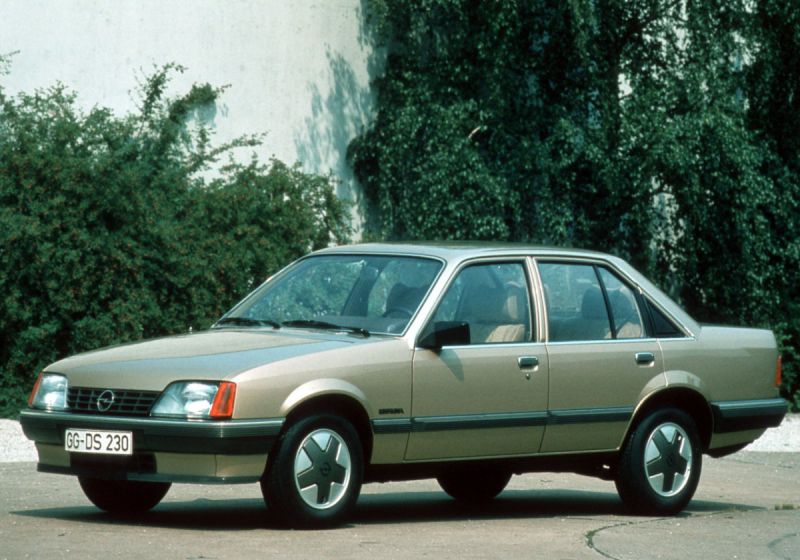
The Opel Rekord E (facelift 1982) 2.3 D (65 Hp) represents a significant chapter in Opel’s history as a prominent European automaker. Positioned in the competitive mid-size to executive car segment, the Rekord E was a staple on European roads, known for its practicality, robust engineering, and conservative styling. This diesel variant, produced from September 1982 to July 1983, served as a reliable family sedan and a preferred choice for fleet operators and business users. While never officially sold in the United States, the Rekord E’s design and mechanical philosophy reflect broader automotive trends of the time, emphasizing spaciousness, comfort, and economical operation, particularly with its diesel powertrain. It was a key model within the Rekord E range, which was itself a facelift of the earlier Rekord E introduced in 1977, and built on the GM’s ‘Q-Platform’ – a chassis shared with other GM vehicles like the Buick Regal and Oldsmobile Century.
Powertrain & Engine Architecture
At the heart of the Opel Rekord E (facelift 1982) 2.3 D (65 Hp) lies its naturally aspirated 2.3-liter (2260 cm³ or 137.91 cu. in.) inline four-cylinder diesel engine, designated as the 23D. This engine was engineered for longevity and fuel economy rather than outright speed. It produced 65 horsepower at 4200 revolutions per minute and 127 Newton-meters (93.67 lb.-ft.) of torque at 2500 rpm. The engine featured a SOHC (Single Overhead Camshaft) valvetrain with two valves per cylinder, a common and reliable configuration for diesel engines of that era.
The 23D engine utilized a precombustion chamber injection system, a hallmark of diesel technology at the time. This system involved injecting fuel into a precombustion chamber connected to the main cylinder, where it was partially ignited before entering the main combustion chamber. This contributed to smoother, albeit less refined, operation compared to later direct injection systems. A high compression ratio of 22:1 was crucial for efficient combustion of diesel fuel. The engine’s robust construction and relatively simple design contributed to its reputation for durability. The engine code ’23D’ is specific to this displacement and power output, differentiating it from other diesel engines offered in the Rekord E range.
Power was delivered to the rear wheels via a five-speed manual transmission. While an automatic transmission was available on other Rekord E models, it was not offered with the 2.3 D engine. This five-speed manual provided a good balance of highway economy and urban tractability. The transmission itself was a conventional design, known for its durability and relatively simple maintenance requirements.
Driving Characteristics
The Opel Rekord E 2.3 D (65 Hp) offered a driving experience focused on practicality and efficiency rather than performance. Acceleration from 0 to 60 miles per hour took a leisurely 21.4 seconds, with a top speed of 96.31 mph (155 km/h). The engine’s torque delivery was concentrated at lower RPMs, making it suitable for everyday driving and hauling loads. However, overtaking maneuvers required careful planning due to the engine’s limited horsepower.
Compared to the gasoline-powered Rekord E variants, such as the 1.8 and 2.0-liter models, the 2.3 D offered significantly better fuel economy but considerably less performance. The gasoline engines provided quicker acceleration and higher top speeds, but at the expense of fuel efficiency. The 2.3 D was also noticeably quieter than the gasoline engines, particularly at cruising speeds. The five-speed manual transmission allowed drivers to optimize engine RPMs for fuel economy or performance, depending on driving conditions. The gear ratios were spaced to provide adequate acceleration in each gear, while also maintaining reasonable engine speeds on the highway.
Equipment & Trim Levels
The Opel Rekord E 2.3 D (65 Hp) was typically offered in a relatively basic trim level, reflecting its positioning as a value-oriented model. Standard features included cloth upholstery, a basic instrument panel with analog gauges, and manually adjustable seats. The interior was designed for durability and practicality, with hard-wearing materials and a functional layout.
Optional extras included a sunroof, upgraded audio system, power windows, and central locking. Higher trim levels, available on other Rekord E models, offered features such as leather upholstery, wood trim, and more sophisticated instrumentation. However, these options were rarely fitted to the 2.3 D variant, as it was primarily targeted at buyers seeking a no-frills, reliable workhorse. The exterior trim was typically minimal, with black plastic bumpers and steel wheels being common features. Chrome trim was often limited to the window surrounds and door handles.
Chassis & Braking
The Opel Rekord E featured a conventional chassis design for its era. It utilized a body-on-frame construction, providing a robust and durable platform. The front suspension consisted of independent coil springs and wishbones, while the rear suspension employed a live axle with leaf springs. This setup provided a comfortable ride, although it was not particularly sporty.
Braking was handled by ventilated disc brakes at the front and drum brakes at the rear. This combination provided adequate stopping power for most driving conditions, but it lacked the performance of all-disc brake systems. The steering was a recirculating ball system, which offered a relatively heavy feel but provided good feedback. The Rekord E’s turning circle of 35.43 feet (10.8 meters) was relatively tight for a car of its size, aiding maneuverability in urban environments. Stabilizer bars were fitted to both the front and rear suspension to reduce body roll during cornering.
Market Reception & Comparison
Critics generally viewed the Opel Rekord E 2.3 D (65 Hp) as a practical and reliable vehicle, but its performance was often criticized as being underwhelming. Its fuel economy was praised, particularly in light of fluctuating oil prices during the early 1980s. The Rekord E 2.3 D was considered a strong competitor to other diesel-powered sedans of its era, such as the Ford Granada Diesel and Peugeot 505 Diesel.
Compared to the gasoline-powered Rekord E variants, the 2.3 D offered significantly better fuel economy, boasting a combined consumption figure of 34.6 US mpg (6.8 l/100 km). However, it was considerably slower and less refined. The 2.3 D was also generally more affordable than the gasoline models, making it an attractive option for budget-conscious buyers. In terms of reliability, the 2.3 D engine was considered to be exceptionally durable, with many examples exceeding 200,000 miles without major issues.
Technical Specifications
| Category | Specification |
| Brand | Opel |
| Model | Rekord |
| Generation | Rekord E (facelift 1982) |
| Type (Engine) | 2.3 D (65 Hp) |
| Start of Production | September, 1982 |
| End of Production | July, 1983 |
| Powertrain Architecture | Internal Combustion engine |
| Body type | Sedan |
| Seats | 5 |
| Doors | 4 |
| Fuel consumption (combined) | 6.8 l/100 km (34.6 US mpg) |
| Fuel Type | Diesel |
| Acceleration 0 – 60 mph | 21.4 sec |
| Maximum speed | 96.31 mph (155 km/h) |
| Weight-to-power ratio | 19.2 kg/Hp (52 Hp/tonne) |
| Weight-to-torque ratio | 9.8 kg/Nm (101.6 Nm/tonne) |
| Power | 65 Hp @ 4200 rpm |
| Power per liter | 28.8 Hp/l |
| Torque | 127 Nm @ 2500 rpm (93.67 lb.-ft.) |
| Engine Model/Code | 23D |
| Engine displacement | 2260 cm³ (137.91 cu. in.) |
| Number of cylinders | 4 |
| Engine configuration | Inline |
| Cylinder Bore | 92 mm (3.62 in.) |
| Piston Stroke | 85 mm (3.35 in.) |
| Compression ratio | 22:1 |
| Number of valves per cylinder | 2 |
| Fuel injection system | Precombustion chamber injection |
| Engine aspiration | Naturally aspirated engine |
| Valvetrain | SOHC |
| Kerb Weight | 1250 kg (2755.78 lbs.) |
| Max. weight | 1780 kg (3924.23 lbs.) |
| Trunk (boot) space – minimum | 490 l (17.3 cu. ft.) |
| Fuel tank capacity | 65 l (17.17 US gal) |
| Length | 4652 mm (183.15 in.) |
| Width | 1726 mm (67.95 in.) |
| Height | 1420 mm (55.91 in.) |
| Wheelbase | 2668 mm (105.04 in.) |
Legacy
The Opel Rekord E 2.3 D (65 Hp) has proven to be a remarkably durable vehicle, with many examples still in operation today. Its robust diesel engine and simple mechanical design contribute to its longevity. In the used car market, these models are often sought after by enthusiasts and collectors who appreciate their reliability and nostalgic appeal. While parts availability can be a challenge, many components are still available through specialist suppliers. The 23D engine is known for its ability to withstand high mileage and its relatively low maintenance requirements. The Rekord E 2.3 D remains a testament to an era of automotive engineering focused on practicality, durability, and economical operation, solidifying its place as a significant vehicle in European automotive history.