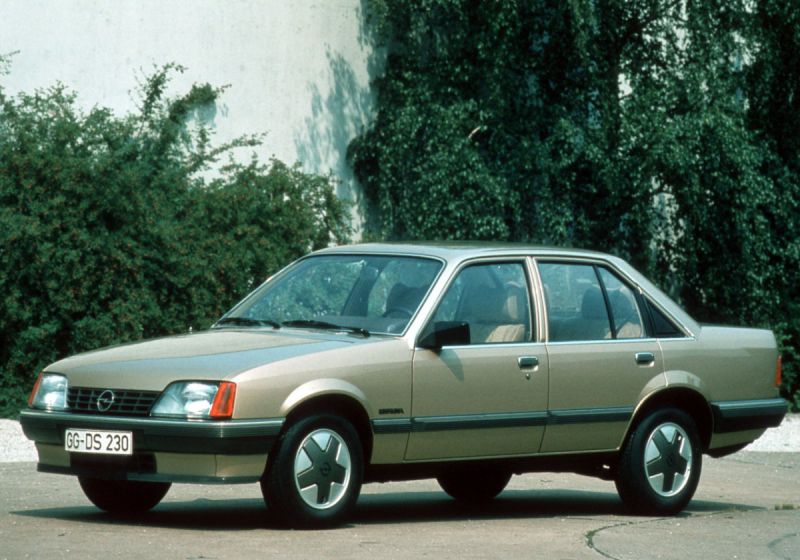
The Opel Rekord E (facelift 1982) 2.3 D (65 Hp) Automatic represents a significant chapter in the history of German automotive manufacturing, serving as a mainstay of the European mid-size to executive car segment for General Motors’ Opel division. Produced primarily for the European market, where it competed with domestic and international rivals, the Rekord E was known for its robust construction, practicality, and cost-effectiveness. The specific variant under review, the 2.3 D (65 Hp) Automatic, was introduced in September 1982 as part of the Rekord E’s significant facelift, aiming to modernize its aesthetics and refine its mechanical package. This model, a four-door sedan with seating for five, embodied the traditional European family car and fleet vehicle ethos of the early 1980s, prioritizing durability and fuel economy, especially in its diesel guise, over outright performance.
Evolution of the Opel Rekord E (facelift 1982)
The Opel Rekord lineage dates back to 1953, establishing itself as a core product for Opel, bridging the gap between smaller models like the Kadett and larger, more luxurious offerings such as the Senator. The Rekord E generation, launched in 1977, was a significant evolution, featuring a more contemporary design and improved aerodynamics compared to its predecessors. The 1982 facelift, sometimes referred to as the Rekord E2, brought a refreshed front fascia with new headlights and grille, revised taillights, and updated interior trim, giving the car a more modern appearance in line with the evolving design trends of the decade. This particular 2.3 D automatic model, produced for a relatively short period from September 1982 to July 1983, was a testament to Opel’s commitment to offering efficient and practical diesel options in a market increasingly conscious of fuel consumption.
Powertrain & Engine Architecture
Under the hood, the Opel Rekord E (facelift 1982) 2.3 D featured a naturally aspirated, inline four-cylinder diesel engine, designated as the 23D. With a displacement of 2,260 cubic centimeters (approximately 2.3 liters or 137.91 cubic inches), this powerplant was engineered for longevity and economy rather than blistering speed. It produced a modest 65 horsepower at 4,200 revolutions per minute, a figure typical for a diesel sedan of its era. Torque output was 127 Newton-meters (93.67 lb.-ft.) available at a relatively low 2,500 rpm, providing adequate pulling power for daily driving and highway cruising.
The engine utilized a precombustion chamber injection system, a common technology for diesel engines of the period, known for its smoother operation compared to direct injection systems, albeit at a slight efficiency penalty. The valvetrain was a simple Single Overhead Camshaft (SOHC) design with two valves per cylinder, emphasizing reliability and ease of maintenance. With a high compression ratio of 22:1, characteristic of diesel engines, the 2.3 D was designed to maximize fuel efficiency.
Power was transmitted to the rear wheels via a three-speed automatic transmission. This transmission, a General Motors-sourced unit (likely the TH180 or a similar variant), was chosen for its simplicity and reliability. It featured a torque converter for smooth engagement and a relatively conservative gear ratio spread, prioritizing fuel economy and comfortable cruising over rapid acceleration. The automatic transmission was a key feature for this trim level, appealing to drivers who preferred the convenience of automatic operation over the engagement of a manual gearbox.
Driving Characteristics
The Opel Rekord E 2.3 D Automatic offered a distinctly relaxed driving experience. The 65 horsepower engine and three-speed automatic transmission resulted in leisurely acceleration. While adequate for everyday driving and highway cruising, it lacked the responsiveness of the gasoline-powered Rekord E variants or the more powerful diesel options. The gear ratios were optimized for fuel efficiency, meaning the engine often operated at lower RPMs during normal driving conditions. This contributed to a quiet cabin and reduced fuel consumption, but also limited the car’s ability to accelerate quickly or climb steep hills without downshifting.
Compared to the manual transmission versions of the 2.3 D, the automatic suffered a noticeable performance penalty. The manual gearbox allowed drivers to better utilize the engine’s torque and maintain optimal RPMs for given driving conditions. The automatic, while convenient, introduced some power loss through the torque converter and limited the driver’s control over gear selection. Against the higher-output Rekord E models (such as the 2.0E or 2.2E), the 2.3 D Automatic was significantly slower and less engaging to drive, but it compensated with superior fuel economy and a more refined ride.
Equipment & Trim Levels
The 2.3 D Automatic trim of the Rekord E was generally positioned as a mid-range offering, balancing practicality with a degree of comfort and convenience. Standard features typically included cloth upholstery, a basic AM/FM radio, and manual windows and door locks. The interior trim was functional and durable, prioritizing longevity over luxury. The dashboard layout was straightforward, with clearly labeled controls and a simple instrument cluster.
Optional extras available for this trim included a sunroof, upgraded stereo system, power windows, and central locking. Air conditioning was also available, though it was not a standard feature. The exterior trim was relatively understated, with chrome accents on the bumpers and window surrounds. Wheel covers were typically included, though some models were equipped with steel wheels. The overall impression was one of understated practicality rather than ostentatious luxury.
Chassis & Braking
The Opel Rekord E featured a traditional body-on-frame construction, providing a robust and durable chassis. The suspension consisted of independent front suspension with MacPherson struts and a solid rear axle with leaf springs. This setup provided a comfortable ride, though it wasn’t particularly sporty. The steering was a recirculating ball system, offering a relatively heavy but precise feel.
The braking system consisted of ventilated disc brakes at the front and drum brakes at the rear. While the front discs provided adequate stopping power, the rear drums were less effective, particularly under heavy braking. The braking system was generally reliable, but it lacked the sophistication of more modern braking systems. The Rekord E was equipped with a hydraulic braking system with no anti-lock braking system (ABS) available, which was typical for vehicles of its era.
Market Reception & Comparison
Critics generally viewed the Opel Rekord E 2.3 D Automatic as a sensible and practical choice for buyers prioritizing fuel economy and durability. It wasn’t a particularly exciting car to drive, but it fulfilled its intended purpose as a reliable family sedan and fleet vehicle. Its fuel economy was a significant selling point, especially in the wake of the 1970s energy crises. However, its performance was often criticized as being lackluster, particularly compared to the gasoline-powered Rekord E models.
Compared to other trims in the Rekord E lineup, the 2.3 D Automatic offered the best fuel economy but the slowest acceleration. The gasoline-powered models provided more performance but at the cost of increased fuel consumption. The 2.0 D and 2.2 D diesel variants offered a compromise between performance and economy. In terms of reliability, the 2.3 D engine was generally considered to be very durable, though it required regular maintenance to ensure optimal performance. The automatic transmission was also relatively reliable, but it was more complex than the manual gearbox and therefore potentially more prone to failure.
Technical Specifications
| Category | Specification |
| Brand | Opel |
| Model | Rekord |
| Generation | Rekord E (facelift 1982) |
| Type (Engine) | 2.3 D (65 Hp) Automatic |
| Start of Production | September, 1982 |
| End of Production | July, 1983 |
| Powertrain Architecture | Internal Combustion engine |
| Body type | Sedan |
| Seats | 5 |
| Doors | 4 |
| Fuel consumption (combined) | 30.2 US mpg (7.8 l/100 km) |
| Fuel Type | Diesel |
| Acceleration 0 – 60 mph | 23.8 sec |
| Maximum speed | 93.21 mph (150 km/h) |
| Power | 65 Hp @ 4200 rpm |
| Torque | 93.67 lb.-ft. @ 2500 rpm (127 Nm @ 2500 rpm) |
| Engine Model/Code | 23D |
| Engine displacement | 2.3 liters (2260 cm³ / 137.91 cu. in.) |
| Number of cylinders | 4 |
| Engine configuration | Inline |
| Compression ratio | 22:1 |
| Kerb Weight | 2799.87 lbs (1270 kg) |
| Fuel tank capacity | 17.17 US gal (65 l) |
| Length | 183.15 in. (4652 mm) |
| Width | 67.95 in. (1726 mm) |
| Height | 55.91 in. (1420 mm) |
Legacy
The Opel Rekord E 2.3 D Automatic, while not a particularly glamorous or high-performance vehicle, holds a significant place in automotive history as a representative of a practical and durable era of European motoring. The 23D diesel engine proved to be remarkably robust, and many examples continue to operate today, albeit often with significant mileage. In the used car market, these Rekords are relatively affordable and sought after by enthusiasts who appreciate their simplicity and reliability. Parts availability can be a challenge, but a dedicated community of Opel enthusiasts helps to keep these vehicles on the road.
The combination of the 2.3-liter diesel engine and the three-speed automatic transmission, while not offering exhilarating performance, proved to be a reliable and economical powertrain. Its legacy lies in its ability to provide dependable transportation for families and businesses across Europe for many years. The Rekord E 2.3 D Automatic remains a testament to Opel’s commitment to building practical and durable vehicles that met the needs of a wide range of customers.