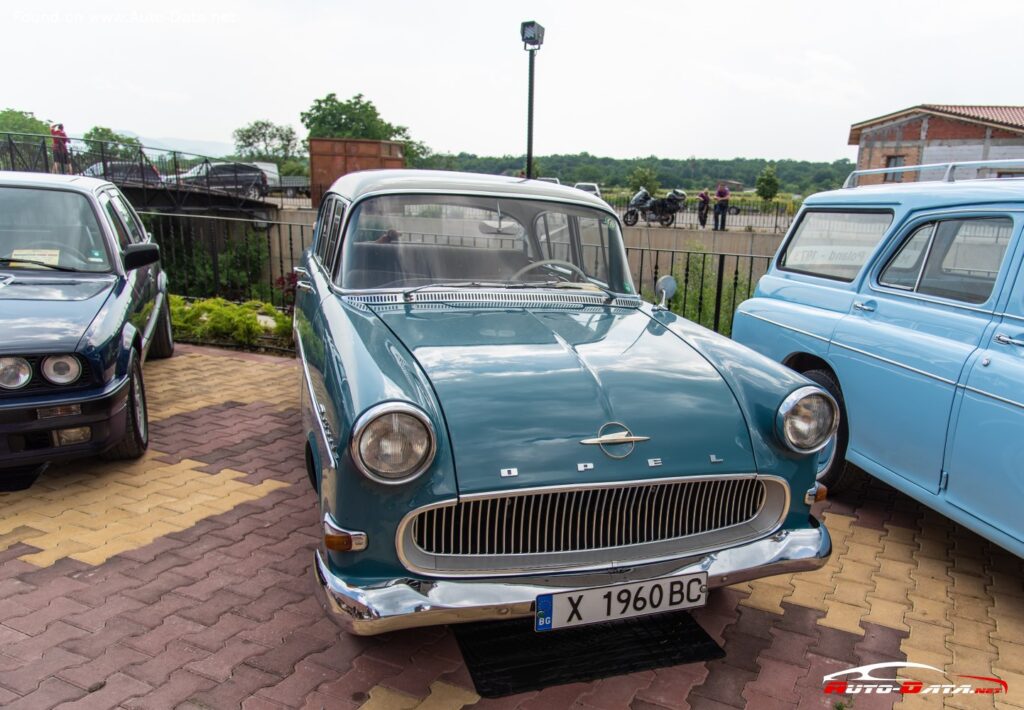
The Opel Rekord P1 (Olympia), manufactured by the German automaker Opel between 1957 and 1960, represents a crucial period in post-war European automotive development. Emerging during Germany’s “Wirtschaftswunder” (economic miracle), the Rekord P1 quickly became a symbol of newfound prosperity and modern transportation for the growing middle class. Primarily marketed in Europe, often referred to as the Opel Olympia Rekord P1 to acknowledge its lineage from the pre-war Olympia, this vehicle marked a stylistic shift for Opel, incorporating American design influences that were highly fashionable at the time. It offered a balance of practicality, affordability, and transatlantic styling, contributing to its success and recognition during its era. This article focuses specifically on the 1.7-liter (55 hp) engine paired with a manual transmission, a common configuration within the P1 range.
The Opel Rekord P1 (Olympia) 1.7: Entry-Level Family Transport
The Rekord P1 (Olympia) 1.7, producing 55 horsepower, served as the entry-level model within the P1 lineup. While Opel also offered more powerful variants, the 1.7 was designed to appeal to budget-conscious families seeking reliable and economical transportation. It occupied a position similar to the base-model Ford Taunus or Volkswagen in terms of price and target demographic. The emphasis was on providing a functional and comfortable vehicle rather than outright performance. This trim level was the most commonly produced, making it the most frequently seen P1 variant today.
Powertrain & Engine Architecture
The heart of the Opel Rekord P1 (Olympia) 1.7 was a straightforward and dependable inline-four cylinder engine. This powertrain featured a front-mounted, longitudinal engine layout with an overhead valve (OHV) valvetrain, known for its simplicity, durability, and ease of maintenance. The engine displaced 1,680 cubic centimeters (1.7 liters or 102.52 cubic inches) and produced 55 horsepower at 4,000 revolutions per minute. Fueling was handled by a single Solex carburetor, a common setup for the period.
Torque output was 120 Newton-meters (88.51 lb-ft) available between 1,900 and 2,300 rpm, providing adequate pulling power for everyday driving. The engine featured a compression ratio of 7.25:1, balancing performance with the quality of available gasoline. The engine code is generally identified as 150/55, though variations existed. Power was transmitted to the rear wheels via a three-speed manual transmission, a standard configuration for this class of vehicle. The transmission was not synchronized on first gear, a characteristic of many European manual transmissions of the era.
Driving Characteristics
The Rekord P1 1.7 offered a driving experience focused on practicality and comfort rather than sporty performance. Acceleration was modest, with a 0-60 mph time estimated around 18-20 seconds. The three-speed manual transmission required deliberate shifting, and the lack of synchronization on first gear demanded skill during starting. However, the broad torque band made the engine tractable and easy to drive in everyday traffic. The gear ratios were optimized for fuel economy and cruising, rather than rapid acceleration. Compared to the later, more powerful Rekord variants, the 1.7 felt noticeably slower, particularly when fully loaded with passengers and luggage. The steering was relatively heavy, lacking power assistance, but provided predictable control. The suspension, while comfortable, offered a degree of body roll in corners.
Equipment & Trim Levels
The Rekord P1 1.7 was typically equipped with basic but functional features. Standard equipment included a heater, a basic instrument panel with speedometer and fuel gauge, and cloth upholstery. The interior was relatively spartan, reflecting the car’s position as an entry-level model. The dashboard was typically finished in a simple, durable plastic. Optional extras included a radio, whitewall tires, and upgraded upholstery. Two-tone paint schemes were popular, often featuring a contrasting roof color. The Olympia trim level generally included slightly more interior trim and chrome detailing compared to the base Rekord models.
Chassis & Braking
The Rekord P1 featured a conventional chassis design for the late 1950s. The front suspension utilized independent coil springs, providing a degree of ride comfort. The rear suspension employed leaf springs, chosen for their durability and ability to handle heavier loads. Braking was accomplished via drum brakes on all four wheels. While adequate for the car’s performance, the drum brakes required a firm pedal and offered limited stopping power by modern standards. The steering system was a cone worm with recirculation balls, providing predictable control but requiring more effort than power-assisted systems. The car rode on 4J x 13-inch wheels, fitted with bias-ply tires. Stabilizer bars were not typically fitted to the base 1.7 model.
Market Reception & Comparison
The Opel Rekord P1 1.7 received generally positive reviews from automotive journalists of the time. Critics praised its practicality, affordability, and comfortable ride. However, some noted its modest performance and lack of advanced features. Compared to the more powerful Rekord variants, the 1.7 offered a more economical option, appealing to a wider range of buyers. Fuel economy was rated at approximately 26.4 US miles per gallon, a respectable figure for a family sedan of its size. Reliability was generally good, although maintenance was required to keep the OHV engine running smoothly. The Rekord P1 1.7 competed directly with models like the Ford Taunus 17M and the Borgward Isabella, offering a similar blend of practicality and affordability. The Volkswagen Beetle, while smaller, was a significant competitor due to its low price and reputation for reliability.
Technical Specifications
| Category | Specification |
| Brand | Opel |
| Model | Rekord |
| Generation | Rekord P1 (Olympia) |
| Type (Engine) | 1.7 (55 Hp) |
| Start of Production | 1957 |
| End of Production | 1960 |
| Powertrain Architecture | Internal Combustion engine |
| Body type | Sedan |
| Seats | 5 |
| Doors | 4 |
| Fuel consumption (economy) – combined | 8.9 l/100 km |
| Fuel Type | Petrol (Gasoline) |
| Maximum speed | 132 km/h |
| Weight-to-power ratio | 16.9 kg/Hp |
| Weight-to-torque ratio | 7.8 kg/Nm |
| Power | 55 Hp @ 4000 rpm |
| Power per liter | 32.7 Hp/l |
| Torque | 120 Nm @ 1900-2300 rpm |
| Engine layout | Front, Longitudinal |
| Engine displacement | 1680 cm3 |
| Number of cylinders | 4 |
| Engine configuration | Inline |
| Cylinder Bore | 85 mm |
| Piston Stroke | 74 mm |
| Compression ratio | 7.25:1 |
| Number of valves per cylinder | 2 |
| Fuel injection system | Carburetor |
| Engine aspiration | Naturally aspirated engine |
| Valvetrain | OHV |
| Engine oil capacity | 3 l |
| Coolant | 8 l |
| Kerb Weight | 930 kg |
| Max. weight | 1340 kg |
| Fuel tank capacity | 40 l |
| Length | 4433 mm |
| Width | 1616 mm |
| Height | 1490 mm |
| Wheelbase | 2541 mm |
| Front track | 1260 mm |
| Rear (Back) track | 1270 mm |
| Minimum turning circle (turning diameter) | 10.7 m |
| Drivetrain Architecture | The Internal combustion engine (ICE) drives the rear wheels of the vehicle. |
| Drive wheel | Rear wheel drive |
| Number of gears and type of gearbox | 3 gears, manual transmission |
| Front suspension | Independent coil spring |
| Rear suspension | Leaf spring |
| Front brakes | Drum |
| Rear brakes | Drum |
| Steering type | Cone worm with recirculation balls |
| Wheel rims size | 4J x 13 |
Legacy
The Opel Rekord P1 1.7 powertrain proved to be relatively reliable, although regular maintenance was essential. The OHV engine, while not particularly powerful, was durable and relatively easy to repair. Today, the Rekord P1 1.7 is a sought-after classic car, appreciated for its charming styling and historical significance. Parts availability can be challenging, but a dedicated community of enthusiasts exists to support restoration efforts. The 1.7 variant, being the most common, is generally more affordable than the higher-performance models, making it an accessible entry point into classic Opel ownership. Its enduring appeal lies in its representation of a pivotal moment in post-war German automotive history and its embodiment of the aspirations of a generation.