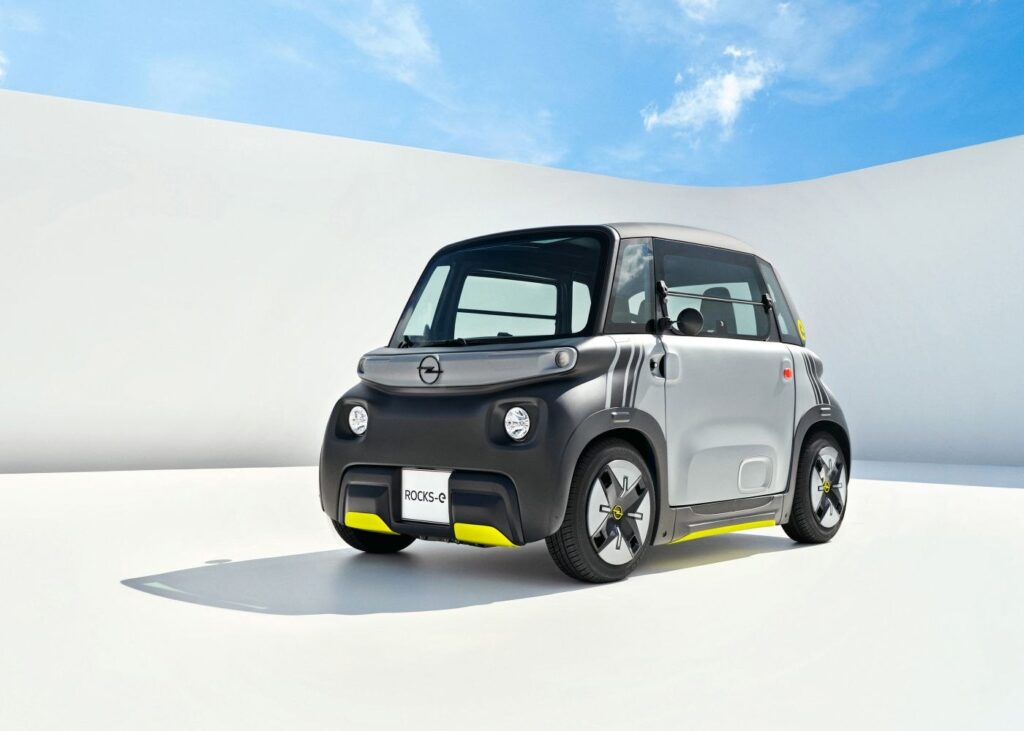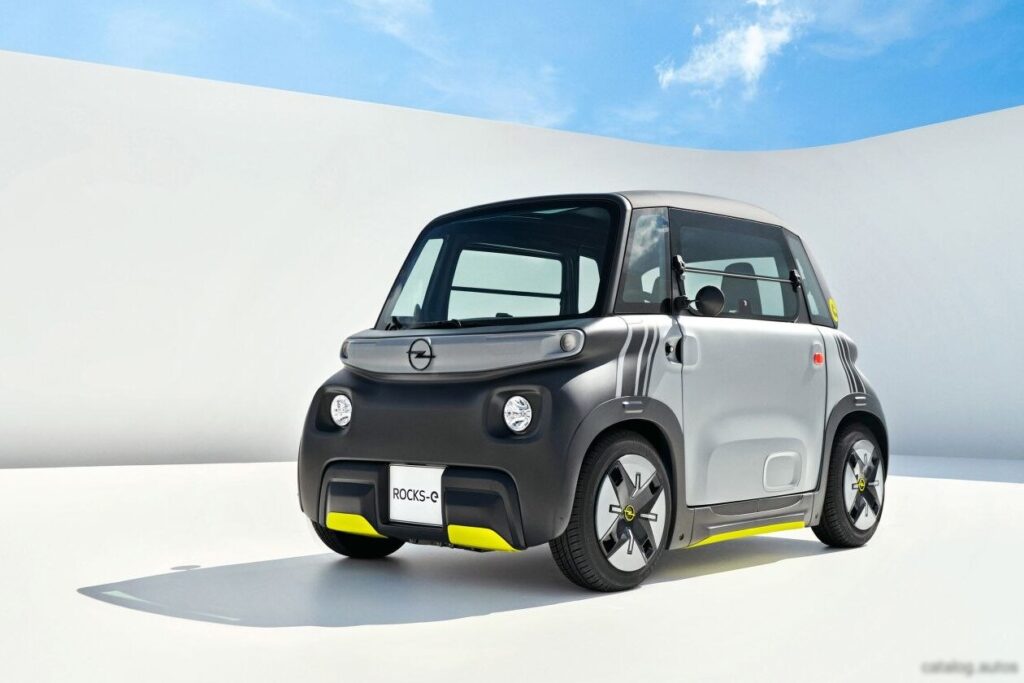
The Opel Rocks-e 5.5 kWh (8 hp) is a two-seat, two-door electric quadricycle produced by Opel starting in 2022. Representing a unique segment within the burgeoning electric vehicle market, the Rocks-e is designed for short-distance urban mobility. It’s positioned as an affordable and practical solution for city dwellers, particularly those seeking an alternative to scooters or public transportation. The vehicle is essentially a rebadged version of the Citroën Ami, stemming from Stellantis’ strategy of platform sharing and cost optimization. The Rocks-e is not intended for highway use, and its limited range and power reflect its intended application.
Technical Specifications
| Brand | Opel |
| Model | Rocks-e |
| Generation | Rocks-e |
| Type (Engine) | 5.5 kWh (8 hp) |
| Start of production | 2022 |
| Powertrain Architecture | BEV (Electric Vehicle) |
| Body type | Quadricycle |
| Seats | 2 |
| Doors | 2 |
| Fuel Type | Electricity |
| Maximum speed | 45 km/h (27.96 mph) |
| Weight-to-power ratio | 49.5 kg/hp, 20.2 hp/tonne |
| Gross battery capacity | 5.5 kWh |
| Battery technology | Lithium-ion (Li-Ion) |
| Battery location | Below the floor |
| All-electric range (WLTP) | 75 km (46.6 mi) |
| Electric motor power | 8 hp |
| Electric motor location | Front axle, Transverse |
| System power | 8 hp |
| Kerb Weight | 396 kg (873.03 lbs) |
| Max. weight | 700 kg (1543.24 lbs) |
| Max load | 304 kg (670.21 lbs) |
| Trunk (boot) space – minimum | 63 l (2.22 cu. ft) |
| Length | 2410 mm (94.88 in) |
| Width | 1388 mm (54.65 in) |
| Width including mirrors | 1541 mm (60.67 in) |
| Height | 1525 mm (60.04 in) |
| Wheelbase | 1728 mm (68.03 in) |
| Front track | 1210 mm (47.64 in) |
| Rear (Back) track | 1210 mm (47.64 in) |
| Minimum turning circle | 7.2 m (23.62 ft) |
| Drivetrain Architecture | One electric motor drives the front wheels |
| Drive wheel | Front wheel drive |
| Number of gears and type of gearbox | 1 gear, automatic transmission |
| Front suspension | Independent type McPherson |
| Rear suspension | Torsion |
| Front brakes | Disc |
| Rear brakes | Drum |
| Steering type | Steering rack and pinion |
| Power steering | Electric Steering |
| Tires size | 155/65 R14 |
| Wheel rims size | 14 |
Powertrain & Engine Architecture
The Opel Rocks-e utilizes a fully electric powertrain. The heart of the system is a 5.5 kWh lithium-ion battery pack located under the floor of the vehicle. This battery powers an 8 hp electric motor mounted on the front axle. The motor delivers its power to the front wheels via a single-speed automatic transmission. The electric motor is a permanent magnet synchronous motor, chosen for its efficiency and compact size. The vehicle employs a standard charging port compatible with typical household outlets and public charging stations, though charging times vary significantly depending on the power source. The Rocks-e does not feature regenerative braking to any significant degree, prioritizing simplicity over energy recovery.
Driving Characteristics
Given its limited power output of just 8 hp, the Opel Rocks-e is not designed for rapid acceleration or high-speed driving. Its top speed is restricted to 45 km/h (28 mph), making it suitable only for urban environments. Acceleration is linear but slow, and the single-speed transmission means there’s no shifting to contend with. The vehicle’s light weight (396 kg) helps to mitigate the lack of power, providing adequate performance for navigating city streets. Steering is light and responsive, making it easy to maneuver in tight spaces. The suspension, while basic, provides a reasonably comfortable ride on smooth surfaces. Compared to higher-powered electric vehicles, the Rocks-e offers a very different driving experience, prioritizing simplicity and ease of use over performance.
Equipment & Trim Levels
The Opel Rocks-e is offered with a relatively basic level of equipment, reflecting its affordability. Standard features include manually adjustable seats, basic instrumentation, and a charging cable. The interior is characterized by its minimalist design and durable materials. Optional extras are limited, but may include features such as a smartphone holder and a panoramic glass roof. The dashboard is simple and functional, providing essential information such as speed and battery charge level. The vehicle lacks many of the advanced features found in more expensive electric cars, such as a touchscreen infotainment system or advanced driver-assistance systems.
Chassis & Braking
The Opel Rocks-e features a simple chassis construction designed to minimize weight and cost. The front suspension utilizes an independent McPherson strut setup, while the rear suspension employs a torsion beam axle. This configuration provides a reasonable balance of ride comfort and handling. The braking system consists of disc brakes on the front wheels and drum brakes on the rear wheels. The steering system is a rack and pinion type with electric power assistance. The vehicle’s small 14-inch wheels are fitted with 155/65 R14 tires. The lightweight construction and basic suspension setup contribute to the Rocks-e’s nimble handling characteristics.
Market Reception & Comparison
The Opel Rocks-e has received mixed reviews from automotive critics. While praised for its affordability and practicality, it has also been criticized for its limited range, slow speed, and basic features. Compared to other electric vehicles, the Rocks-e occupies a unique niche as a low-cost, short-range urban mobility solution. Its main competitor is the Citroën Ami, which is mechanically identical. The Rocks-e offers comparable fuel economy (electricity consumption) to other electric vehicles, but its limited range means it is not suitable for long journeys. Reliability is expected to be good, given the simplicity of the powertrain and the lack of complex systems.
Legacy
The Opel Rocks-e represents a novel approach to urban mobility, offering a compelling alternative to traditional cars and scooters. Its long-term reliability remains to be seen, but the simplicity of its electric powertrain suggests it should be relatively durable. On the used car market, the Rocks-e is likely to appeal to buyers seeking an affordable and practical electric vehicle for short-distance city driving. Its unique design and limited production numbers may also make it a desirable collector’s item in the future. The Rocks-e’s success will likely depend on its ability to address the specific needs of urban dwellers and its continued affordability.