
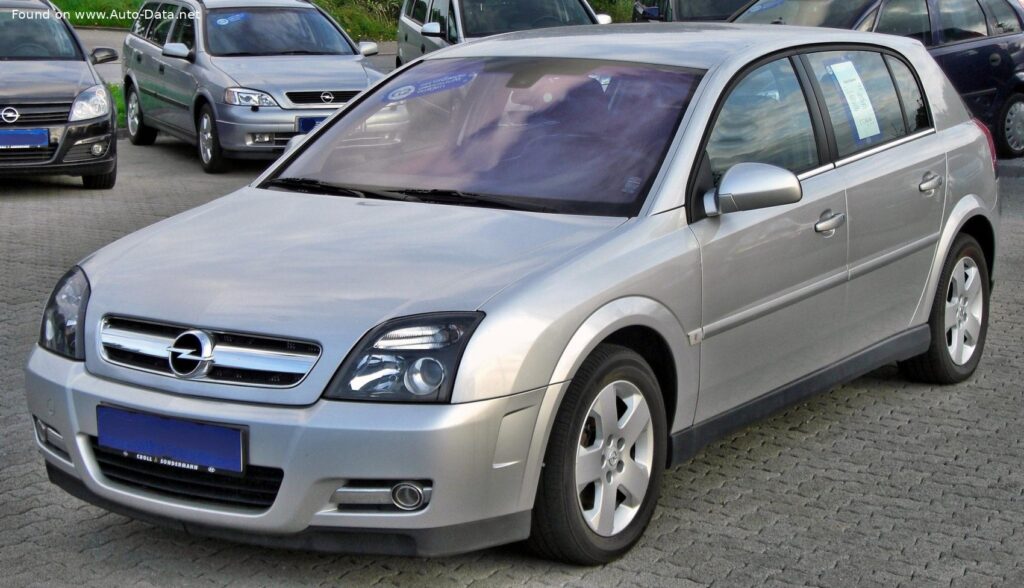
The Opel Signum 2.2i 16V ECOTEC: A European Executive Hatchback (2003-2005)
The Opel Signum 2.2i 16V ECOTEC: An Overview
The Opel Signum, specifically the 2.2i 16V ECOTEC (155 Hp) variant, was a distinctive offering from the German automaker aimed at the executive car segment. Launched in May 2003 and produced until 2005, this model represented the single generation of the Signum, positioned above the Opel Vectra C. Primarily designed for the European market, where it was also sold as the Vauxhall Signum in the United Kingdom, it sought to combine the practicality of a wagon with the comfort and premium feel of a sedan. Its five-door hatchback body style, often categorized as a large hatchback or a C-segment crossover, presented a unique alternative for buyers desiring versatility without sacrificing comfort or driving dynamics.
Unlike many of its competitors, the Signum prioritized interior flexibility and rear passenger space, attempting to establish a niche between traditional sedans and the emerging SUV market. This article provides a detailed examination of the technical specifications, design principles, and market impact of the 2.2i 16V ECOTEC variant, a key gasoline engine option during its production period.
Engine & Performance: The ECOTEC Powertrain
The Opel Signum 2.2i 16V ECOTEC was powered by a 2.2-liter (2198 cm³) 16-valve ECOTEC engine, designated internally as the Z22YH. This naturally aspirated, inline four-cylinder gasoline engine was engineered to balance performance and fuel efficiency, consistent with Opel’s ECOTEC philosophy. It featured a Double Overhead Camshaft (DOHC) valvetrain and, importantly for its time, a direct injection fuel system, optimizing fuel delivery and combustion efficiency.
The engine generated 155 horsepower (Hp) at 5600 revolutions per minute (rpm), providing sufficient power for highway driving and confident acceleration. Torque output was 220 Newton-meters (Nm), equivalent to approximately 162.26 pound-feet (lb.-ft.), peaking at 3800 rpm. This torque curve ensured responsive performance in everyday driving conditions.
When paired with a 5-speed manual transmission, the Opel Signum 2.2i 16V ECOTEC could accelerate from 0 to 60 mph in 9.3 seconds, and from 0 to 100 km/h in 9.8 seconds. Its top speed was rated at 131.11 mph (211 km/h), making it a capable performer on European highways. Fuel economy figures were competitive for its class and engine size, achieving a combined rating of 29 US mpg (8.1 liters per 100 km). Urban fuel consumption was 22.2 US mpg (10.6 l/100 km), while extra-urban consumption reached 35.6 US mpg (6.6 l/100 km), demonstrating the engine’s efficiency across various driving scenarios. The 60-liter (15.85 US gallon) fuel tank provided a reasonable driving range.
Design & Features: Versatility and Comfort
The Opel Signum’s design deviated from conventional executive car aesthetics. While sharing its platform and numerous components with the Vectra C, its extended wheelbase (111.42 inches or 2830 mm) and unique hatchback body set it apart. Measuring 182.52 inches (4636 mm) in length, 70.79 inches (1798 mm) in width, and 57.72 inches (1466 mm) in height, the Signum presented a substantial presence on the road. The drag coefficient (Cd) of 0.33 was respectable for a vehicle of its size and shape, contributing to both fuel efficiency and reduced wind noise.
The interior was where the Signum aimed to truly innovate. With five seats and five doors, its “FlexSpace” seating system allowed for considerable interior configuration. The rear seats could slide, recline, and fold individually, transforming the interior from a comfortable four-seater with ample legroom into a versatile cargo carrier. Minimum trunk space was 12.89 cubic feet (365 liters), expanding to 49.79 cubic feet (1410 liters) with the rear seats folded, comparable to many wagons.
Standard features included power steering (hydraulic), front-wheel drive, and a robust braking system with ventilated discs at the front and disc brakes at the rear, enhanced by ABS (Anti-lock Braking System) for improved safety. The suspension system utilized coil springs at both the front and rear, providing a comfortable and stable ride typical of European executive cars. The vehicle was equipped with 215/55 R16 tires mounted on 6.5J x 16 wheel rims. With a curb weight of 3384.1 pounds (1535 kg) and a maximum permissible weight of 4519.48 pounds (2050 kg), the Signum was a substantial and well-constructed vehicle.
Technical Specifications: Opel Signum 2.2i 16V ECOTEC (155 Hp)
| Category | Specification |
| General Information | |
| Brand | Opel |
| Model | Signum |
| Generation | Signum |
| Type (Engine) | 2.2i 16V ECOTEC (155 Hp) |
| Start of Production | May, 2003 |
| End of Production | 2005 |
| Powertrain Architecture | Internal Combustion engine |
| Body Type | Hatchback |
| Seats | 5 |
| Doors | 5 |
| Performance Specs | |
| Fuel Consumption (Urban) | 10.6 l/100 km (22.2 US mpg) |
| Fuel Consumption (Extra Urban) | 6.6 l/100 km (35.6 US mpg) |
| Fuel Consumption (Combined) | 8.1 l/100 km (29 US mpg) |
| Fuel Type | Petrol (Gasoline) |
| Acceleration 0-60 mph | 9.3 sec |
| Acceleration 0-100 km/h | 9.8 sec |
| Maximum Speed | 211 km/h (131.11 mph) |
| Weight-to-Power Ratio | 9.9 kg/Hp (101 Hp/tonne) |
| Weight-to-Torque Ratio | 7 kg/Nm (143.3 Nm/tonne) |
| Engine Specs | |
| Power | 155 Hp @ 5600 rpm |
| Power per Liter | 70.5 Hp/l |
| Torque | 220 Nm (162.26 lb.-ft.) @ 3800 rpm |
| Engine Layout | Front, Transverse |
| Engine Model/Code | Z22YH |
| Engine Displacement | 2198 cm³ (134.13 cu. in.) |
| Number of Cylinders | 4 |
| Engine Configuration | Inline |
| Cylinder Bore | 86 mm (3.39 in.) |
| Piston Stroke | 94.6 mm (3.72 in.) |
| Compression Ratio | 12:1 |
| Number of Valves per Cylinder | 4 |
| Fuel Injection System | Direct injection |
| Engine Aspiration | Naturally aspirated engine |
| Valvetrain | DOHC |
| Engine Oil Capacity | 5 l (5.28 US qt) |
| Coolant Capacity | 7.1 l (7.5 US qt) |
| Space, Volume and Weights | |
| Kerb Weight | 1535 kg (3384.1 lbs.) |
| Max. Weight | 2050 kg (4519.48 lbs.) |
| Max Load | 515 kg (1135.38 lbs.) |
| Trunk (Boot) Space – Minimum | 365 l (12.89 cu. ft.) |
| Trunk (Boot) Space – Maximum | 1410 l (49.79 cu. ft.) |
| Fuel Tank Capacity | 60 l (15.85 US gal) |
| Dimensions | |
| Length | 4636 mm (182.52 in.) |
| Width | 1798 mm (70.79 in.) |
| Height | 1466 mm (57.72 in.) |
| Wheelbase | 2830 mm (111.42 in.) |
| Front Track | 1524 mm (60 in.) |
| Rear (Back) Track | 1512 mm (59.53 in.) |
| Drag Coefficient (Cd) | 0.33 |
| Drivetrain, Brakes and Suspension Specs | |
| Drivetrain Architecture | Front wheel drive, Internal Combustion engine |
| Drive Wheel | Front wheel drive |
| Number of Gears and Type of Gearbox | 5 gears, manual transmission |
| Front Suspension | Coil spring |
| Rear Suspension | Coil spring |
| Front Brakes | Ventilated discs |
| Rear Brakes | Disc |
| Assisting Systems | ABS (Anti-lock braking system) |
| Steering Type | Steering rack and pinion |
| Power Steering | Hydraulic Steering |
| Tires Size | 215/55 R16 |
| Wheel Rims Size | 6.5J x 16 |
Legacy and Market Impact of the Opel Signum
The Opel Signum 2.2i 16V ECOTEC represents an ambitious, though ultimately not commercially triumphant, chapter in Opel’s history. It was a bold attempt to address a perceived gap in the European market for a versatile, premium executive car offering greater practicality than a traditional sedan and more comfort than a conventional wagon. Its main European competitors included the Ford Mondeo, Volkswagen Passat, Renault Vel Satis, and Citroën C5, all of which also explored innovative designs and functionalities.
Despite its innovative interior and comfortable ride, the Signum struggled to achieve significant sales. Its unconventional styling and positioning as a premium Opel, a brand traditionally associated with mainstream vehicles, made it difficult for consumers to justify its price compared to established executive cars from BMW, Mercedes-Benz, and Audi. The 2.2i 16V ECOTEC engine, while capable, also faced competition from more powerful gasoline and increasingly popular diesel engines.
The Signum’s relatively short production run (2003-2008, with the 2.2i 16V ECOTEC ending in 2005) suggests it did not meet Opel’s sales expectations. However, its legacy lies in its forward-thinking design and interior versatility. It demonstrated Opel’s willingness to experiment with new body styles and prioritize passenger comfort and modularity, concepts that would later become more prevalent in the automotive industry with the rise of crossovers and MPVs. Today, the Opel Signum is remembered as a unique and commendable attempt to innovate within a conservative market segment, and a distinctive piece of European automotive history.
