
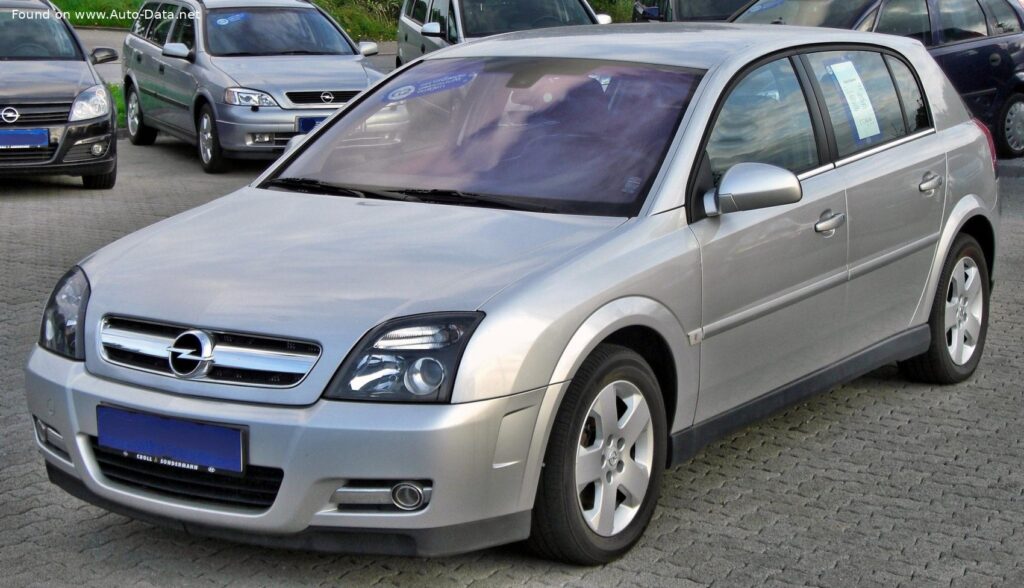
The Opel Signum, specifically the 3.2i V6 24V ECOTEC (211 Hp) variant, was a distinctive offering from the German automaker Opel during the early 2000s. Launched in May 2003, the Signum was positioned as a premium executive hatchback, designed primarily for the European market. It aimed to bridge the gap between traditional sedans and station wagons, offering enhanced rear passenger comfort and exceptional versatility within a sophisticated package. Built on the extended platform of the Opel Vectra C, the Signum distinguished itself with a unique “crossover estate” body style that prioritized interior space and flexibility, particularly for rear occupants. This particular model, with its potent 3.2-liter V6 engine, served as the flagship performance variant, combining robust power with Opel’s commitment to refined driving dynamics and innovative packaging.
Opel Signum 3.2i V6: A Unique Executive Hatchback
The Opel Signum represented a departure from conventional executive car design. While many manufacturers focused on traditional sedan or wagon formats, Opel sought to create a vehicle that offered the best of both worlds – the practicality of a wagon with the sleekness of a hatchback. This approach, combined with a focus on rear passenger comfort, defined the Signum’s market position. It was never widely exported outside of Europe, making it a relatively rare sight in other parts of the world. The Signum aimed to appeal to buyers who desired a premium vehicle with a spacious interior and a touch of individuality.
Engine & Performance
At the heart of the Opel Signum 3.2i V6 24V ECOTEC was a 3.2-liter (3175 cm³ or 193.75 cu. in.) naturally aspirated V6 engine, designated the Z32SE. This engine embodied Opel’s ECOTEC (Emissions COntrol TEChnology) philosophy, striving for a balance between performance and efficiency. The engine featured a 60-degree V-configuration with four valves per cylinder, totaling 24 valves for optimized airflow. A Double Overhead Camshaft (DOHC) valvetrain precisely controlled the intake and exhaust cycles, contributing to smooth operation and strong power delivery.
Producing 211 horsepower (Hp) at 6200 revolutions per minute (rpm), the engine delivered 66.5 Hp per liter. Torque peaked at 221.27 lb.-ft. (300 Nm) at 4000 rpm, providing ample pulling power throughout the rev range. The engine’s favorable weight-to-power ratio of 7.6 kg/Hp and weight-to-torque ratio of 5.4 kg/Nm, combined with a kerb weight of 3549.44 lbs. (1610 kg), resulted in responsive acceleration. Power was transmitted to the front wheels via a 5-speed manual transmission, offering an engaging driving experience. The Signum 3.2i V6 could accelerate from 0 to 60 mph in 7.5 seconds, reaching 0-62 mph (0-100 km/h) in 7.9 seconds, with a top speed of 147.26 mph (237 km/h). Fuel economy figures were reported as 16.4 US mpg in urban conditions, 30.9 US mpg on extra-urban cycles, and a combined average of 23.3 US mpg (10.1 l/100 km).
Design & Features
The Opel Signum’s design prioritized interior space and versatility. Classified as a 5-door hatchback, it utilized a long wheelbase of 111.42 inches (2830 mm) – shared with the long-wheelbase Vectra Caravan – to maximize cabin space. The overall length was 182.52 inches (4636 mm), with a width of 70.79 inches (1798 mm) and a height of 57.72 inches (1466 mm). A drag coefficient (Cd) of 0.33 contributed to both spaciousness and aerodynamic efficiency.
The interior was designed for five occupants, but the rear seats were the focal point of innovation. Opel’s “FlexSpace” seating system allowed the two outer rear seats to slide forward and backward, recline, and even fold flat individually. A central console, known as the “Travel Assistant,” could be installed between the rear seats, offering features like a cool box, cup holders, and multimedia connections, enhancing the executive travel experience. Standard features included coil spring suspension, ventilated disc brakes on all wheels with ABS, and a hydraulic rack and pinion steering system. The vehicle rode on 215/55 R16 tires mounted on 6.5J x 16-inch wheel rims. Trunk space ranged from 12.89 cu. ft. (365 liters) to 49.79 cu. ft. (1410 liters) with the rear seats folded.
Technical Specifications: Opel Signum 3.2i V6 24V ECOTEC (211 Hp)
| Feature | Specification |
| Brand | Opel |
| Model | Signum |
| Generation | Signum |
| Type (Engine) | 3.2i V6 24V ECOTEC (211 Hp) |
| Start of Production | May, 2003 |
| End of Production | June, 2005 |
| Powertrain Architecture | Internal Combustion engine |
| Body Type | Hatchback |
| Seats | 5 |
| Doors | 5 |
| Fuel Consumption (Urban) | 16.4 US mpg (14.3 l/100 km) |
| Fuel Consumption (Extra Urban) | 30.9 US mpg (7.6 l/100 km) |
| Fuel Consumption (Combined) | 23.3 US mpg (10.1 l/100 km) |
| Fuel Type | Petrol (Gasoline) |
| Acceleration 0-60 mph | 7.5 sec |
| Acceleration 0-62 mph (0-100 km/h) | 7.9 sec |
| Maximum Speed | 147.26 mph (237 km/h) |
| Weight-to-Power Ratio | 7.6 kg/Hp (131.1 Hp/tonne) |
| Weight-to-Torque Ratio | 5.4 kg/Nm (186.3 Nm/tonne) |
| Power | 211 Hp @ 6200 rpm |
| Power per Liter | 66.5 Hp/l |
| Torque | 221.27 lb.-ft. @ 4000 rpm (300 Nm @ 4000 rpm) |
| Engine Layout | Front, Transverse |
| Engine Model/Code | Z32SE |
| Engine Displacement | 3.2 liters (3175 cm³ / 193.75 cu. in.) |
| Number of Cylinders | 6 |
| Engine Configuration | V-engine |
| Cylinder Bore | 3.44 in. (87.5 mm) |
| Piston Stroke | 3.46 in. (88 mm) |
| Compression Ratio | 10:1 |
| Valves per Cylinder | 4 |
| Fuel Injection System | Multi-port manifold injection |
| Engine Aspiration | Naturally aspirated engine |
| Valvetrain | DOHC |
| Engine Oil Capacity | 5.02 US qt (4.75 l) |
| Coolant Capacity | 8.14 US qt (7.7 l) |
| Kerb Weight | 3549.44 lbs. (1610 kg) |
| Max. Weight | 4684.82 lbs. (2125 kg) |
| Max Load | 1135.38 lbs. (515 kg) |
| Trunk Space (Minimum) | 12.89 cu. ft. (365 l) |
| Trunk Space (Maximum) | 49.79 cu. ft. (1410 l) |
| Fuel Tank Capacity | 15.85 US gal (60 l) |
| Length | 182.52 in. (4636 mm) |
| Width | 70.79 in. (1798 mm) |
| Height | 57.72 in. (1466 mm) |
| Wheelbase | 111.42 in. (2830 mm) |
| Front Track | 60 in. (1524 mm) |
| Rear Track | 59.53 in. (1512 mm) |
| Drag Coefficient (Cd) | 0.33 |
| Drivetrain Architecture | Front wheel drive (Internal combustion engine drives front wheels) |
| Drive Wheel | Front wheel drive |
| Gearbox Type | 5 gears, manual transmission |
| Front Suspension | Coil spring |
| Rear Suspension | Coil spring |
| Front Brakes | Ventilated discs |
| Rear Brakes | Ventilated discs |
| Assisting Systems | ABS (Anti-lock braking system) |
| Steering Type | Steering rack and pinion |
| Power Steering | Hydraulic Steering |
| Tire Size | 215/55 R16 |
| Wheel Rim Size | 6.5J x 16 |
Legacy and Market Impact: The Opel Signum’s Unique Position
The Opel Signum 3.2i V6 24V ECOTEC, along with its less powerful siblings, represented Opel’s ambitious attempt to innovate within the executive car segment in Europe. Its primary market was continental Europe and the UK, where it was sold as a Vauxhall Signum. The car’s unique “large hatchback” or “crossover estate” body style was a deliberate effort to offer something different from the traditional sedan and wagon offerings that dominated the D-segment. While it competed with models like the Ford Mondeo, Volkswagen Passat, and Renault Laguna, it struggled to achieve significant sales volumes due to its polarizing styling and the established brand prestige of its competitors.
Despite its limited commercial success, the Opel Signum holds a notable place in Opel’s history. It showcased the brand’s willingness to experiment with body architectures and prioritize interior versatility and passenger comfort. The 3.2-liter V6 variant, in particular, demonstrated Opel’s capability to produce a refined and powerful executive cruiser. Today, the Signum is remembered as an interesting, albeit misunderstood, chapter in Opel’s quest to offer innovative and comfortable vehicles in the competitive European market.
