
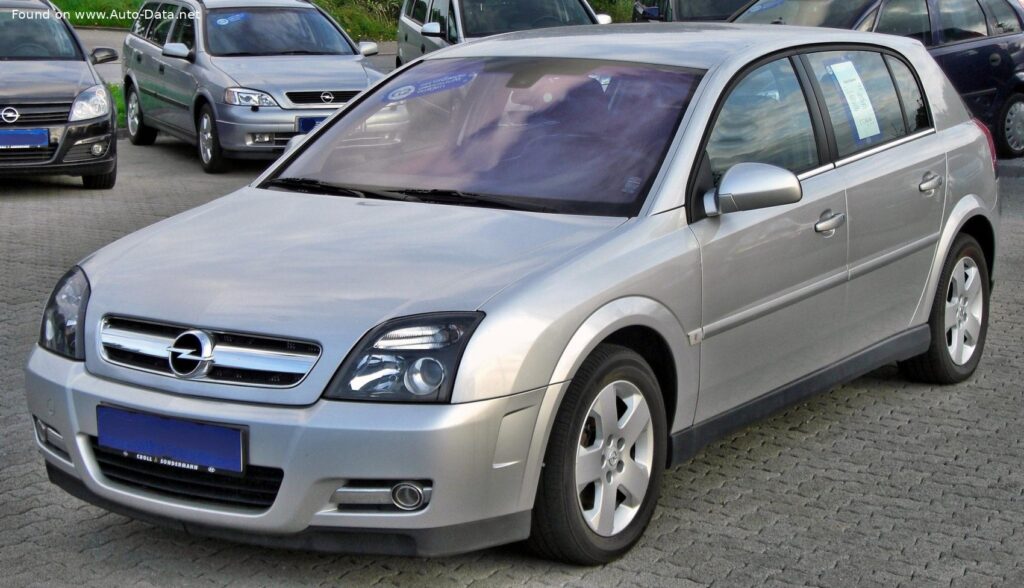
The Opel Signum 3.2i V6 24V ECOTEC (211 Hp) Automatic represents a distinctive and somewhat experimental chapter in European automotive history. Launched in May 2003 and produced until June 2005, the Signum was Opel’s attempt to establish a unique position within the competitive European D-segment, or mid-size executive car market. Instead of a conventional sedan or station wagon, Opel opted for a five-door “executive hatchback,” or liftback, body style, prioritizing interior versatility and rear passenger comfort.
The Opel Signum: A Unique Executive Hatchback
Based on the extended platform of the Opel Vectra C station wagon, the Signum aimed to combine the practicality of a hatchback with the spaciousness and premium feel associated with larger, more upscale vehicles. The 3.2-liter V6 ECOTEC engine, coupled with a smooth automatic transmission, positioned this variant as the flagship model, offering robust performance for drivers valuing both power and innovative design. While never a mainstream success, the Signum remains a noteworthy example of Opel’s design ambition.
Engine & Performance
The Opel Signum 3.2i V6 24V ECOTEC (211 Hp) Automatic was powered by a 3.2-liter (3175 cm³, 193.75 cu. in.) naturally aspirated V6 ECOTEC engine, designated the Z32SE. This engine was engineered to deliver a balance of performance and refinement. Featuring a DOHC (Double Overhead Camshaft) valvetrain and four valves per cylinder, the engine produced 211 horsepower at 6200 rpm. Torque output was 221.27 lb.-ft. (300 Nm) at 4000 rpm, providing ample power across a broad rev range.
Power was delivered to the front wheels via a 5-speed automatic transmission, chosen for its smooth shifting and ease of use, aligning with the Signum’s executive character. This powertrain allowed the 1610 kg (3549.44 lbs.) vehicle to accelerate from 0 to 60 mph in 8.1 seconds, with a maximum speed of 146.02 mph (235 km/h). While not a sports car, the V6 Signum offered brisk performance for highway driving and confident overtaking.
Despite its larger engine, Opel’s ECOTEC (Emissions COntrol TEChnology) philosophy aimed for a balance of power and efficiency. Combined fuel economy was rated at 10.7 liters per 100 km, approximately 22 US mpg. Urban consumption was higher at 15.7 l/100 km (15 US mpg), while extra-urban driving yielded a more economical 7.8 l/100 km (30.2 US mpg). These figures were competitive for a V6-powered vehicle of its size and class in the early 2000s.
Design & Features
The Opel Signum’s defining characteristic was its unique hatchback body style, blurring the lines between a traditional sedan, wagon, and luxury liftback. Measuring 182.52 inches (4636 mm) in length, 70.79 inches (1798 mm) in width, and 57.72 inches (1466 mm) in height, the Signum was a substantial vehicle. Its extended wheelbase of 111.42 inches (2830 mm), shared with the Vectra C wagon, was crucial for maximizing rear passenger space and flexibility.
The interior featured a sophisticated and adaptable cabin. The rear seating area was particularly innovative, offering two individual seats (with an optional central jump seat) that could slide, recline, and fold independently. This “FlexSpace” system provided exceptional legroom for rear occupants, comparable to larger executive sedans, along with modular cargo capabilities. Trunk space ranged from 12.89 cu. ft. (365 l) with all seats up to 49.79 cu. ft. (1410 l) with the rear seats folded, offering significant practicality.
Standard features for the segment in the early 2000s included an advanced climate control system, a comprehensive infotainment setup (often with a color display), and various power amenities. Safety features included ABS (Anti-lock Braking System) and a suite of airbags. The car’s driving dynamics were managed by a front-wheel-drive architecture, coil spring suspension, and ventilated disc brakes all around, ensuring a comfortable and secure ride. Hydraulic power steering with a rack and pinion setup provided responsive handling.
Technical Specifications: Opel Signum 3.2i V6 24V ECOTEC
| Category | Specification |
| General Information | |
| Brand | Opel |
| Model | Signum |
| Generation | Signum |
| Type (Engine) | 3.2i V6 24V ECOTEC (211 Hp) Automatic |
| Start of Production | May, 2003 |
| End of Production | June, 2005 |
| Powertrain Architecture | Internal Combustion engine |
| Body type | Hatchback |
| Seats | 5 |
| Doors | 5 |
| Performance Specs | |
| Fuel consumption (economy) – urban | 15.7 l/100 km (15 US mpg) |
| Fuel consumption (economy) – extra urban | 7.8 l/100 km (30.2 US mpg) |
| Fuel consumption (economy) – combined | 10.7 l/100 km (22 US mpg) |
| Fuel Type | Petrol (Gasoline) |
| Acceleration 0 – 60 mph | 8.1 sec |
| Maximum speed | 146.02 mph (235 km/h) |
| Weight-to-power ratio | 7.6 kg/Hp, 131.1 Hp/tonne |
| Weight-to-torque ratio | 5.4 kg/Nm, 186.3 Nm/tonne |
| Engine Specs | |
| Power | 211 Hp @ 6200 rpm |
| Power per liter | 66.5 Hp/l |
| Torque | 221.27 lb.-ft. (300 Nm) @ 4000 rpm |
| Engine layout | Front, Transverse |
| Engine Model/Code | Z32SE |
| Engine displacement | 3.2 l (3175 cm³, 193.75 cu. in.) |
| Number of cylinders | 6 |
| Engine configuration | V-engine |
| Cylinder Bore | 3.44 in. (87.5 mm) |
| Piston Stroke | 3.46 in. (88 mm) |
| Compression ratio | 10:1 |
| Number of valves per cylinder | 4 |
| Fuel injection system | Multi-port manifold injection |
| Engine aspiration | Naturally aspirated engine |
| Valvetrain | DOHC |
| Engine oil capacity | 5.02 US qt (4.75 l) |
| Coolant capacity | 8.35 US qt (7.9 l) |
| Space, Volume and Weights | |
| Kerb Weight | 3549.44 lbs. (1610 kg) |
| Max. weight | 4684.82 lbs. (2125 kg) |
| Max load | 1135.38 lbs. (515 kg) |
| Trunk (boot) space – minimum | 12.89 cu. ft. (365 l) |
| Trunk (boot) space – maximum | 49.79 cu. ft. (1410 l) |
| Fuel tank capacity | 15.85 US gal (60 l) |
| Dimensions | |
| Length | 182.52 in. (4636 mm) |
| Width | 70.79 in. (1798 mm) |
| Height | 57.72 in. (1466 mm) |
| Wheelbase | 111.42 in. (2830 mm) |
| Front track | 60 in. (1524 mm) |
| Rear (Back) track | 59.53 in. (1512 mm) |
| Drag coefficient (Cd) | 0.33 |
| Drivetrain, Brakes and Suspension Specs | |
| Drivetrain Architecture | The Internal combustion engine (ICE) drives the front wheels of the vehicle. |
| Drive wheel | Front wheel drive |
| Number of gears and type of gearbox | 5 gears, automatic transmission |
| Front suspension | Coil spring |
| Rear suspension | Coil spring |
| Front brakes | Ventilated discs |
| Rear brakes | Ventilated discs |
| Assisting systems | ABS (Anti-lock braking system) |
| Steering type | Steering rack and pinion |
| Power steering | Hydraulic Steering |
| Tires size | 215/55 R16 |
| Wheel rims size | 6.5J x 16 |
Legacy & Market Impact
The Opel Signum, particularly the 3.2i V6 24V ECOTEC (211 Hp) Automatic, was a bold attempt by Opel to redefine the executive car segment in Europe. Its competitors included the Volkswagen Passat, Ford Mondeo, Peugeot 406, and potentially more premium models from Audi and BMW. However, its unconventional styling and positioning hindered its market success. Production ended in 2005 for the V6 model and the entire Signum line was discontinued in 2008.
Today, the Signum is viewed as an interesting but commercially unsuccessful experiment. It showcased Opel’s willingness to innovate and challenge segment definitions, offering a versatile and comfortable vehicle. The Signum remains appreciated by enthusiasts for its unique design and robust V6 powertrain, representing a period when manufacturers were more willing to explore unconventional body styles.
