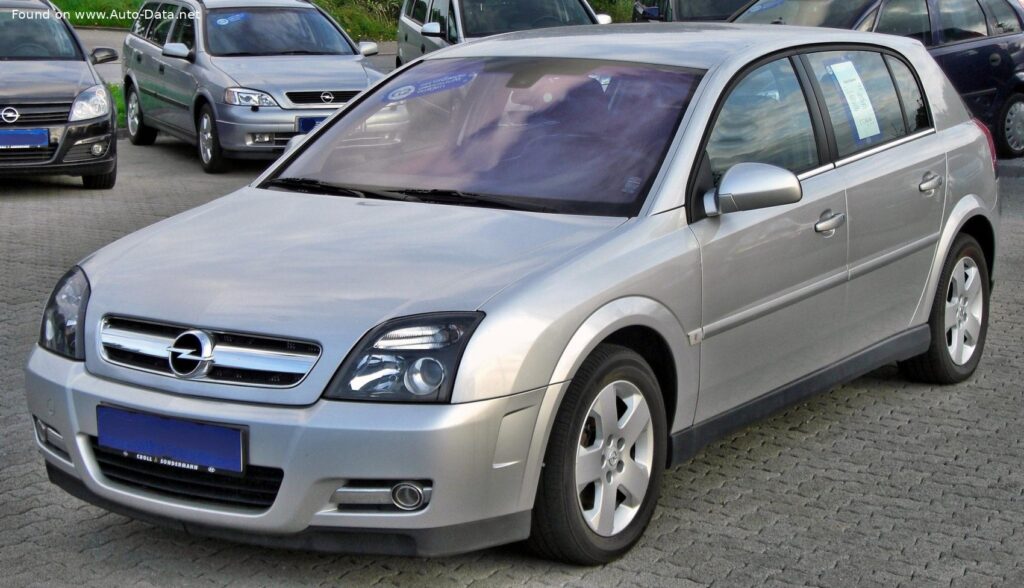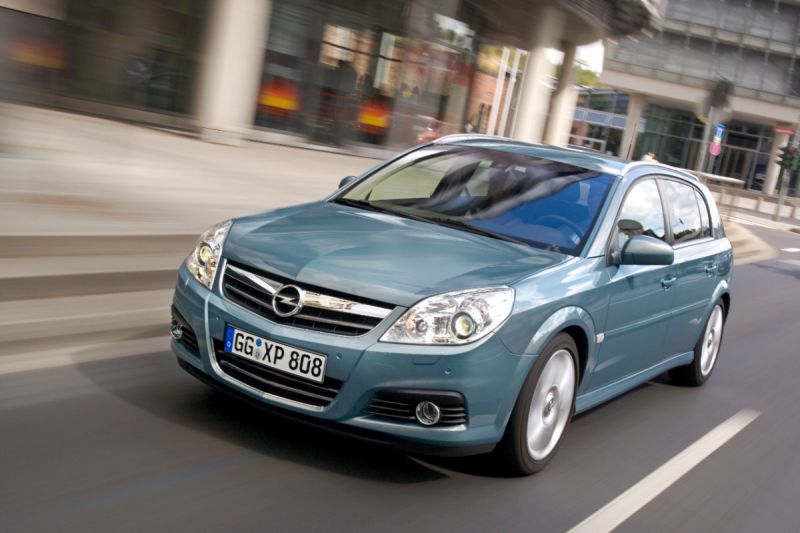
The Opel Signum (facelift 2005) 1.9 CDTI (120 Hp) represented a distinctive and ambitious venture by German automaker Opel within the European D-segment. Launched in 2003 and refreshed in 2005, the Signum was conceived as a premium “lifestyle hatchback” or “executive liftback,” aiming to bridge the gap between traditional sedans and more versatile station wagons, offering enhanced rear passenger comfort and adaptability. Unlike many of its contemporaries, the Signum was never officially sold in the United States, remaining a European-market exclusive where it competed against established players like the Volkswagen Passat, Ford Mondeo, and its stablemate, the Opel Vectra.
Opel Signum (facelift 2005): A Unique European Proposition
The 2005 facelift brought a series of aesthetic and mechanical updates, aligning the Signum more closely with Opel’s evolving design language and improving its powertrain offerings. This particular variant, featuring the 1.9-liter Common Rail Diesel Injection (CDTI) engine, was a popular choice for its balance of fuel efficiency, torque, and adequate performance for daily European driving conditions, reflecting the growing demand for diesel powertrains in the region during the mid-2000s.
Engine & Performance: The 1.9 CDTI Powerplant
At the heart of this particular Opel Signum (facelift 2005) model was the Z19DT engine code 1.9-liter (1910 cm3 or 116.56 cu. in.) CDTI inline-four diesel engine. This unit was a product of the GM/Fiat Powertrain joint venture, known for its robustness and efficiency. It featured a DOHC (Dual Overhead Camshaft) valvetrain with 2 valves per cylinder, a common rail fuel injection system, and was significantly enhanced by a turbocharger and intercooler. This setup allowed the engine to produce 120 horsepower at 3250 rpm, delivering a power-per-liter figure of 62.8 Hp/l, respectable for a diesel of its era.
Crucially for a diesel engine, torque output was substantial, peaking at 280 Nm (206.52 lb.-ft.) at a low 1750 rpm. This ample low-end torque was instrumental in providing the Signum with responsive acceleration and strong pulling power, making it well-suited for both city driving and highway cruising. Power was delivered to the front wheels via a smooth-shifting 6-speed manual transmission, offering a good balance between spirited driving and fuel economy.
In terms of outright performance, the Signum 1.9 CDTI (120 Hp) could accelerate from 0 to 60 mph in a calculated 11.4 seconds (0-100 km/h in 12 seconds) and reach a maximum speed of 119.3 mph (192 km/h). While not a performance leader, these figures were more than adequate for its intended purpose as a comfortable and efficient long-distance cruiser. Fuel economy was a strong suit, with an estimated urban consumption of 30.5 US mpg (7.7 l/100 km) and an impressive extra-urban (highway) figure of 47 US mpg (5.0 l/100 km), highlighting the efficiency benefits of its diesel powertrain.
Design & Features: A Focus on Versatility and Comfort
The Opel Signum adopted a distinct five-door hatchback body style, though its elongated profile and extended wheelbase often led it to be described as a “liftback” or even a “short wagon.” Measuring 183.11 inches (4651 mm) in length, 70.79 inches (1798 mm) in width, and 57.48 inches (1460 mm) in height, the Signum was notably longer than its Vectra sedan sibling, a characteristic that directly contributed to its primary design objective: maximizing rear passenger space and comfort. The generous 111.42-inch (2830 mm) wheelbase was a key enabler for this, providing executive-level legroom for rear occupants.
Inside, the Signum offered seating for five, but its rear cabin was particularly innovative. Instead of a conventional three-person bench, the Signum featured two individual rear seats that could slide fore and aft, recline, and even be folded down independently. A central console system, dubbed “Travel Assistant,” was available, offering features like a cooler/heater box, fold-out tables, and multimedia connections, further emphasizing its focus on rear passenger luxury and versatility. The trunk space was practical, ranging from 12.89 cu. ft. (365 liters) with all seats up to a substantial 49.79 cu. ft. (1410 liters) with the rear seats folded, making it highly adaptable for various cargo needs.
Standard features for the 2005 facelift model included power steering (hydraulic steering rack and pinion), an Anti-lock Braking System (ABS), and a comprehensive set of airbags. The car rode on 215/55 R16 tires mounted on 6.5J x 16-inch wheel rims. Suspension was handled by coil springs at both the front and rear, with ventilated discs at the front and disc brakes at the rear, providing stable handling and confident stopping power. The drag coefficient (Cd) of 0.32 was competitive for its class, contributing to both fuel efficiency and reduced wind noise at higher speeds.
Technical Specifications: Opel Signum (facelift 2005) 1.9 CDTI (120 Hp)
| Category | Specification |
| General Information | |
| Brand | Opel |
| Model | Signum |
| Generation | Signum (facelift 2005) |
| Type (Engine) | 1.9 CDTI (120 Hp) |
| Start of Production | 2005 year |
| End of Production | June, 2008 year |
| Powertrain Architecture | Internal Combustion engine |
| Body type | Hatchback |
| Performance Specs | |
| City Fuel Economy | 7.7 l/100 km |
| Highway Fuel Economy | 5.0 l/100 km |
| Fuel Type | Diesel |
| Acceleration 0 – 60 mph | 11.4 sec |
| Acceleration 0 – 100 km/h | 12 sec |
| Maximum Speed | 192 km/h |
| Weight-to-Power Ratio | 12.9 kg/Hp |
| Weight-to-Torque Ratio | 5.5 kg/Nm |
| Engine Specs | |
| Power | 120 Hp @ 3250 rpm |
| Power per liter | 62.8 Hp/l |
| Torque | 280 Nm @ 1750 rpm |
| Engine Layout | Front, Transverse |
| Engine Model/Code | Z19DT |
| Engine Displacement | 1910 cm3 |
| Number of Cylinders | 4 |
| Engine Configuration | Inline |
| Cylinder Bore | 82 mm |
| Piston Stroke | 90.4 mm |
| Compression Ratio | 17.5:1 |
| Number of Valves per Cylinder | 2 |
| Fuel Injection System | Diesel Commonrail |
| Engine Aspiration | Turbocharger, Intercooler |
| Valvetrain | DOHC |
| Space, Volume and Weights | |
| Curb Weight | 1545 kg |
| Trunk Space – Minimum | 365 l |
| Trunk Space – Maximum | 1410 l |
| Dimensions | |
| Length | 4651 mm |
| Width | 1798 mm |
| Height | 1460 mm |
| Wheelbase | 2830 mm |
| Drivetrain, Brakes and Suspension Specs | |
| Transmission | 6 gears, manual transmission |
The Opel Signum, particularly the Opel Signum (facelift 2005), holds a unique, if somewhat challenging, place in Opel’s history. It was an ambitious attempt to carve out a niche in the competitive European D-segment by offering something genuinely different from the conventional sedan and wagon formats. Opel aimed to appeal to buyers looking for greater flexibility and rear passenger comfort than a traditional sedan, but without the bulk or utilitarian image of a full-size station wagon or minivan. Its direct competitors were often more mainstream offerings, but Opel sought to position the Signum as a more premium, lifestyle-oriented vehicle, potentially challenging models from brands like Skoda (e.g., Superb) or even some entry-level executive cars.
Despite its innovative interior packaging and comfortable ride, the Signum struggled to achieve significant sales success. Its unique styling was not universally appealing, and many buyers in the segment preferred the more established and often more conservatively styled sedans and wagons. Furthermore, its pricing, often higher than the Vectra from which it was derived, placed it in a difficult position against more premium brands. The market segment it aimed to create proved to be smaller than Opel had anticipated.
Production of the Signum ceased in June 2008, with no direct successor. Its discontinuation marked the end of Opel’s experiment with a dedicated executive liftback. However, the Signum’s legacy is not without merit. It demonstrated Opel’s willingness to innovate and challenge conventional segment definitions. Its focus on rear passenger comfort and adaptable interior foreshadowed trends seen in later crossover and MPV designs, highlighting an early recognition of the demand for versatile family vehicles. Today, the Signum remains a curio for automotive enthusiasts, appreciated for its distinctive approach and its comfortable, well-equipped interior, especially in its efficient 1.9 CDTI guise.