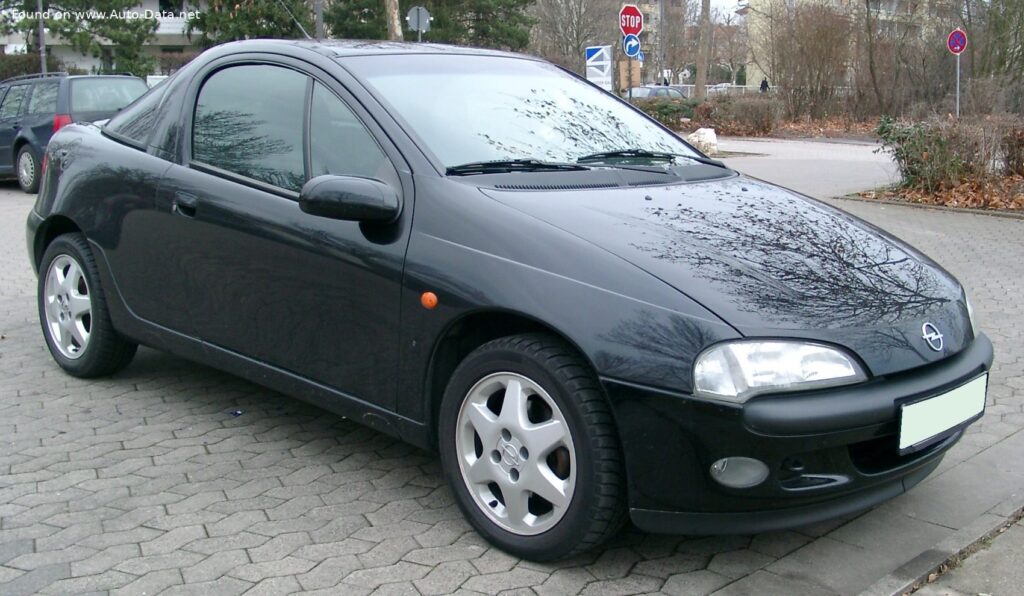
The Opel Tigra A 1.4 16V represents a distinctive chapter in Opel’s history, emerging in November 1994 as a stylish and compact 2+2 coupe. Based on the platform of the popular Opel Corsa B, the Tigra A was an ambitious venture by the German automaker to inject a dose of sportiness and youthful appeal into its lineup. Positioned as an affordable, entry-level sports coupe, it aimed to attract a demographic seeking a car with a more expressive design than a conventional hatchback, without compromising on everyday usability. While never officially sold in the United States, the Tigra A carved out a significant niche in European markets, offering a blend of eye-catching aesthetics, nimble handling, and efficient powertrains. Its production spanned from late 1994 through June 2000, during which it became a recognizable sight on European roads, embodying the era’s trend for small, fashionable coupes.
Opel Tigra A 1.4 16V: An Overview
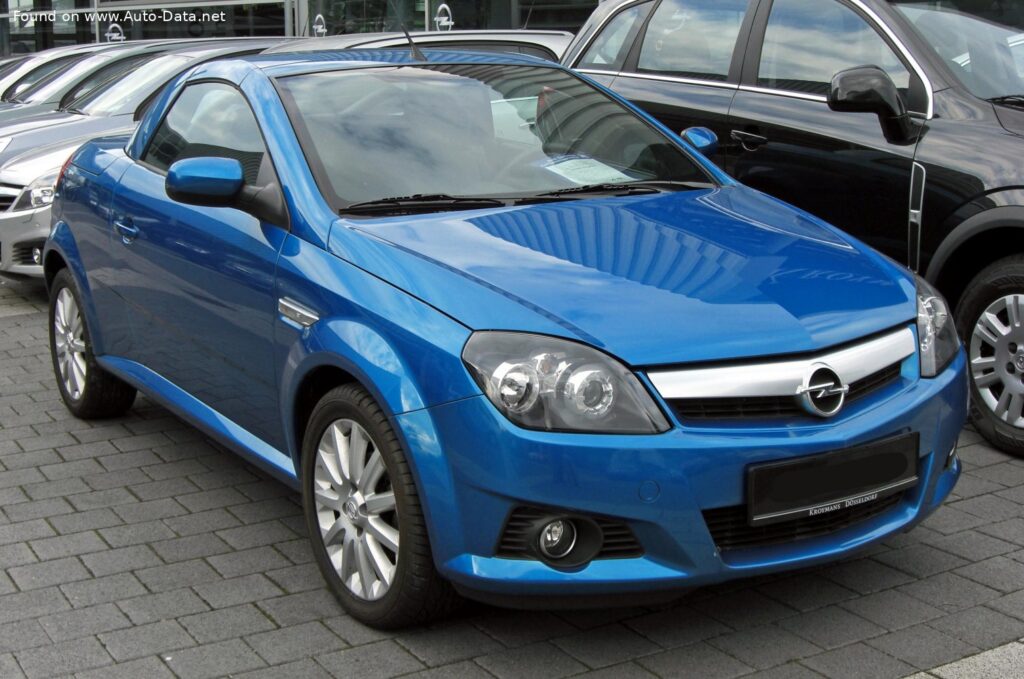
The Tigra A was conceived as a more emotive alternative to the standard Corsa, capitalizing on the growing demand for affordable, stylish coupes in the mid-1990s. It wasn’t intended to be a high-performance sports car, but rather a visually appealing and enjoyable vehicle for everyday use. The “A” designation signifies this as the first generation of the Tigra model, later followed by a significantly different second generation in 2004, which was based on the Fiat Punto platform after Opel became part of the Fiat Group.
Engine & Performance
At the heart of the Opel Tigra A 1.4 16V lies a 1.4-liter (1389 cm3 or 84.76 cu. in.) naturally aspirated inline four-cylinder engine, designated the X14XE. This engine utilizes a Dual Overhead Camshaft (DOHC) valvetrain with four valves per cylinder, a configuration that optimizes breathing and contributes to a respectable power output. The engine produces 90 horsepower at 6000 rpm and 92.2 lb.-ft. (125 Nm) of torque at 4000 rpm. This power is delivered to the front wheels through a smooth-shifting 5-speed manual transmission, a common setup for European compact cars of the period.
The Tigra A 1.4 16V achieves a 0 to 60 mph acceleration time of approximately 10.5 seconds, and 0 to 62 mph (100 km/h) in 11 seconds. Its top speed is an impressive 118.06 mph (190 km/h). Fuel efficiency was a key consideration in the Tigra A’s design. It achieves a combined fuel consumption of around 31.4 US mpg (7.5 l/100 km), with urban figures around 22.4 US mpg (10.5 l/100 km) and extra-urban figures reaching 42.8 US mpg (5.5 l/100 km). These figures made it an attractive option for cost-conscious buyers.
Design & Features
The design of the Opel Tigra A was its most striking feature, differentiating it significantly from the Corsa B. It boasts a sleek, aerodynamic coupe body style with a distinctive, swooping roofline and pronounced wheel arches. Its compact dimensions – a length of 154.41 inches, a width of 63.15 inches, and a height of 52.76 inches – contribute to its sporty appearance and maneuverability. The wheelbase of 95.63 inches provides a stable ride, while the front and rear tracks of 54.61 and 54.65 inches, respectively, enhance its planted stance.
Despite being a coupe, the Tigra A offers a 2+2 seating arrangement, providing occasional rear passenger accommodation, although space is limited. The trunk offers 7.59 cu. ft. (215 liters) of space, expandable to 15.01 cu. ft. (425 liters) with the rear seats folded down. The chassis utilizes coil springs for the front suspension and a trailing arm design for the rear, providing a comfortable yet engaging ride. Braking is handled by disc brakes at the front and drum brakes at the rear, often supplemented by an Anti-lock Braking System (ABS). Steering is a hydraulic rack and pinion system, offering precise feedback. The car typically came equipped with 185/55 R15 tires on 15-inch wheels, balancing grip and ride comfort.
Technical Specifications: Opel Tigra A 1.4 16V (90 Hp)
| Category | Specification |
| General Information | |
| Brand | Opel |
| Model | Tigra A |
| Type (Engine) | 1.4 16V (90 Hp) |
| Production Start | November, 1994 |
| Production End | June, 2000 |
| Powertrain Architecture | Internal Combustion Engine |
| Body Type | Coupe |
| Seats | 4 |
| Doors | 2 |
| Performance Specs | |
| Fuel Consumption (Urban) | 10.5 l/100 km (22.4 US mpg) |
| Fuel Consumption (Extra Urban) | 5.5 l/100 km (42.8 US mpg) |
| Fuel Consumption (Combined) | 7.5 l/100 km (31.4 US mpg) |
| Fuel Type | Petrol (Gasoline) |
| Acceleration 0-60 mph | 10.5 sec |
| Acceleration 0-62 mph (0-100 km/h) | 11 sec |
| Maximum Speed | 190 km/h (118.06 mph) |
| Weight-to-Power Ratio | 10.9 kg/Hp (91.8 Hp/tonne) |
| Weight-to-Torque Ratio | 7.8 kg/Nm (127.6 Nm/tonne) |
| Engine Specs | |
| Power | 90 Hp @ 6000 rpm |
| Power per Liter | 64.8 Hp/l |
| Torque | 125 Nm @ 4000 rpm (92.2 lb.-ft. @ 4000 rpm) |
| Engine Layout | Front, Transverse |
| Engine Model/Code | X14XE |
| Engine Displacement | 1389 cm3 (1.4 liters / 84.76 cu. in.) |
| Number of Cylinders | 4 Inline |
| Cylinder Bore | 77.6 mm (3.06 in.) |
| Piston Stroke | 73.4 mm (2.89 in.) |
| Compression Ratio | 10:1 |
| Valves per Cylinder | 4 |
| Fuel Injection System | Multi-port manifold injection |
| Engine Aspiration | Naturally aspirated |
| Valvetrain | DOHC |
| Engine Oil Capacity | 3.5 l (3.7 US qt / 3.08 UK qt) |
| Coolant Capacity | 5.6 l (5.92 US qt / 4.93 UK qt) |
| Space, Volume and Weights | |
| Kerb Weight | 980 kg (2160.53 lbs.) |
| Max. Weight (GVWR) | 1330 kg (2932.15 lbs.) |
| Max Load | 350 kg (771.62 lbs.) |
| Trunk (Boot) Space – Minimum | 215 l (7.59 cu. ft.) |
| Trunk (Boot) Space – Maximum | 425 l (15.01 cu. ft.) |
| Fuel Tank Capacity | 46 l (12.15 US gal / 10.12 UK gal) |
| Dimensions | |
| Length | 3922 mm (154.41 in.) |
| Width | 1604 mm (63.15 in.) |
| Height | 1340 mm (52.76 in.) |
| Wheelbase | 2429 mm (95.63 in.) |
| Front Track | 1387 mm (54.61 in.) |
| Rear Track | 1388 mm (54.65 in.) |
| Drivetrain, Brakes and Suspension | |
| Drivetrain Architecture | Front-wheel drive, Internal Combustion Engine |
| Drive Wheel | Front wheel drive |
| Number of Gears | 5 Manual transmission |
| Front Suspension | Coil spring |
| Rear Suspension | Trailing arm |
| Front Brakes | Disc |
| Rear Brakes | Drum |
| Assisting Systems | ABS (Anti-lock braking system) |
| Steering Type | Steering rack and pinion |
| Power Steering | Hydraulic Steering |
| Tires Size | 185/55 R15 |
| Wheel Rims Size | 15 inches |
Legacy and Market Impact
The Opel Tigra A 1.4 16V, along with its other engine variants, left a noticeable mark on the European automotive landscape during its production run. It successfully captured the imagination of a segment of buyers looking for something more exciting than a conventional family car, but still within an accessible price bracket. Its distinctive design made it instantly recognizable. While the Tigra A may not have achieved the iconic status of some legendary sports cars, it played an important role in demonstrating Opel’s ability to produce emotionally resonant vehicles. It proved that a stylish, fun-to-drive coupe could be built on a mass-market platform, making aspirational design accessible to a broader audience.