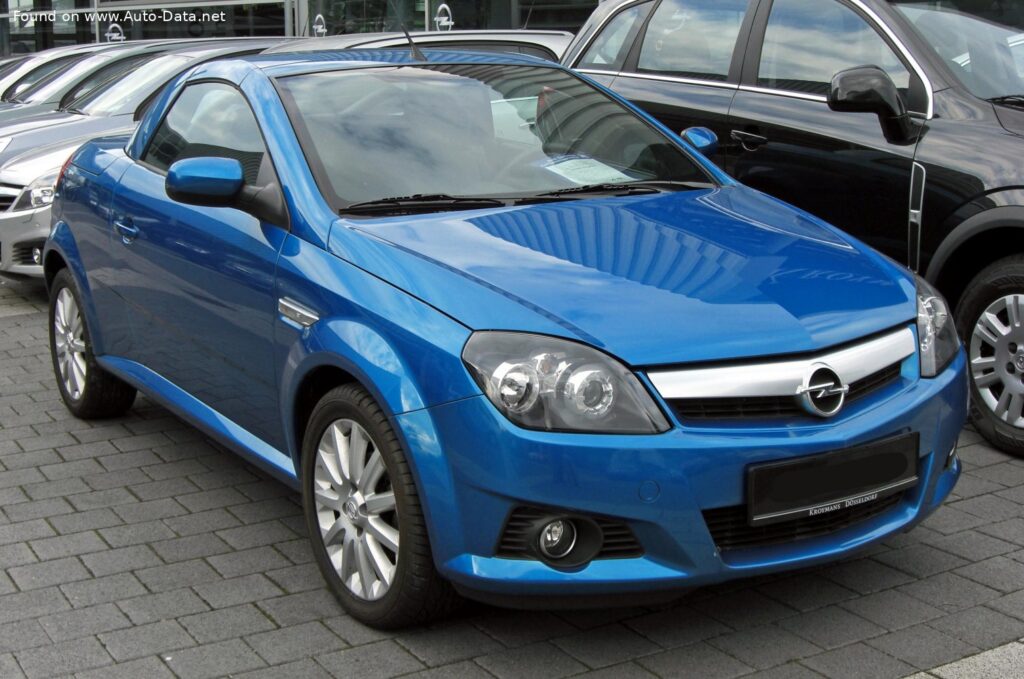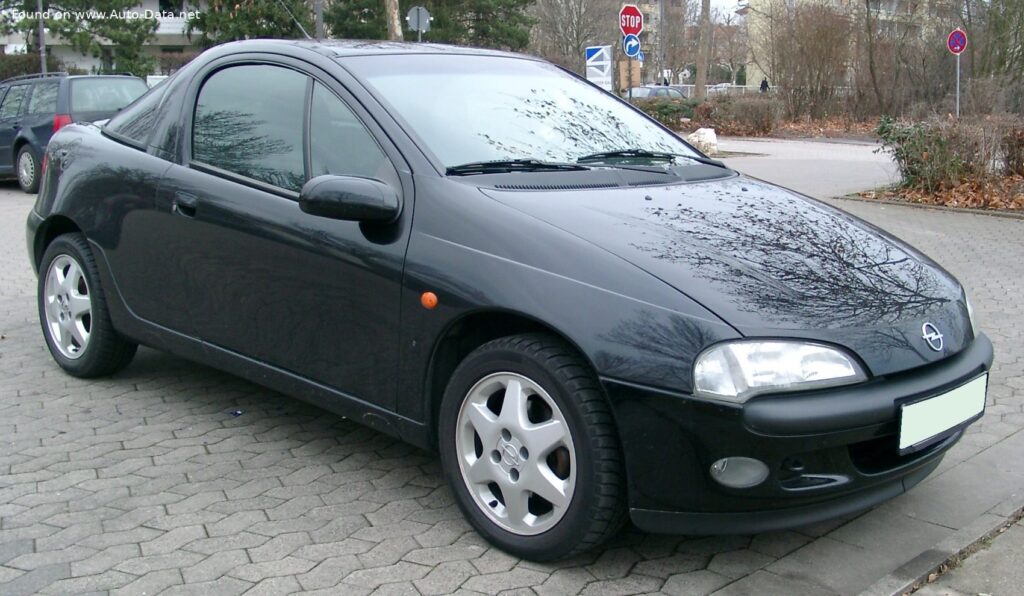
The Opel Tigra A 1.4 16V (90 Hp) Automatic represents a distinctive chapter in Opel’s history, emerging as a compact 2+2 coupe in November 1994. Designed to appeal to a growing demand for stylish and affordable coupes in Europe, the Tigra A was based on the Opel Corsa B platform. This particular variant, equipped with a 1.4-liter 16-valve engine and a four-speed automatic transmission, offered a blend of practicality and visual appeal, catering to drivers seeking a comfortable and easy-to-drive vehicle for urban environments. Production continued until June 2000, during which time the Tigra A established itself as a fun, entry-level coupe primarily within the European market, celebrated for its youthful design and accessible price point.
Engine & Performance: The X14XE Powertrain
At the heart of the Opel Tigra A 1.4 16V Automatic lies a naturally aspirated 1.4-liter (1389 cm3 or 84.76 cu. in.) inline four-cylinder engine, internally designated as the X14XE. This engine utilizes a Double Overhead Camshaft (DOHC) configuration with 16 valves – four valves per cylinder – a common design choice for maximizing efficiency and power output in engines of this displacement. A compression ratio of 10:1, coupled with a multi-port fuel injection system, ensures smooth and reliable power delivery using gasoline fuel.
The engine generates 90 horsepower (Hp) at 6000 rpm, resulting in a power-to-liter ratio of 64.8 Hp/l. Peak torque of 125 Nm (92.2 lb.-ft.) is achieved at 4000 rpm, providing sufficient pulling power for a vehicle of its size and weight. The powertrain layout is front-transverse, driving the front wheels – a typical configuration for compact cars designed to optimize interior space and manufacturing efficiency. The four-speed automatic transmission, while offering convenience, does slightly compromise performance compared to the available manual transmission options. Acceleration from 0 to 60 mph takes approximately 13.3 seconds, and the vehicle reaches a top speed of 113.09 mph (182 km/h). While not a high-performance vehicle, the Tigra A 1.4 16V Automatic delivers a comfortable and effortless driving experience, well-suited for daily commuting and relaxed cruising.
Fuel economy figures were competitive for its time. Urban driving yielded approximately 11.4 liters per 100 kilometers (20.6 US mpg), while extra-urban driving improved to 6.4 liters per 100 kilometers (36.8 US mpg). Combined fuel consumption averaged 8.4 liters per 100 kilometers (28 US mpg), offering a reasonable balance between performance and efficiency for its segment.
Design & Features: A Coupe Aesthetic
The Opel Tigra A’s most defining characteristic is its design. As a 2-door, 4-seat coupe, it distinguished itself from the more conventional styling of the Corsa B. Its sleek, aerodynamic profile, characterized by a steeply raked windshield, a flowing roofline that gracefully tapered towards the rear, and a prominent glass hatch, gave it a unique and sporty appearance. The design was heavily influenced by the 1993 Tigra concept car, successfully translating much of its futuristic appeal into a production model.
The Tigra A measures 154.41 inches (3922 mm) in length, 63.15 inches (1604 mm) in width, and 52.76 inches (1340 mm) in height, making it a decidedly compact vehicle. Its 95.63-inch (2429 mm) wheelbase contributes to its nimble handling and short overhangs. Despite its coupe body style, the Tigra A offered practical features. The trunk (boot) provided 7.59 cubic feet (215 liters) of space with the rear seats in place, expanding to 15.01 cubic feet (425 liters) when the rear seats were folded, offering reasonable cargo versatility for a car of its type.
The interior of the Tigra A shared many components with the Corsa B, ensuring familiar ergonomics and straightforward controls. Features included hydraulic power steering, front disc brakes, rear drum brakes, and an Anti-lock Braking System (ABS) for enhanced safety. The vehicle rode on 185/55 R15 tires mounted on 15-inch wheel rims, providing a balance of grip and ride comfort. The suspension system comprised coil springs at the front and a trailing arm setup at the rear, tuned for a compliant yet engaging ride quality on European roads.
Opel Tigra A: Legacy and Market Impact
The Opel Tigra A entered a market segment that, while not large, held significant appeal for younger buyers and those seeking a stylish second vehicle. Its primary market was Europe, where it competed with other small coupes such as the Ford Puma (introduced in 1997), the Renault Megane Coupe, and various other niche offerings. The Tigra’s unique selling point was its eye-catching design, which successfully translated from concept to production, making it stand out on the road.
Despite sharing its platform with the Corsa, the Tigra managed to establish its own identity. Its compact dimensions and light curb weight of 2160.53 lbs (980 kg) contributed to agile handling, making it enjoyable to drive, particularly with the manual transmission options. The 1.4 16V Automatic, while less focused on performance, offered a relaxed driving experience that appealed to a broader audience who prioritized convenience and style.
The Tigra A’s legacy is that of an accessible, stylish coupe that brought a touch of flair to the mainstream compact car market. It demonstrated that a mass-market brand like Opel could produce a car with strong emotional appeal. While not a sales leader like the Corsa, it achieved its goal of attracting a specific demographic and enhancing Opel’s brand image with a youthful, sporty offering. Today, the Opel Tigra A holds a nostalgic value, particularly among enthusiasts of 1990s European cars, appreciated for its distinctive design and its role as an early example of a compact, affordable coupe.
| Category | Specification |
| General Information | |
| Brand | Opel |
| Model | Tigra |
| Generation | Tigra A |
| Type (Engine) | 1.4 16V (90 Hp) Automatic |
| Start of Production | November, 1994 |
| End of Production | June, 2000 |
| Powertrain Architecture | Internal Combustion engine |
| Body Type | Coupe |
| Seats | 4 |
| Doors | 2 |
| Performance Specs | |
| Fuel Consumption (Urban) | 11.4 l/100 km (20.6 US mpg) |
| Fuel Consumption (Extra Urban) | 6.4 l/100 km (36.8 US mpg) |
| Fuel Consumption (Combined) | 8.4 l/100 km (28 US mpg) |
| Fuel Type | Petrol (Gasoline) |
| Acceleration 0-62 mph (0-100 km/h) | 14 seconds |
| Acceleration 0-60 mph (Calculated) | 13.3 seconds |
| Maximum Speed | 113.09 mph (182 km/h) |
| Weight-to-Power Ratio | 10.9 kg/Hp (91.8 Hp/tonne) |
| Weight-to-Torque Ratio | 7.8 kg/Nm (127.6 Nm/tonne) |
| Engine Specs | |
| Power | 90 Hp @ 6000 rpm |
| Power per Liter | 64.8 Hp/l |
| Torque | 125 Nm (92.2 lb.-ft.) @ 4000 rpm |
| Engine Layout | Front, Transverse |
| Engine Model/Code | X14XE |
| Engine Displacement | 1389 cm3 (84.76 cu. in.) |
| Number of Cylinders | 4 |
| Engine Configuration | Inline |
| Cylinder Bore | 77.6 mm (3.06 in.) |
| Piston Stroke | 73.4 mm (2.89 in.) |
| Compression Ratio | 10:1 |
| Valves per Cylinder | 4 |
| Fuel Injection System | Multi-port manifold injection |
| Engine Aspiration | Naturally aspirated engine |
| Valvetrain | DOHC |
| Engine Oil Capacity | 3.5 l (3.7 US qt) |
| Coolant Capacity | 5.6 l (5.92 US qt) |
| Space, Volume and Weights | |
| Kerb Weight | 980 kg (2160.53 lbs) |
| Max. Weight | 1330 kg (2932.15 lbs) |
| Max Load | 350 kg (771.62 lbs) |
| Trunk (Boot) Space – Minimum | 215 l (7.59 cu. ft.) |
| Trunk (Boot) Space – Maximum | 425 l (15.01 cu. ft.) |
| Fuel Tank Capacity | 46 l (12.15 US gal) |
| Dimensions | |
| Length | 3922 mm (154.41 in.) |
| Width | 1604 mm (63.15 in.) |
| Height | 1340 mm (52.76 in.) |
| Wheelbase | 2429 mm (95.63 in.) |
| Front Track | 1387 mm (54.61 in.) |
| Rear Track | 1388 mm (54.65 in.) |
| Drivetrain, Brakes and Suspension Specs | |
| Drivetrain Architecture | Front-wheel drive, Internal Combustion Engine (ICE) drives the front wheels. |
| Drive Wheel | Front-wheel drive |
| Number of Gears and Gearbox Type | 4 gears, automatic transmission |
| Front Suspension | Coil spring |
| Rear Suspension | Trailing arm |
| Front Brakes | Disc |
| Rear Brakes | Drum |
| Assisting Systems | ABS (Anti-lock braking system) |
| Steering Type | Steering rack and pinion |
| Power Steering | Hydraulic Steering |
| Tires Size | 185/55 R15 |
| Wheel Rims Size | 15 inches |