
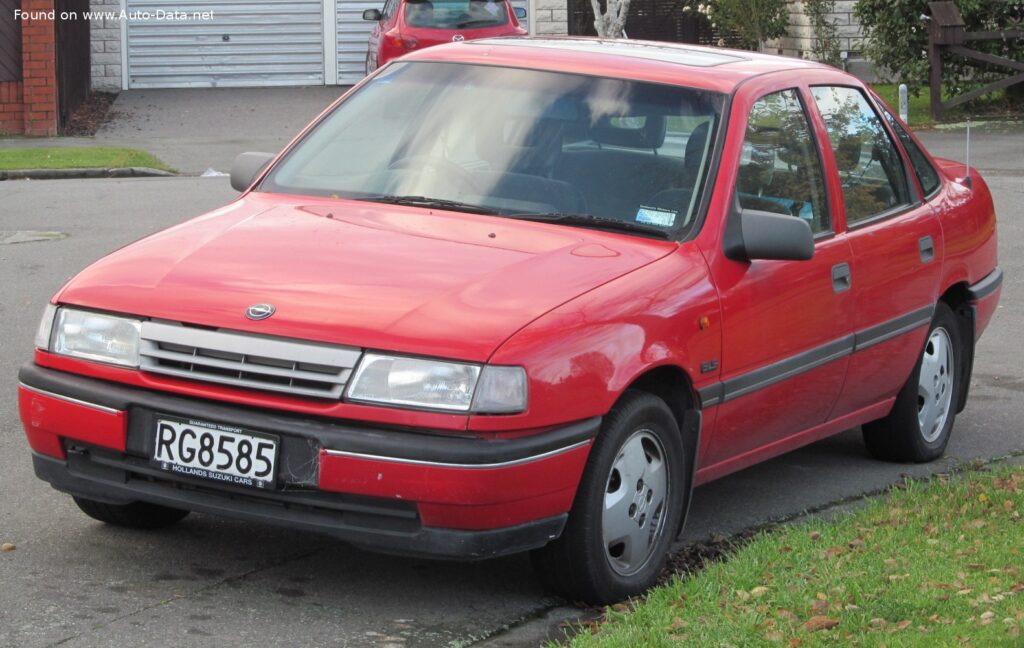
The Opel Vectra A 1.6 S represents a significant chapter in Opel’s history, serving as a cornerstone of the European mid-size family car segment during its production run from 1988 to 1992. As the successor to the long-running Ascona, the Vectra A was tasked with bringing Opel into a new era of design, aerodynamics, and front-wheel-drive efficiency. While the Opel brand, and by extension the Vectra, was never officially sold in the United States under its original badge, its platform and design philosophy often mirrored technologies found in contemporary General Motors products globally. In its primary European market, the Vectra A quickly established itself as a popular choice for families and fleet buyers alike, lauded for its practicality, robust engineering, and competitive pricing. This particular variant, the 1.6 S, offered an accessible entry point into the Vectra lineup, balancing adequate performance with commendable fuel economy for its time.
Opel Vectra A 1.6 S: A Detailed Overview
The Vectra A marked a pivotal shift for Opel, moving away from the more traditional rear-wheel-drive layouts of the Ascona towards a more modern front-wheel-drive configuration. This change allowed for increased interior space and improved fuel efficiency, key considerations for the target demographic of family car buyers. The 1.6 S trim level specifically targeted customers seeking a balance between affordability and usability, offering a reliable and economical transportation solution.
Engine & Performance
The Opel Vectra A 1.6 S was powered by the 16SV engine, a naturally aspirated, inline-four cylinder gasoline engine. Displacing 1,598 cubic centimeters (97.52 cubic inches), the engine utilized an overhead camshaft (OHC) design with two valves per cylinder and a compression ratio of 10:1. Notably, the 1.6 S retained a carburetor fuel delivery system, a cost-effective choice for the entry-level model in an era where fuel injection was becoming increasingly prevalent. This configuration produced 82 horsepower at 5,200 revolutions per minute (rpm) and 130 Newton-meters (95.88 lb.-ft.) of torque at 2,600 rpm. The engine’s torque curve prioritized low-end responsiveness, making it suitable for both urban driving and highway cruising.
Power was transmitted to the front wheels via a five-speed manual transmission. Performance figures reflected the car’s focus on practicality rather than outright speed. Acceleration from 0 to 60 miles per hour took approximately 13.3 seconds, with a top speed of 110.6 miles per hour. Fuel economy was a strong point, achieving a combined cycle rating of 34.6 US mpg (6.8 l/100 km). The vehicle’s weight-to-power ratio of 12.4 kg/Hp (approximately 80.4 Hp per tonne) further emphasized its emphasis on efficient and economical transportation.
Design & Features
The design of the Opel Vectra A represented a significant departure from the more angular aesthetics of the Ascona. Opel adopted a more streamlined and aerodynamic approach, resulting in a drag coefficient (Cd) of just 0.29 – a class-leading figure at the time. This aerodynamic efficiency contributed to both improved fuel economy and reduced wind noise. The Vectra A 1.6 S was primarily available as a four-door sedan, a body style favored by European families for its practicality and spaciousness.
The vehicle’s dimensions – a length of 174.49 inches, a width of 67.17 inches, and a wheelbase of 102.36 inches – provided a comfortable cabin for five passengers. The interior was functional and ergonomically designed, offering a well-laid-out dashboard and comfortable seating. Practicality was further enhanced by a generous trunk capacity of 18.72 cubic feet with the rear seats in place, expanding to 29.66 cubic feet when folded. For its time, the Vectra A offered a commendable level of safety features, including an optional Anti-lock Braking System (ABS), which was still considered an advanced feature for a mass-market family car. Hydraulic power steering and a coil spring suspension system at both the front and rear contributed to comfortable ride quality and stable handling.
Technical Specifications
| Category | Specification |
| Brand | Opel |
| Model | Vectra A |
| Type (Engine) | 1.6 S (82 Hp) |
| Start of Production | 1988 year |
| End of Production | 1992 year |
| Powertrain Architecture | Internal Combustion engine |
| Body Type | Sedan |
| Seats | 5 |
| Doors | 4 |
| Performance Specs | |
| Fuel Consumption (Economy) – Urban | 8.9 l/100 km (26.4 US mpg) |
| Fuel Consumption (Economy) – Extra Urban | 5.2 l/100 km (45.2 US mpg) |
| Fuel Consumption (Economy) – Combined | 6.8 l/100 km (34.6 US mpg) |
| Fuel Type | Petrol (Gasoline) |
| Acceleration 0 – 62 mph (0 – 100 km/h) | 14 sec |
| Acceleration 0 – 60 mph (Calculated) | 13.3 sec |
| Maximum Speed | 178 km/h (110.6 mph) |
| Weight-to-Power Ratio | 12.4 kg/Hp (80.4 Hp/tonne) |
| Weight-to-Torque Ratio | 7.8 kg/Nm (127.5 Nm/tonne) |
| Engine Specs | |
| Power | 82 Hp @ 5200 rpm |
| Power per Liter | 51.3 Hp/l |
| Torque | 130 Nm @ 2600 rpm (95.88 lb.-ft. @ 2600 rpm) |
| Engine Layout | Front, Transverse |
| Engine Model/Code | 16SV |
| Engine Displacement | 1598 cm3 (97.52 cu. in.) |
| Number of Cylinders | 4 |
| Engine Configuration | Inline |
| Cylinder Bore | 79 mm (3.11 in.) |
| Piston Stroke | 81.5 mm (3.21 in.) |
| Compression Ratio | 10:1 |
| Number of Valves per Cylinder | 2 |
| Fuel Injection System | Carburetor |
| Engine Aspiration | Naturally aspirated engine |
| Valvetrain | OHC |
| Engine Oil Capacity | 3.5 l (3.7 US qt) |
| Coolant Capacity | 5.8 l (6.13 US qt) |
| Space, Volume and Weights | |
| Kerb Weight | 1020 kg (2248.72 lbs) |
| Max. Weight | 1550 kg (3417.17 lbs) |
| Max Load | 530 kg (1168.45 lbs) |
| Trunk (Boot) Space – Minimum | 530 l (18.72 cu. ft.) |
| Trunk (Boot) Space – Maximum | 840 l (29.66 cu. ft.) |
| Fuel Tank Capacity | 61 l (16.11 US gal) |
| Dimensions | |
| Length | 4432 mm (174.49 in.) |
| Width | 1706 mm (67.17 in.) |
| Height | 1400 mm (55.12 in.) |
| Wheelbase | 2600 mm (102.36 in.) |
| Front Track | 1426 mm (56.14 in.) |
| Rear (Back) Track | 1423 mm (56.02 in.) |
| Drag Coefficient (Cd) | 0.29 |
| Drivetrain, Brakes and Suspension Specs | |
| Drivetrain Architecture | Front-wheel drive, Internal Combustion engine |
| Drive Wheel | Front wheel drive |
| Number of Gears and Type of Gearbox | 5 gears, manual transmission |
| Front Suspension | Coil spring |
| Rear Suspension | Coil spring |
| Front Brakes | Disc |
| Rear Brakes | Drum |
| Assisting Systems | ABS (Anti-lock braking system) |
| Power Steering | Hydraulic Steering |
| Tires Size | 175/70 R14 |
| Wheel Rims Size | 14 |
Legacy and Market Impact
The Opel Vectra A, and specifically the 1.6 S variant, successfully established itself in the competitive European mid-size segment. It directly competed with models like the Ford Sierra/Mondeo, Volkswagen Passat, Peugeot 405, and Renault 21. Opel’s strategy focused on delivering a modern, aerodynamic, and reliable vehicle appealing to a wide range of buyers, including families and fleet operators. The 1.6 S, with its fuel-efficient carburetor engine, provided an accessible and economical option. Its durability and straightforward mechanics ensured a long service life, making it a common sight on European roads for years after production ended. The Vectra A played a vital role in solidifying the “Vectra” nameplate as a successor to the Ascona, continuing Opel’s tradition of providing dependable family transportation. While not the most dynamic car in its class, its combination of aerodynamic design, spacious interior, reasonable fuel economy, and available features like ABS made it a competent and influential vehicle of its era, laying the foundation for future generations of Opel’s mid-size offerings.
