
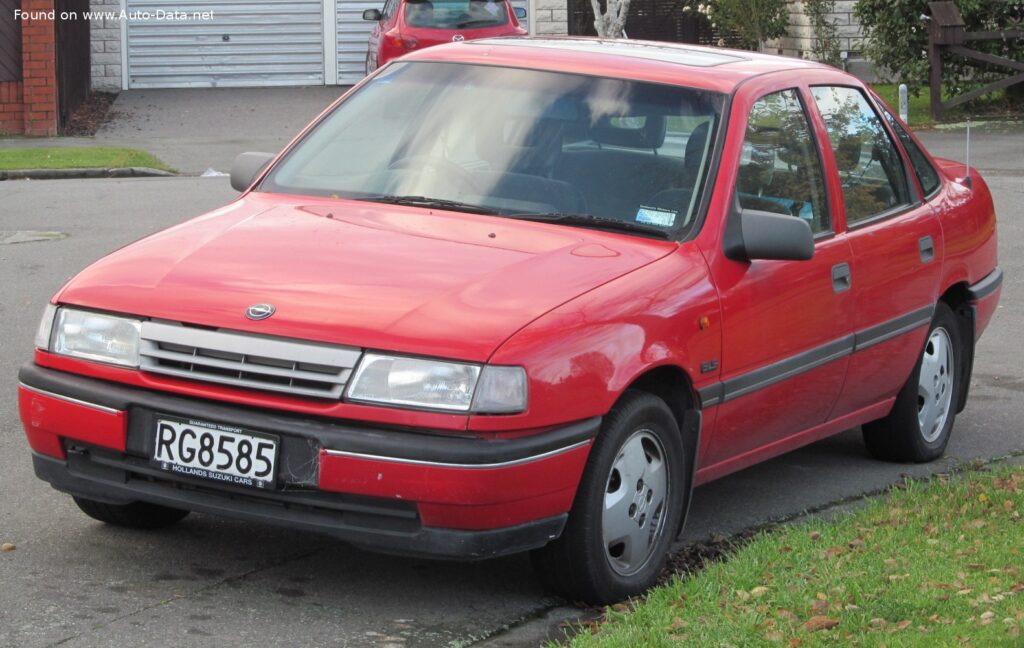
The Opel Vectra A 1.6 S (82 Hp) Automatic, introduced in 1988, was a significant vehicle in Opel’s strategy for the competitive European mid-size sedan market. As the successor to the Ascona C, the Vectra A represented a move towards a more modern, aerodynamic design and improved mechanical sophistication. Positioned in the D-segment, it aimed to appeal to families and fleet managers alike, offering a balance of reliability, economy, and practicality. While never officially sold in the United States under the Opel brand, the Vectra A’s platform underpinned various General Motors (GM) models globally, establishing its legacy as an internationally relevant vehicle, primarily recognized in Europe.
Opel Vectra A: A European Mid-Size Sedan
Produced from 1988 to 1992, the first generation Vectra quickly became a common sight on European roads, appreciated for its contemporary styling, spacious interior, and robust build quality. The 1.6 S (82 Hp) Automatic model, with its carbureted engine and conventional automatic transmission, embodied the practical, no-nonsense approach valued by many consumers. It prioritized accessibility, low running costs, and a comfortable driving experience over outright performance.
Engine & Performance: The 1.6-Liter Powertrain
The Opel Vectra A 1.6 S Automatic was powered by the 16SV engine, a 1.6-liter (1598 cm³ or 97.52 cu. in.) naturally aspirated inline four-cylinder unit. This engine, featuring an overhead camshaft (OHC) valvetrain and a carbureted fuel injection system, was typical of mainstream automotive technology of the era. It produced 82 horsepower at 5200 rpm, along with 95.88 lb.-ft. of torque at 2600 rpm. The torque curve provided sufficient pulling power for everyday driving without requiring high engine speeds.
The engine’s configuration – a bore of 79 mm (3.11 in.) and a piston stroke of 81.5 mm (3.21 in.), combined with a 10:1 compression ratio – was optimized for balanced performance and fuel economy. Power output per liter was 51.3 horsepower, a respectable figure for a non-turbocharged, carbureted engine. Paired with a 4-speed automatic transmission, the powertrain delivered smooth, effortless driving, particularly in traffic or for drivers preferring the convenience of an automatic. This front-wheel-drive setup offered predictable handling and improved traction.
Performance figures were modest but adequate. The Vectra A 1.6 S Automatic achieved a top speed of approximately 105.63 mph (170 km/h) and offered a combined fuel economy of around 34.1 US mpg (6.9 l/100 km). This efficiency was a key selling point in the European market, where fuel prices were higher than in the US. The engine’s 3.7 US quarts (3.5 liters) oil capacity and 6.13 US quarts (5.8 liters) coolant capacity underscored its straightforward maintenance requirements.
Design & Features: Aerodynamics and Practicality
The Opel Vectra A’s design marked a departure from its more angular predecessor. Its sleek, aerodynamic profile, with a drag coefficient (Cd) of 0.29, was a significant selling point. This “Aero-look” wasn’t just aesthetic; it improved fuel efficiency and reduced wind noise, enhancing occupant comfort. The car measured 174.49 inches (4432 mm) in length, 67.17 inches (1706 mm) in width, and 55.12 inches (1400 mm) in height, providing a substantial presence while remaining maneuverable. The 102.36-inch (2600 mm) wheelbase contributed to a stable ride and a spacious cabin.
As a 4-door sedan seating five, practicality was paramount. The interior was functional and ergonomic. Trunk space was generous, ranging from 18.72 cubic feet (530 liters) to 29.66 cubic feet (840 liters) with the rear seats folded. The 16.11 US gallon (61 liter) fuel tank provided a good cruising range.
The Vectra A featured a conventional suspension setup. The front used an independent McPherson strut system with coil springs and an anti-roll bar for precise steering and road holding. The rear employed a coil spring torsion beam, a cost-effective and space-efficient solution that didn’t compromise ride comfort. Braking was handled by front disc brakes and rear drum brakes, a common configuration for mid-range vehicles. The steering system was rack and pinion, offering direct feedback. Standard tires were 175/70 R14 mounted on 5.5J x 14-inch wheel rims, prioritizing comfort and economy.
Technical Specifications: Opel Vectra A 1.6 S (82 Hp) Automatic (1988-1992)
| General Information | |
|---|---|
| Brand | Opel |
| Model | Vectra |
| Generation | Vectra A |
| Type (Engine) | 1.6 S (82 Hp) Automatic |
| Production Start | 1988 |
| Production End | 1992 |
| Powertrain Architecture | Internal Combustion Engine (ICE) |
| Body Type | Sedan |
| Seats | 5 |
| Doors | 4 |
| Performance Specifications | |
| Fuel Consumption (Combined) | 34.1 US mpg (6.9 l/100 km) |
| Fuel Type | Petrol (Gasoline) |
| Maximum Speed | 105.63 mph (170 km/h) |
| Engine Specifications | |
| Power | 82 Hp @ 5200 rpm |
| Power per Liter | 51.3 Hp/l |
| Torque | 95.88 lb.-ft. @ 2600 rpm (130 Nm) |
| Engine Layout | Front, Transverse |
| Engine Model/Code | 16SV |
| Engine Displacement | 1.6 liters (1598 cm³ / 97.52 cu. in.) |
| Number of Cylinders | 4 |
| Engine Configuration | Inline |
| Cylinder Bore | 3.11 in. (79 mm) |
| Piston Stroke | 3.21 in. (81.5 mm) |
| Compression Ratio | 10:1 |
| Number of Valves per Cylinder | 2 |
| Fuel Injection System | Carburettor |
| Engine Aspiration | Naturally Aspirated |
| Valvetrain | OHC |
| Engine Oil Capacity | 3.7 US qt (3.5 l) |
| Coolant Capacity | 6.13 US qt (5.8 l) |
| Space, Volume, and Weights | |
| Trunk (Boot) Space – Minimum | 18.72 cu. ft. (530 l) |
| Trunk (Boot) Space – Maximum | 29.66 cu. ft. (840 l) |
| Fuel Tank Capacity | 16.11 US gal (61 l) |
| Dimensions | |
| Length | 174.49 in. (4432 mm) |
| Width | 67.17 in. (1706 mm) |
| Height | 55.12 in. (1400 mm) |
| Wheelbase | 102.36 in. (2600 mm) |
| Front Track | 55.91 in. (1420 mm) |
| Rear Track | 56.02 in. (1423 mm) |
| Drag Coefficient (Cd) | 0.29 |
| Drivetrain, Brakes, and Suspension | |
| Drivetrain Architecture | Front-wheel drive (ICE drives front wheels) |
| Drive Wheel | Front-wheel drive |
| Number of Gears & Type | 4 gears, Automatic Transmission |
| Front Suspension | Independent, McPherson with coil spring and anti-roll bar |
| Rear Suspension | Coil spring, Torsion beam |
| Front Brakes | Disc |
| Rear Brakes | Drum |
| Steering Type | Steering rack and pinion |
| Tires Size | 175/70 R14 |
| Wheel Rims Size | 5.5J x 14 |
Legacy and Market Impact of the Opel Vectra A
The Opel Vectra A, and variants like the 1.6 S Automatic, was pivotal in the European automotive market of the late 1980s and early 1990s. It competed with the Ford Sierra/Mondeo, Volkswagen Passat, Renault 21, and Peugeot 405. The Vectra A gained significant market share due to its modern styling, practical design, and Opel’s reputation for reliability.
Its aerodynamic design was a key feature, contributing to fuel efficiency and setting a trend for future Opel models. For many European consumers, the Vectra A was a sensible and dependable choice, offering space, comfort, and economical running costs. Its popularity as a fleet vehicle highlighted its robustness and low total cost of ownership.
The 1.6 S Automatic, while not the most powerful, exemplified the car’s strengths. It offered a smooth driving experience, valued in congested urban areas, and its fuel efficiency was a draw. The carbureted engine, while now dated, was a proven and reliable technology at the time.
The Vectra A’s influence extended beyond Europe through GM’s global operations, appearing as the Vauxhall Cavalier in the UK, the Holden Apollo in Australia, and the Chevrolet Vectra in Latin America. This international reach cemented its status as a significant model in GM’s portfolio. The Vectra A laid the groundwork for the Vectra B and C, continuing the model’s evolution. It remains a symbol of a quintessential European mid-size car: practical, reliable, and modern for its time.
