
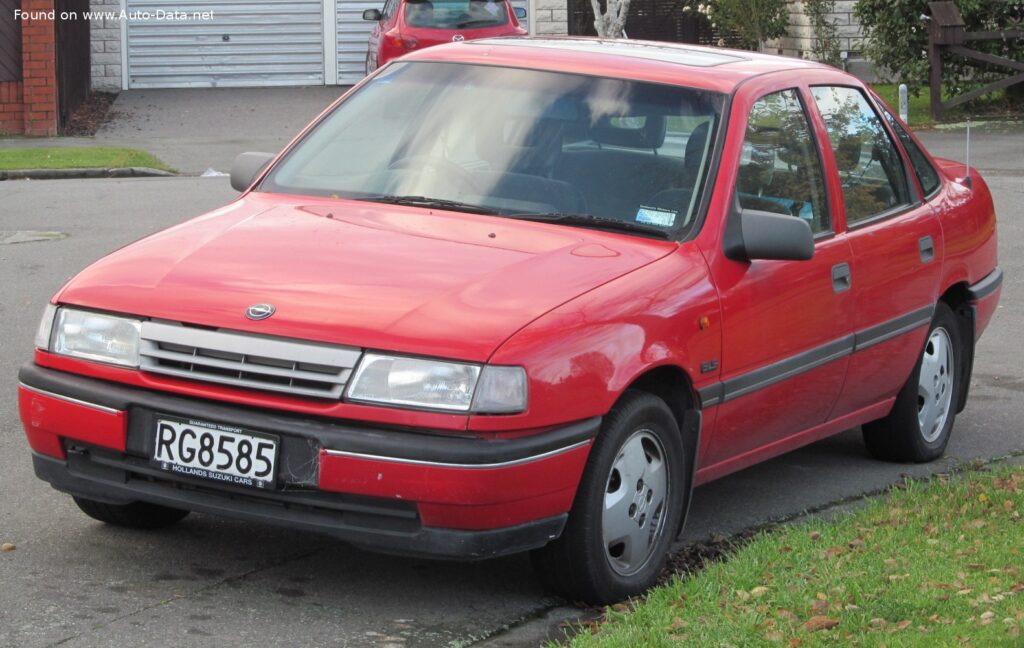
The Opel Vectra A represents a significant chapter in European automotive history, serving as Opel’s entry into the competitive mid-size family car segment. Launched in October 1988, the Vectra A succeeded the long-running Opel Ascona (and its Vauxhall Cavalier counterpart in the UK), marking a modernization of the brand’s design language and engineering philosophy. The model under scrutiny, the Opel Vectra A 1.6i (75 Hp), was an early iteration, produced for a relatively short initial window from October 1988 to February 1989. This particular variant, with its 1.6-liter engine, was positioned as an economical and practical choice for families and fleet buyers across Europe, prioritizing efficiency and reliability over outright performance.
During the late 1980s, Opel, a subsidiary of General Motors, aimed to solidify its market position with a vehicle that offered contemporary styling, improved aerodynamics, and enhanced driving dynamics. The Vectra A was designed to meet these aspirations, featuring a sleek, aerodynamic body that was a distinct departure from its more angular predecessor. While the Opel brand itself was not directly sold in the United States during this era, its engineering and design philosophies often permeated other GM marques, such as Saturn or Chevrolet models, albeit in different forms. The Vectra A, therefore, stands as a testament to European automotive trends and engineering prowess of its time, providing a robust platform for everyday commuting and family travel.
Opel Vectra A 1.6i: Engine and Performance
At the heart of the Opel Vectra A 1.6i (75 Hp) lies a 1,598 cm³ (97.52 cu. in.) naturally aspirated inline-four gasoline engine, designated E16NZ. This powertrain was engineered for durability and fuel efficiency, characteristics highly valued in the European market. The engine featured a single overhead camshaft (OHC) valvetrain with two valves per cylinder, a common and reliable configuration for mass-market vehicles of the period. Fuel delivery was managed by a single-point injection system, an evolution from carbureted setups, offering better fuel metering and emission control.
The engine produced a modest but adequate 75 horsepower at 5200 rpm, translating to a power-to-liter ratio of 46.9 Hp/l. Torque output was rated at 127 Nm (93.67 lb.-ft.) at a relatively low 2600 rpm, indicating a focus on usable power in the lower rev range, ideal for city driving and relaxed cruising. Mated to a 5-speed manual transmission, the front-wheel-drive Vectra A 1.6i was capable of accelerating from 0 to 60 mph in a calculated 13.3 seconds, with a top speed of 109.36 mph (176 km/h). While these figures might seem leisurely by today’s standards, they were competitive for an entry-level family sedan in the late 1980s.
Fuel economy was a strong point for this variant, with a combined cycle rating of 34.6 US mpg (6.8 l/100 km). Urban driving saw consumption at 26.4 US mpg (8.9 l/100 km), while extra-urban cruising improved significantly to 45.2 US mpg (5.2 l/100 km). These figures underscored the Vectra A’s role as an economical choice for motorists, especially in an era where fuel prices were a constant consideration for European consumers. The engine’s layout was front, transverse, contributing to efficient packaging and maximizing interior space.
Design and Features of the Opel Vectra A
The Opel Vectra A, particularly in its sedan guise, represented a modern and practical design for its time. With a length of 174.49 inches (4432 mm), a width of 67.17 inches (1706 mm), and a height of 55.12 inches (1400 mm), it offered a substantial road presence and a spacious cabin. The wheelbase of 102.36 inches (2600 mm) contributed to a stable ride and generous legroom for a car in its class. The design was characterized by smooth lines and a relatively low drag coefficient, a key focus for manufacturers in the late 1980s to improve fuel efficiency and reduce wind noise.
As a four-door sedan accommodating five occupants, the Vectra A was designed with family utility in mind. Its generous trunk space, ranging from 18.72 cu. ft. (530 liters) to a maximum of 29.66 cu. ft. (840 liters) with the rear seats folded (if applicable for this specific variant, though usually more common in hatchback versions), provided ample cargo capacity for luggage, groceries, or sports equipment. The interior, while functional, prioritized ergonomics and user-friendliness, with controls logically placed for easy access.
In terms of chassis and safety, the Vectra A featured a conventional but effective setup. Both front and rear suspensions utilized coil springs, providing a comfortable yet competent ride. Braking was handled by disc brakes at the front and drum brakes at the rear, a typical configuration for entry-level models of the era. Notably, the inclusion of ABS (Anti-lock Braking System) as an assisting system was a significant safety feature for a mainstream car in 1988, demonstrating Opel’s commitment to advancing vehicle safety. The steering system was a rack and pinion type, complemented by hydraulic power steering, offering drivers a comfortable and predictable steering feel. The car rode on 175/70 R14 tires, fitted on 14-inch wheel rims, providing a good balance of grip and ride comfort.
Market Positioning and Competition
The Vectra A was intended to compete directly with established models like the Ford Sierra, Volkswagen Passat, Renault 21, and Peugeot 405. Opel aimed to offer a compelling blend of practicality, modern styling, and reasonable running costs, appealing to both individual buyers and fleet operators. The 1.6i variant served as the entry point to the Vectra range, offering a balance between affordability and acceptable performance.
Technical Specifications: Opel Vectra A 1.6i (75 Hp)
| Category | Specification |
|---|---|
| General Information | |
| Brand | Opel |
| Model | Vectra |
| Generation | Vectra A |
| Type (Engine) | 1.6i (75 Hp) |
| Start of Production | October, 1988 |
| End of Production | February, 1989 |
| Powertrain Architecture | Internal Combustion engine |
| Body type | Sedan |
| Seats | 5 |
| Doors | 4 |
| Performance Specs | |
| Fuel consumption (urban) | 8.9 l/100 km (26.4 US mpg) |
| Fuel consumption (extra urban) | 5.2 l/100 km (45.2 US mpg) |
| Fuel consumption (combined) | 6.8 l/100 km (34.6 US mpg) |
| Fuel Type | Petrol (Gasoline) |
| Acceleration 0 – 60 mph | 13.3 sec |
| Maximum speed | 176 km/h (109.36 mph) |
| Engine Specs | |
| Power | 75 Hp @ 5200 rpm |
| Power per liter | 46.9 Hp/l |
| Torque | 127 Nm @ 2600 rpm (93.67 lb.-ft. @ 2600 rpm) |
| Engine layout | Front, Transverse |
| Engine Model/Code | E16NZ |
| Engine displacement | 1598 cm³ (97.52 cu. in.) |
| Number of cylinders | 4 |
| Engine configuration | Inline |
Legacy and Market Impact of the Opel Vectra A
The Opel Vectra A, despite its relatively brief initial production run for the 1.6i (75 Hp) variant, established itself as a cornerstone of Opel’s lineup and a formidable competitor in the European mid-size segment. It quickly garnered a reputation for its reliability, practicality, and cost-effectiveness, making it a popular choice among private buyers and, crucially, large fleet operators across countries like Germany, the UK (as the Vauxhall Cavalier), France, and Spain. Its conservative yet modern styling ensured broad appeal, avoiding the polarizing aesthetics that some rivals occasionally adopted.
The Vectra A’s historical significance lies in its role as a transitional model for Opel. It successfully bridged the gap between the older Ascona/Cavalier generation and the more technologically advanced vehicles that would follow. It introduced a new level of aerodynamic efficiency and safety features to the mainstream, influencing subsequent designs and setting new benchmarks for the segment. While the 1.6i (75 Hp) model was an entry-level offering, it played a vital role in broadening the Vectra’s appeal, providing an accessible option that delivered on the core promises of the brand: dependable, efficient, and comfortable transportation.
Its legacy continues through its successors, the Vectra B and C, and eventually the Insignia, all of which carried forward the principles of practicality and modern engineering that the original Vectra A so successfully embodied. Even today, the Vectra A is remembered as a robust and unpretentious vehicle that reliably served millions of European motorists, solidifying Opel’s position as a key player in the continent’s automotive landscape during a period of significant change and technological advancement.
