
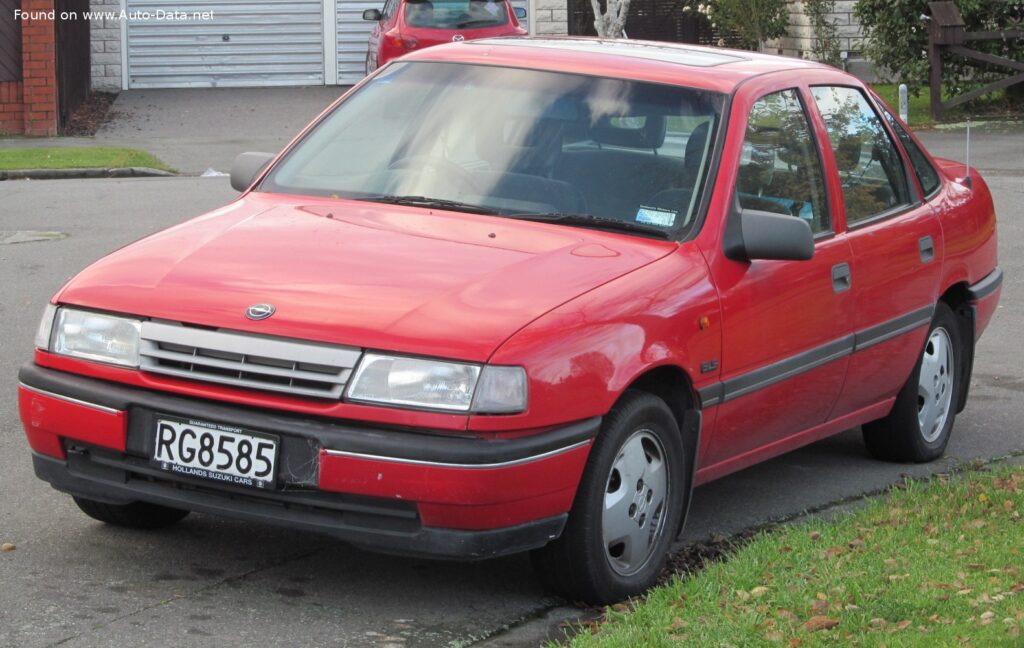
The Opel Vectra A, introduced in October 1988, represented a significant step forward for General Motors’ European subsidiary, Opel, in the highly competitive D-segment (mid-size car segment) of the European market. As a direct successor to the venerable Opel Ascona C, the Vectra A aimed to modernize Opel’s offering with contemporary styling, improved aerodynamics, and a range of efficient powertrains. This particular variant, the Opel Vectra A 1.6i CAT (75 Hp), was a core model in the lineup, embodying the brand’s commitment to providing practical, economical, and environmentally conscious transportation for families and fleet buyers across the continent. While the Opel brand itself was never officially sold in the United States, its engineering DNA often found its way into North American GM products. The Vectra A, however, remained a distinctly European proposition, playing a crucial role in Opel’s strategy from its launch until its discontinuation in July 1992, before the introduction of the significantly updated Vectra B.
Engine & Performance: The Heart of the Opel Vectra A
The Opel Vectra A 1.6i CAT (75 Hp) was powered by the C16NZ engine, a 1.6-liter (1598 cm3 or 97.52 cu. in.) naturally aspirated inline-four gasoline engine. This powerplant prioritized reliability and fuel efficiency over outright performance. It featured a single overhead camshaft (OHC) valvetrain with two valves per cylinder, a robust and common configuration for the era. Fuel delivery was managed by a single-point injection system, an improvement over carburetors but preceding the more precise multi-point injection systems of later years. The “CAT” designation indicated the inclusion of a catalytic converter, essential for reducing harmful exhaust emissions and meeting increasingly stringent European environmental regulations of the late 1980s and early 1990s.
The engine produced 75 horsepower at 5200 rpm, with a power-per-liter figure of 46.9 horsepower per liter. Torque output was 92.2 lb.-ft. (125 Nm) delivered at 2600 rpm, providing reasonable pulling power for everyday driving. This made the Vectra A 1.6i CAT tractable for city driving and cruising on European highways. Power was sent to the front wheels via a standard 5-speed manual transmission, offering driver engagement and contributing to the car’s overall efficiency. Performance figures included a 0 to 60 mph acceleration time of 13.3 seconds and a top speed of 109.36 mph (176 km/h). While not a performance car, these numbers were competitive for its segment and intended purpose.
Fuel economy was a strong point, especially for its time. The combined fuel consumption was rated at 34.6 US mpg (6.8 l/100 km), with urban driving yielding 26.4 US mpg (8.9 l/100 km) and extra-urban driving achieving an impressive 45.2 US mpg (5.2 l/100 km). These figures underscored the Vectra A’s economical nature, making it an attractive option for budget-conscious European consumers.
Design & Features: Form Follows Function
The Opel Vectra A adopted a clean, aerodynamic design characteristic of late 1980s automotive trends. It was primarily offered as a 4-door sedan, the body type for this 1.6i CAT variant. Its dimensions were 174.49 inches (4432 mm) in length, 67.17 inches (1706 mm) in width, and 55.12 inches (1400 mm) in height, with a wheelbase of 102.36 inches (2600 mm). These proportions provided a spacious cabin for five occupants and a substantial trunk. The design was notably slippery for its time, boasting a drag coefficient (Cd) of just 0.29, contributing significantly to fuel efficiency and reducing wind noise at higher speeds.
Inside, the Vectra A offered a functional and ergonomic interior. While not luxurious, the cabin was well-appointed for a mainstream family car, with durable materials and logical control placement. The 4-door sedan configuration provided easy access for all passengers, and the trunk space was generous, ranging from 18.72 cu. ft. (530 liters) to a maximum of 29.66 cu. ft. (840 liters) with the rear seats folded, making it highly practical for family trips or hauling cargo. Safety features, typical for the era, included a robust body structure and, in later models, optional anti-lock brakes (ABS), though the base 1.6i CAT primarily relied on front disc and rear drum brakes.
Opel Vectra A in the European Market
The Vectra A was designed specifically for the European market, where fuel efficiency, practicality, and affordability were paramount. It filled a crucial role as a family sedan, competing directly with established models from Ford, Volkswagen, Renault, and Peugeot. Its success demonstrated Opel’s ability to deliver a compelling product that resonated with European consumers, and it helped solidify the brand’s position as a major player in the region.
Technical Specifications: Opel Vectra A 1.6i CAT (75 Hp)
| Category | Specification |
| Brand | Opel |
| Model | Vectra |
| Generation | Vectra A |
| Type (Engine) | 1.6i CAT (75 Hp) |
| Start of Production | October, 1988 |
| End of Production | July, 1992 |
| Powertrain Architecture | Internal Combustion Engine (ICE) |
| Body Type | Sedan |
| Seats | 5 |
| Doors | 4 |
| Fuel Consumption (Urban) | 26.4 US mpg (8.9 l/100 km) |
| Fuel Consumption (Extra Urban) | 45.2 US mpg (5.2 l/100 km) |
| Fuel Consumption (Combined) | 34.6 US mpg (6.8 l/100 km) |
| Fuel Type | Petrol (Gasoline) |
| Acceleration 0-60 mph | 13.3 seconds |
| Maximum Speed | 109.36 mph (176 km/h) |
| Weight-to-Power Ratio | 14.9 kg/Hp (67.3 Hp/tonne) |
| Weight-to-Torque Ratio | 8.9 kg/Nm (112.1 Nm/tonne) |
| Power | 75 Hp @ 5200 rpm |
| Power per Liter | 46.9 Hp/l |
| Torque | 92.2 lb.-ft. (125 Nm) @ 2600 rpm |
| Engine Layout | Front, Transverse |
| Engine Model/Code | C16NZ |
| Engine Displacement | 1.6 liters (1598 cm3 / 97.52 cu. in.) |
| Number of Cylinders | 4 |
| Engine Configuration | Inline |
| Cylinder Bore | 3.15 in. (80 mm) |
| Piston Stroke | 3.13 in. (79.5 mm) |
| Compression Ratio | 8.8:1 |
| Number of Valves per Cylinder | 2 |
| Fuel Injection System | Single-point injection |
| Engine Aspiration | Naturally aspirated |
| Valvetrain | OHC |
| Engine Oil Capacity | 3.7 US qt (3.5 l) |
| Coolant Capacity | 6.13 US qt (5.8 l) |
| Kerb Weight | 2458.15 lbs. (1115 kg) |
| Max. Weight | 3593.53 lbs. (1630 kg) |
| Max Load | 1135.38 lbs. (515 kg) |
| Trunk (Boot) Space – Minimum | 18.72 cu. ft. (530 l) |
| Trunk (Boot) Space – Maximum | 29.66 cu. ft. (840 l) |
| Fuel Tank Capacity | 16.11 US gal (61 l) |
| Length | 174.49 in. (4432 mm) |
| Width | 67.17 in. (1706 mm) |
| Height | 55.12 in. (1400 mm) |
| Wheelbase | 102.36 in. (2600 mm) |
| Front Track | 55.91 in. (1420 mm) |
| Rear (Back) Track | 56.02 in. (1423 mm) |
| Drag Coefficient (Cd) | 0.29 |
| Drivetrain Architecture | Front-wheel drive with Internal Combustion Engine |
| Drive Wheel | Front wheel drive |
| Number of Gears and Type of Gearbox | 5-speed, manual transmission |
| Front Brakes | Disc |
| Rear Brakes | Drum |
| Tires Size | 175/70 R14 |
| Wheel Rims Size | 14 inches |
Legacy & Market Impact of the Opel Vectra A
The Opel Vectra A, and particularly its accessible 1.6i CAT variant, established itself as a formidable competitor in the European D-segment. It faced stiff competition from rivals such as the Ford Sierra (and later the Mondeo), Volkswagen Passat, Renault 21 (and later the Laguna), and the Peugeot 405. Despite this, the Vectra A carved out a significant market share due to its combination of modern styling, practical interior, good fuel economy, and Opel’s reputation for reliability and affordability. It quickly became a common sight on European roads, popular among private buyers looking for a dependable family car and a favorite within large corporate fleets.
The inclusion of a catalytic converter in the 1.6i CAT model was particularly impactful. At a time when environmental awareness was growing, offering a “cleaner” engine option, even at the lower end of the power spectrum, demonstrated Opel’s commitment to evolving emissions standards. This helped solidify its image as a responsible and modern automaker. The Vectra A also pioneered advanced chassis design for Opel, with its fully independent suspension setup contributing to a comfortable ride and predictable handling, a significant improvement over its predecessor.
Its legacy is that of a highly successful, no-nonsense family sedan that accurately reflected the needs and preferences of European car buyers in the late 1980s and early 1990s. While not a groundbreaking vehicle in terms of revolutionary technology or performance, the Opel Vectra A was a supremely competent and well-engineered car that provided reliable and economical transportation for millions. It set the stage for subsequent generations of the Vectra and continued to bolster Opel’s position as a key player in the European automotive landscape for decades to come.
